krit.club logo

Geometry and Trigonometry - Distances (HL)

Grade 11IB_AA

Review the key concepts, formulae, and examples before starting your quiz.

🔑Concepts

•

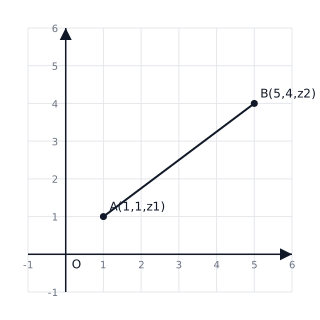
The distance between two points A(x1,y1,z1)A(x_1, y_1, z_1) and B(x2,y2,z2)B(x_2, y_2, z_2) in 3D space is the length of the vector AB⃗\vec{AB}, calculated using the Pythagorean extension: d=(x2−x1)2+(y2−y1)2+(z2−z1)2d = \sqrt{(x_2-x_1)^2 + (y_2-y_1)^2 + (z_2-z_1)^2}.

A line segment AB in a 3D coordinate system representing the distance between two points.
•

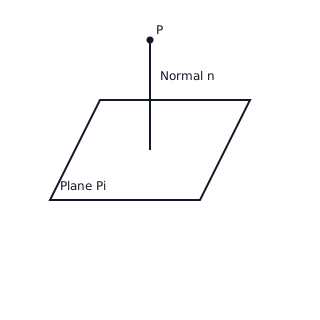
The distance from a point PP to a plane Π\Pi is the perpendicular (shortest) distance. It is found by projecting the vector AP⃗\vec{AP} (where AA is any point on the plane) onto the normal vector n\mathbf{n} of the plane.

A point P above a plane Pi with a perpendicular line segment representing the distance.
•

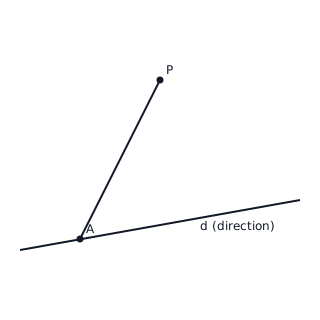
The distance from a point PP to a line LL is determined by the magnitude of the cross product of the direction vector d\mathbf{d} and the vector AP⃗\vec{AP}, divided by the magnitude of d\mathbf{d}. This represents the height of the parallelogram formed by AP⃗\vec{AP} and d\mathbf{d}.

A point P and a line L, with vector AP and direction vector d shown.
•

Skew lines are lines that are not parallel and do not intersect. The shortest distance between them is the length of the common perpendicular segment connecting the two lines.
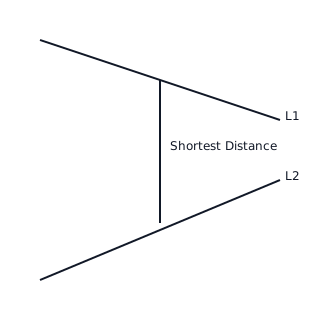
Two non-parallel, non-intersecting lines with a perpendicular line segment between them.

📐Formulae

d(A,B)=(x2−x1)2+(y2−y1)2+(z2−z1)2d(A, B) = \sqrt{(x_2 - x_1)^2 + (y_2 - y_1)^2 + (z_2 - z_1)^2}

d(P,Π)=∣ax0+by0+cz0+d∣a2+b2+c2 (Point P(x0,y0,z0) to plane ax+by+cz+d=0)d(P, \Pi) = \frac{|ax_0 + by_0 + cz_0 + d|}{\sqrt{a^2 + b^2 + c^2}} \text{ (Point } P(x_0, y_0, z_0) \text{ to plane } ax+by+cz+d=0)

d(L1,L2)=∣(a2−a1)⋅(d1×d2)∣∣d1×d2∣ (Shortest distance between skew lines)d(L_1, L_2) = \frac{|(\mathbf{a}_2 - \mathbf{a}_1) \cdot (\mathbf{d}_1 \times \mathbf{d}_2)|}{|\mathbf{d}_1 \times \mathbf{d}_2|} \text{ (Shortest distance between skew lines)}

d(P,L)=∣AP⃗×d∣∣d∣ (Point P to line through A with direction d)d(P, L) = \frac{|\vec{AP} \times \mathbf{d}|}{|\mathbf{d}|} \text{ (Point } P \text{ to line through } A \text{ with direction } \mathbf{d})

💡Examples

Problem 1:

Find the distance between the points A(1,−2,4)A(1, -2, 4) and B(3,0,−1)B(3, 0, -1).

Solution:

d=(3−1)2+(0−(−2))2+(−1−4)2d = \sqrt{(3 - 1)^2 + (0 - (-2))^2 + (-1 - 4)^2} d=22+22+(−5)2d = \sqrt{2^2 + 2^2 + (-5)^2} d=4+4+25=33d = \sqrt{4 + 4 + 25} = \sqrt{33}

Explanation:

Apply the 3D distance formula by taking the square root of the sum of the squared differences of the xx, yy, and zz coordinates.

Problem 2:

Calculate the shortest distance from the point P(2,1,3)P(2, 1, 3) to the plane with equation 3x−2y+6z=53x - 2y + 6z = 5.

Solution:

Rewrite the plane equation as 3x−2y+6z−5=03x - 2y + 6z - 5 = 0. Here a=3,b=−2,c=6,d=−5a=3, b=-2, c=6, d=-5. D=∣3(2)+(−2)(1)+6(3)−5∣32+(−2)2+62D = \frac{|3(2) + (-2)(1) + 6(3) - 5|}{\sqrt{3^2 + (-2)^2 + 6^2}} D=∣6−2+18−5∣9+4+36D = \frac{|6 - 2 + 18 - 5|}{\sqrt{9 + 4 + 36}} D=1749=177D = \frac{17}{\sqrt{49}} = \frac{17}{7}

Explanation:

Substitute the point coordinates into the numerator of the point-to-plane distance formula and divide by the magnitude of the normal vector (a,b,c)(a, b, c).

Problem 3:

Find the shortest distance between the skew lines L1:rL_1: \mathbf{r} = (100)\begin{pmatrix} 1 \\ 0 \\ 0 \end{pmatrix} + λ(110)\lambda \begin{pmatrix} 1 \\ 1 \\ 0 \end{pmatrix} and L2:rL_2: \mathbf{r} = (010)\begin{pmatrix} 0 \\ 1 \\ 0 \end{pmatrix} + μ(011)\mu \begin{pmatrix} 0 \\ 1 \\ 1 \end{pmatrix}.

Solution:

Step 1: Find the common normal n=d1×d2\mathbf{n} = \mathbf{d}_1 \times \mathbf{d}_2: n=∣ijk110011∣=i(1−0)−j(1−0)+k(1−0)\mathbf{n} = \begin{vmatrix} \mathbf{i} & \mathbf{j} & \mathbf{k} \\ 1 & 1 & 0 \\ 0 & 1 & 1 \end{vmatrix} = \mathbf{i}(1-0) - \mathbf{j}(1-0) + \mathbf{k}(1-0) = (1−11)\begin{pmatrix} 1 \\ -1 \\ 1 \end{pmatrix} Step 2: Vector between points on the lines a2−a1\mathbf{a}_2 - \mathbf{a}_1 = (010)\begin{pmatrix} 0 \\ 1 \\ 0 \end{pmatrix} - (100)\begin{pmatrix} 1 \\ 0 \\ 0 \end{pmatrix} = (−110)\begin{pmatrix} -1 \\ 1 \\ 0 \end{pmatrix}. Step 3: Apply the formula: d=∣(−110)⋅(1−11)∣12+(−1)2+12=∣−1−1+0∣3=23=233d = \frac{\left|\begin{pmatrix} -1 \\ 1 \\ 0 \end{pmatrix} \cdot \begin{pmatrix} 1 \\ -1 \\ 1 \end{pmatrix}\right|}{\sqrt{1^2 + (-1)^2 + 1^2}} = \frac{|-1 - 1 + 0|}{\sqrt{3}} = \frac{2}{\sqrt{3}} = \frac{2\sqrt{3}}{3}

Explanation:

The shortest distance between skew lines is the scalar projection of the vector joining any two points on the lines onto the cross product of the direction vectors.

Problem 4:

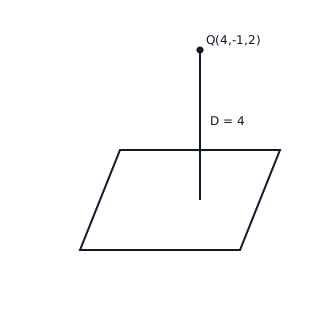
Find the distance between the point Q(4,−1,2)Q(4, -1, 2) and the plane given by x+2y−2z=10x + 2y - 2z = 10.

Point Q at a perpendicular distance of 4 units from a flat plane.

Solution:

  1. Identify the plane equation in the form ax+by+cz+d=0ax + by + cz + d = 0: x+2y−2z−10=0x + 2y - 2z - 10 = 0.
  2. Identify coefficients: a=1,b=2,c=−2,d=−10a=1, b=2, c=-2, d=-10.
  3. Point coordinates: x0=4,y0=−1,z0=2x_0=4, y_0=-1, z_0=2.
  4. Apply formula: D=∣1(4)+2(−1)−2(2)−10∣12+22+(−2)2D = \frac{|1(4) + 2(-1) - 2(2) - 10|}{\sqrt{1^2 + 2^2 + (-2)^2}}
  5. Calculate numerator: ∣4−2−4−10∣=∣−12∣=12|4 - 2 - 4 - 10| = |-12| = 12.
  6. Calculate denominator: 1+4+4=9=3\sqrt{1 + 4 + 4} = \sqrt{9} = 3.
  7. Result: D=123=4D = \frac{12}{3} = 4.

Explanation:

The point-to-plane distance formula calculates the projection of a vector from any point on the plane to QQ onto the plane's normal vector n=[1,2,−2]\mathbf{n} = [1, 2, -2].

Problem 5:

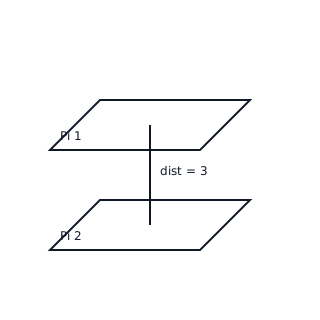
Calculate the distance between two parallel planes Π1:2x−y+2z=6\Pi_1: 2x - y + 2z = 6 and Π2:2x−y+2z=15\Pi_2: 2x - y + 2z = 15.

Two parallel planes stacked vertically with a connecting distance segment.

Solution:

  1. Find a point PP on Π1\Pi_1. Let x=0,y=0x=0, y=0, then 2z=6⇒z=32z=6 \Rightarrow z=3. So P(0,0,3)P(0, 0, 3).
  2. Use the point-to-plane distance formula from P(0,0,3)P(0, 0, 3) to Π2:2x−y+2z−15=0\Pi_2: 2x - y + 2z - 15 = 0.
  3. D=∣2(0)−1(0)+2(3)−15∣22+(−1)2+22D = \frac{|2(0) - 1(0) + 2(3) - 15|}{\sqrt{2^2 + (-1)^2 + 2^2}}
  4. Numerator: ∣6−15∣=∣−9∣=9|6 - 15| = |-9| = 9.
  5. Denominator: 4+1+4=9=3\sqrt{4 + 1 + 4} = \sqrt{9} = 3.
  6. Result: D=93=3D = \frac{9}{3} = 3.

Explanation:

Since the planes are parallel (they share the same normal vector [2,−1,2][2, -1, 2]), the distance between them is constant. We can pick any point on one plane and find its distance to the other.

Distances (HL) Grade 11 Notes & Examples | IB AA Maths