krit.club logo

Geometry and Trigonometry - Planes (HL)

Grade 11IB_AA

Review the key concepts, formulae, and examples before starting your quiz.

🔑Concepts

•

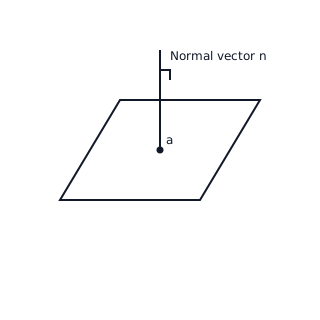
The vector equation of a plane can be defined using a position vector a\mathbf{a} of a point on the plane and two non-parallel direction vectors u\mathbf{u} and v\mathbf{v} that lie within (or are parallel to) the plane: r=a+λu+μv\mathbf{r} = \mathbf{a} + \lambda \mathbf{u} + \mu \mathbf{v}. Alternatively, the normal form uses a vector n\mathbf{n} perpendicular to the plane: r⋅n=a⋅n\mathbf{r} \cdot \mathbf{n} = \mathbf{a} \cdot \mathbf{n}.

A parallelogram representing a plane with a perpendicular normal vector n and a point a on the surface.
•

The Cartesian equation of a plane is given by ax+by+cz=dax + by + cz = d, where the vector (abc)\begin{pmatrix} a \\ b \\ c \end{pmatrix} represents the normal vector n\mathbf{n} to the plane. The constant dd is determined by substituting a known point on the plane into the equation.

•

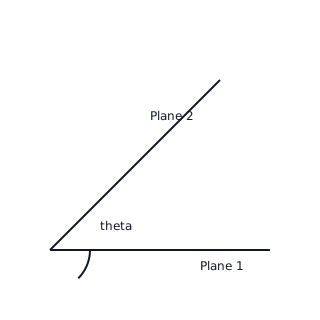
The angle between two planes is equivalent to the acute angle between their normal vectors n1\mathbf{n_1} and n2\mathbf{n_2}. It is calculated using the dot product: cos⁡θ=∣n1⋅n2∣∣n1∣∣n2∣\cos \theta = \frac{|\mathbf{n_1} \cdot \mathbf{n_2}|}{|\mathbf{n_1}| |\mathbf{n_2}|}.

Two intersecting lines representing planes viewed from the edge, showing the angle theta between them.
•

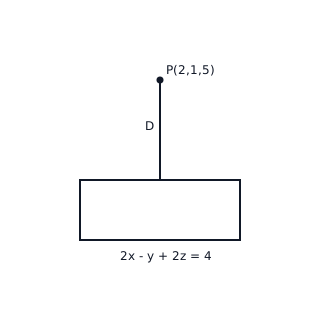
The shortest distance from a point to a plane is the length of the perpendicular segment from the point (x0,y0,z0)(x_0, y_0, z_0) to the plane ax+by+cz=dax + by + cz = d. This is given by the formula D=∣ax0+by0+cz0−d∣a2+b2+c2D = \frac{|ax_0 + by_0 + cz_0 - d|}{\sqrt{a^2 + b^2 + c^2}}.

📐Formulae

r=a+λu+μv\mathbf{r} = \mathbf{a} + \lambda \mathbf{u} + \mu \mathbf{v}

r⋅n=d\mathbf{r} \cdot \mathbf{n} = d

ax+by+cz=dax + by + cz = d

cos⁡θ=∣n1⋅n2∣∣n1∣∣n2∣\cos \theta = \frac{|\mathbf{n_1} \cdot \mathbf{n_2}|}{|\mathbf{n_1}| |\mathbf{n_2}|}

sin⁡ϕ=∣d⋅n∣∣d∣∣n∣\sin \phi = \frac{|\mathbf{d} \cdot \mathbf{n}|}{|\mathbf{d}| |\mathbf{n}|}

D=∣ax0+by0+cz0−d∣a2+b2+c2D = \frac{|ax_0 + by_0 + cz_0 - d|}{\sqrt{a^2 + b^2 + c^2}}

💡Examples

Problem 1:

Find the Cartesian equation of the plane passing through the point P(1,−2,3)P(1, -2, 3) with normal vector n=(25−1)\mathbf{n} = \begin{pmatrix} 2 \\ 5 \\ -1 \end{pmatrix}.

Solution:

Using the scalar product form r⋅n=a⋅n\mathbf{r} \cdot \mathbf{n} = \mathbf{a} \cdot \mathbf{n}: 2(x)+5(y)−1(z)=2(1)+5(−2)−1(3)2(x) + 5(y) - 1(z) = 2(1) + 5(-2) - 1(3) 2x+5y−z=2−10−32x + 5y - z = 2 - 10 - 3 2x+5y−z=−112x + 5y - z = -11

Explanation:

The coefficients of x,y,zx, y, z in the Cartesian equation are the components of the normal vector. We calculate the constant dd by substituting the coordinates of point PP into the equation.

Problem 2:

Find the acute angle between the plane x+2y−2z=5x + 2y - 2z = 5 and the line r=\mathbf{r} = (012)\begin{pmatrix} 0 \\ 1 \\ 2 \end{pmatrix} +t(1−11) + t \begin{pmatrix} 1 \\ -1 \\ 1 \end{pmatrix}.

Solution:

The normal vector of the plane is n=(12−2)\mathbf{n} = \begin{pmatrix} 1 \\ 2 \\ -2 \end{pmatrix} and the direction vector of the line is d=(1−11)\mathbf{d} = \begin{pmatrix} 1 \\ -1 \\ 1 \end{pmatrix}. Calculate ∣n∣=12+22+(−2)2=3|\mathbf{n}| = \sqrt{1^2 + 2^2 + (-2)^2} = 3. Calculate ∣d∣=12+(−1)2+12=3|\mathbf{d}| = \sqrt{1^2 + (-1)^2 + 1^2} = \sqrt{3}. Calculate ∣n⋅d∣=∣(1)(1)+(2)(−1)+(−2)(1)∣=∣1−2−2∣=∣−3∣=3|\mathbf{n} \cdot \mathbf{d}| = |(1)(1) + (2)(-1) + (-2)(1)| = |1 - 2 - 2| = |-3| = 3. Using sin⁡ϕ=∣n⋅d∣∣n∣∣d∣\sin \phi = \frac{|\mathbf{n} \cdot \mathbf{d}|}{|\mathbf{n}| |\mathbf{d}|}: sin⁡ϕ=333=13\sin \phi = \frac{3}{3\sqrt{3}} = \frac{1}{\sqrt{3}} ϕ=arcsin⁡(13)≈35.3∘\phi = \arcsin\left(\frac{1}{\sqrt{3}}\right) \approx 35.3^\circ

Explanation:

The angle between a line and a plane is the complement of the angle between the line's direction and the plane's normal. Therefore, we use the sine function instead of cosine.

Problem 3:

Determine the coordinates of the point of intersection between the line x−12=y+13=z1\frac{x-1}{2} = \frac{y+1}{3} = \frac{z}{1} and the plane 3x−y+2z=123x - y + 2z = 12.

Solution:

Express the line in parametric form: x=1+2tx = 1 + 2t, y=−1+3ty = -1 + 3t, z=tz = t. Substitute these into the plane equation: 3(1+2t)−(−1+3t)+2(t)=123(1 + 2t) - (-1 + 3t) + 2(t) = 12 3+6t+1−3t+2t=123 + 6t + 1 - 3t + 2t = 12 5t+4=125t + 4 = 12 5t=8  ⟹  t=1.65t = 8 \implies t = 1.6 Substitute t=1.6t = 1.6 back into parametric equations: x=1+2(1.6)=4.2x = 1 + 2(1.6) = 4.2 y=−1+3(1.6)=3.8y = -1 + 3(1.6) = 3.8 z=1.6z = 1.6 Point of intersection: (4.2,3.8,1.6)(4.2, 3.8, 1.6)

Explanation:

To find where a line intersects a plane, convert the line to parametric form, substitute the expressions for x,y,zx, y, z into the plane's Cartesian equation, solve for the parameter tt, and then find the coordinates.

Problem 4:

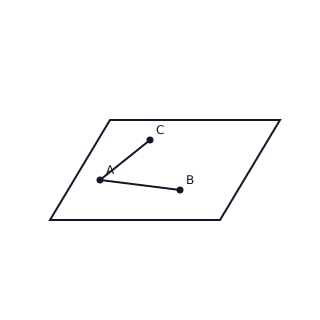
Find the equation of the plane that contains the points A(1,0,2)A(1, 0, 2), B(2,−1,3)B(2, -1, 3), and C(0,2,4)C(0, 2, 4). Express the answer in the form ax+by+cz=dax + by + cz = d.

A plane containing three points A, B, and C with vectors AB and AC drawn.

Solution:

  1. Find two vectors in the plane: AB⃗=(2−1−1−03−2)=(1−11)\vec{AB} = \begin{pmatrix} 2-1 \\ -1-0 \\ 3-2 \end{pmatrix} = \begin{pmatrix} 1 \\ -1 \\ 1 \end{pmatrix} and AC⃗=(0−12−04−2)=(−122)\vec{AC} = \begin{pmatrix} 0-1 \\ 2-0 \\ 4-2 \end{pmatrix} = \begin{pmatrix} -1 \\ 2 \\ 2 \end{pmatrix}.
  2. Find the normal vector n=AB⃗×AC⃗\mathbf{n} = \vec{AB} \times \vec{AC}: n=∣ijk1−11−122∣=i(−2−2)−j(2−(−1))+k(2−1)=(−4−31)\mathbf{n} = \begin{vmatrix} \mathbf{i} & \mathbf{j} & \mathbf{k} \\ 1 & -1 & 1 \\ -1 & 2 & 2 \end{vmatrix} = \mathbf{i}(-2-2) - \mathbf{j}(2 - (-1)) + \mathbf{k}(2 - 1) = \begin{pmatrix} -4 \\ -3 \\ 1 \end{pmatrix}.
  3. Use the point A(1,0,2)A(1, 0, 2): −4(1)−3(0)+1(2)=−4+2=−2-4(1) - 3(0) + 1(2) = -4 + 2 = -2.
  4. The equation is −4x−3y+z=−2-4x - 3y + z = -2, or 4x+3y−z=24x + 3y - z = 2.

Explanation:

To define a plane, we need a normal vector. We find this by taking the cross product of two vectors that lie within the plane (formed by the three given points). Then, use the scalar product with a point to find the constant dd.

Problem 5:

Calculate the shortest distance from the point P(2,1,5)P(2, 1, 5) to the plane 2x−y+2z=42x - y + 2z = 4.

A point P above a plane with a vertical dashed line labeled D representing the shortest distance.

Solution:

  1. Identify a=2,b=−1,c=2,d=4a=2, b=-1, c=2, d=4 and the point (x0,y0,z0)=(2,1,5)(x_0, y_0, z_0) = (2, 1, 5).
  2. Substitute into the distance formula: D=∣2(2)+(−1)(1)+2(5)−4∣22+(−1)2+22D = \frac{|2(2) + (-1)(1) + 2(5) - 4|}{\sqrt{2^2 + (-1)^2 + 2^2}}.
  3. Simplify the numerator: ∣4−1+10−4∣=∣9∣=9|4 - 1 + 10 - 4| = |9| = 9.
  4. Simplify the denominator: 4+1+4=9=3\sqrt{4 + 1 + 4} = \sqrt{9} = 3.
  5. D=93=3D = \frac{9}{3} = 3.

Explanation:

The shortest distance is the perpendicular distance. We apply the standard formula which projects the vector from the plane to the point onto the normal vector.