
Review the key concepts, formulae, and examples before starting your quiz.
🔑Concepts
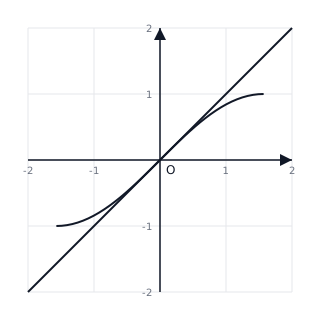
The function is the inverse of the sine function restricted to the domain . Its domain is and its range is . The graph is a reflection of the restricted sine curve over the line .
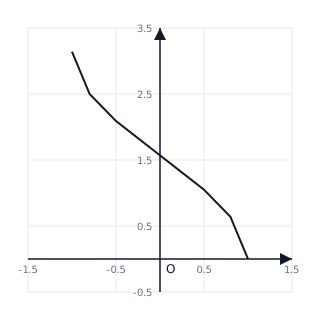
The function has a domain of and a range of . It is strictly decreasing. Unlike , which is an odd function, is neither even nor odd but satisfies the property .
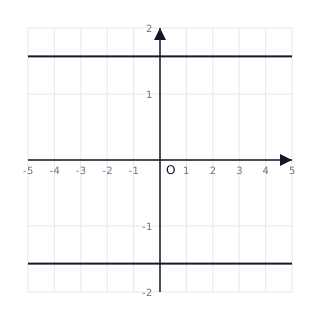
The function is defined for all . Its range is the open interval . The graph has horizontal asymptotes at and .
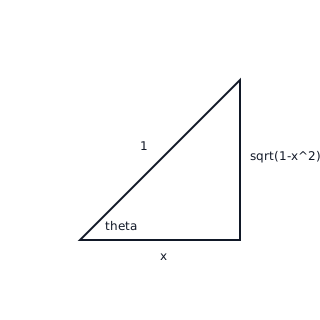
Right triangle relationships allow us to convert trigonometric expressions. For example, to find , we model a triangle with adjacent side and hypotenuse , leading to the opposite side via Pythagoras.
📐Formulae
💡Examples
Problem 1:
Evaluate exactly: .
Solution:
Let . This implies where . Since the value is negative, must be in the second quadrant. The reference angle for is . Thus, .
Explanation:
To evaluate inverse cosine, we find the unique angle in the range that yields the given cosine value.
Problem 2:
Express as an algebraic expression in terms of .
Solution:
Let , so . In a right-angled triangle, let the opposite side be and the hypotenuse be . Using Pythagoras' Theorem, the adjacent side is . Therefore, .
Explanation:
By defining the inverse function as an angle in a right triangle, we can use the Pythagorean theorem to find the other trigonometric ratios.
Problem 3:
Solve for : .
Solution:
Explanation:
Isolate the inverse trigonometric function and then apply the forward trigonometric function to both sides within the valid domain.
Problem 4:
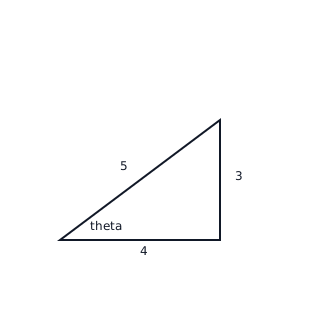
Given that , find the exact value of .
Solution:
- Let , then for .
- Construct a right triangle with opposite side and adjacent side .
- Hypotenuse .
- Thus, and .
- Use the double angle identity: .
- .
Explanation:
This problem uses the definition of inverse tangent to define a triangle and then applies double-angle trigonometric identities.
Problem 5:
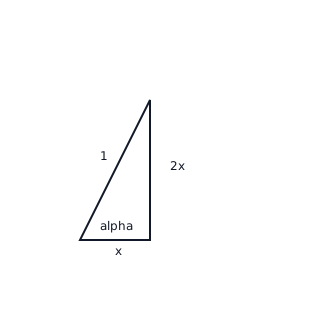
Solve for : for .
Solution:
- Let and .
- This implies and .
- Use the identity .
- Substitute the values: .
- .
- (since ).
Explanation:
By setting the two inverse functions equal to an angle, we can relate to the Pythagorean identity.