krit.club logo

Geometry and Trigonometry - Scalar (Dot) product (HL)

Grade 11IB_AA

Review the key concepts, formulae, and examples before starting your quiz.

🔑Concepts

•

The scalar (dot) product is a real number representing the product of the magnitudes of two vectors and the cosine of the angle θ\theta between them (0≤θ≤π0 \le \theta \le \pi). Geometrically, it represents the projection of one vector onto the direction of the other.
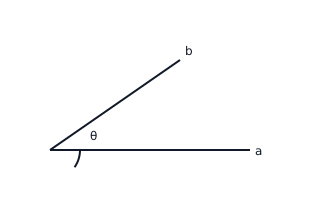
Diagram showing two vectors a and b starting from the same origin with an angle theta between them.
•

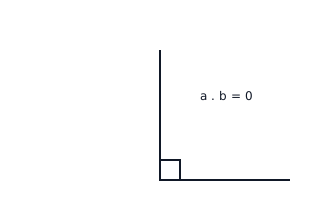
Two non-zero vectors a\mathbf{a} and b\mathbf{b} are perpendicular (orthogonal) if and only if their scalar product is zero (a1b1+a2b2+a3b3=0a_1b_1 + a_2b_2 + a_3b_3 = 0), because cos⁡(90∘)=0\cos(90^\circ) = 0.

Two perpendicular lines forming a right angle.
•

The scalar product is commutative: a⋅b=b⋅a\mathbf{a} \cdot \mathbf{b} = \mathbf{b} \cdot \mathbf{a}. It is also distributive over addition: a⋅(b+c)=a⋅b+a⋅c\mathbf{a} \cdot (\mathbf{b} + \mathbf{c}) = \mathbf{a} \cdot \mathbf{b} + \mathbf{a} \cdot \mathbf{c}.

•

The scalar product of a vector with itself is the square of its magnitude: v⋅v=∣v∣2\mathbf{v} \cdot \mathbf{v} = |\mathbf{v}|^2. This is a common technique used to find the length of vector sums, such as ∣a+b∣2|\mathbf{a} + \mathbf{b}|^2.

📐Formulae

a⋅b=∣a∣∣b∣cos⁡θ\mathbf{a} \cdot \mathbf{b} = |\mathbf{a}| |\mathbf{b}| \cos \theta

a⋅b=a1b1+a2b2+a3b3\mathbf{a} \cdot \mathbf{b} = a_1b_1 + a_2b_2 + a_3b_3

cos⁡θ=a⋅b∣a∣∣b∣\cos \theta = \frac{\mathbf{a} \cdot \mathbf{b}}{|\mathbf{a}| |\mathbf{b}|}

∣v∣=v12+v22+v32=v⋅v|\mathbf{v}| = \sqrt{v_1^2 + v_2^2 + v_3^2} = \sqrt{\mathbf{v} \cdot \mathbf{v}}

If a⊥b, then a⋅b=0\text{If } \mathbf{a} \perp \mathbf{b}, \text{ then } \mathbf{a} \cdot \mathbf{b} = 0

💡Examples

Problem 1:

Find the value of kk such that the vectors u=(2−31)\mathbf{u} = \begin{pmatrix} 2 \\ -3 \\ 1 \end{pmatrix} and v=(k42)\mathbf{v} = \begin{pmatrix} k \\ 4 \\ 2 \end{pmatrix} are perpendicular.

Solution:

For u\mathbf{u} and v\mathbf{v} to be perpendicular, their scalar product must be zero: u⋅v=0\mathbf{u} \cdot \mathbf{v} = 0 (2)(k)+(−3)(4)+(1)(2)=0(2)(k) + (-3)(4) + (1)(2) = 0 2k−12+2=02k - 12 + 2 = 0 2k−10=02k - 10 = 0 2k=102k = 10 k=5k = 5

Explanation:

Two vectors are perpendicular if their dot product equals zero. We use the component-wise multiplication formula and solve for the unknown variable.

Problem 2:

Calculate the angle between vectors a=i+2j−2k\mathbf{a} = \mathbf{i} + 2\mathbf{j} - 2\mathbf{k} and b=3i+4k\mathbf{b} = 3\mathbf{i} + 4\mathbf{k}. Give your answer to the nearest degree.

Solution:

Step 1: Find a⋅b\mathbf{a} \cdot \mathbf{b} a⋅b=(1)(3)+(2)(0)+(−2)(4)=3+0−8=−5\mathbf{a} \cdot \mathbf{b} = (1)(3) + (2)(0) + (-2)(4) = 3 + 0 - 8 = -5

Step 2: Find magnitudes ∣a∣|\mathbf{a}| and ∣b∣|\mathbf{b}| ∣a∣=12+22+(−2)2=1+4+4=9=3|\mathbf{a}| = \sqrt{1^2 + 2^2 + (-2)^2} = \sqrt{1 + 4 + 4} = \sqrt{9} = 3 ∣b∣=32+02+42=9+0+16=25=5|\mathbf{b}| = \sqrt{3^2 + 0^2 + 4^2} = \sqrt{9 + 0 + 16} = \sqrt{25} = 5

Step 3: Calculate cos⁡θ\cos \theta cos⁡θ=a⋅b∣a∣∣b∣=−5(3)(5)=−515=−13\cos \theta = \frac{\mathbf{a} \cdot \mathbf{b}}{|\mathbf{a}| |\mathbf{b}|} = \frac{-5}{(3)(5)} = -\frac{5}{15} = -\frac{1}{3}

Step 4: Find θ\theta θ=cos⁡−1(−13)≈109.47∘\theta = \cos^{-1}\left(-\frac{1}{3}\right) \approx 109.47^{\circ} Rounding to the nearest degree, θ≈109∘\theta \approx 109^{\circ}.

Explanation:

The angle θ\theta between two vectors is found using the formula cos⁡θ=a⋅b∣a∣∣b∣\cos \theta = \frac{\mathbf{a} \cdot \mathbf{b}}{|\mathbf{a}||\mathbf{b}|}. Note that a negative dot product indicates an obtuse angle.

Problem 3:

Given two vectors u=(4−12)\mathbf{u} = \begin{pmatrix} 4 \\ -1 \\ 2 \end{pmatrix} and v=(13−2)\mathbf{v} = \begin{pmatrix} 1 \\ 3 \\ -2 \end{pmatrix}, find the scalar product u⋅v\mathbf{u} \cdot \mathbf{v} and determine if the angle between them is acute, obtuse, or right.
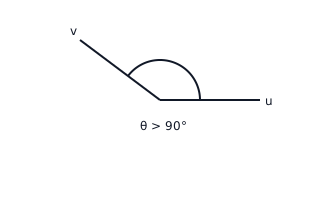
Illustration of two vectors forming an obtuse angle.

Solution:

u⋅v=(4)(1)+(−1)(3)+(2)(−2)\mathbf{u} \cdot \mathbf{v} = (4)(1) + (-1)(3) + (2)(-2) u⋅v=4−3−4=−3\mathbf{u} \cdot \mathbf{v} = 4 - 3 - 4 = -3

Since u⋅v<0\mathbf{u} \cdot \mathbf{v} < 0, cos⁡θ<0\cos \theta < 0. Therefore, the angle θ\theta is obtuse (90∘<θ≤180∘90^\circ < \theta \le 180^\circ).

Explanation:

To find the dot product, multiply corresponding components and sum them. The sign of the dot product reveals the nature of the angle: positive is acute, zero is right, and negative is obtuse.

Problem 4:

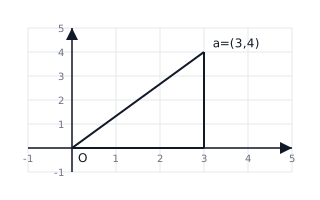
Calculate the projection of vector a=(34)\mathbf{a} = \begin{pmatrix} 3 \\ 4 \end{pmatrix} onto the unit vector i=(10)\mathbf{i} = \begin{pmatrix} 1 \\ 0 \end{pmatrix}.

Coordinate plane showing vector (3,4) and its vertical projection onto the x-axis at x=3.

Solution:

The scalar projection is given by a⋅i^\mathbf{a} \cdot \hat{\mathbf{i}}. a⋅i=(3)(1)+(4)(0)=3\mathbf{a} \cdot \mathbf{i} = (3)(1) + (4)(0) = 3 The length of the projection on the x-axis is 3 units.

Explanation:

The dot product of a vector with a unit vector in a specific direction gives the scalar component (projection) of that vector in that direction.