krit.club logo

Geometry and Trigonometry - Vector equation of a line in 2D (HL)

Grade 11IB_AA

Review the key concepts, formulae, and examples before starting your quiz.

🔑Concepts

•

A vector equation of a line represents the position vector of any point on the line as r=a+tb\mathbf{r} = \mathbf{a} + t\mathbf{b}, where a\mathbf{a} is the position vector of a known point on the line and b\mathbf{b} is the direction vector. The parameter tt determines the distance moved along the direction vector from the fixed point.
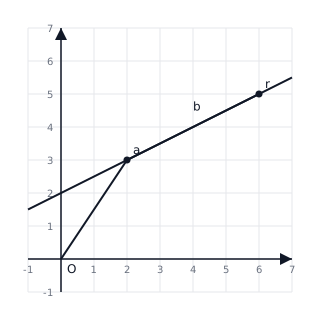
Vector diagram showing position vector a and direction vector b forming the line equation r = a + tb.
•

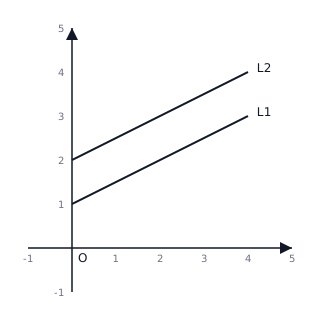
The direction vector b=(b1b2)\mathbf{b} = \begin{pmatrix} b_1 \\ b_2 \end{pmatrix} determines the gradient of the line in 2D, which is given by m=b2b1m = \frac{b_2}{b_1}. If two lines are parallel, their direction vectors are multiples of each other (b1=kb2\mathbf{b_1} = k\mathbf{b_2}).

Two parallel lines with identical direction vectors.
•

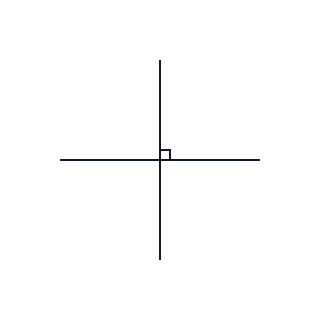
Two lines are perpendicular if the scalar product (dot product) of their direction vectors is zero: b1⋅b2=0\mathbf{b_1} \cdot \mathbf{b_2} = 0. For a direction vector (lm)\begin{pmatrix} l \\ m \end{pmatrix}, a perpendicular direction vector is (−ml)\begin{pmatrix} -m \\ l \end{pmatrix}.

Two perpendicular lines intersecting at 90 degrees.
•

The angle θ\theta between two lines is the angle between their direction vectors d1\mathbf{d_1} and d2\mathbf{d_2}, calculated using cos⁡θ=∣d1⋅d2∣∣d1∣∣d2∣\cos \theta = \frac{|\mathbf{d_1} \cdot \mathbf{d_2}|}{|\mathbf{d_1}| |\mathbf{d_2}|}.

📐Formulae

r=\mathbf{r} = \begin{pmatrix} x \ y \end{pmatrix}==\begin{pmatrix} a_1 \ a_2 \end{pmatrix}+t(b1b2) + t \begin{pmatrix} b_1 \\ b_2 \end{pmatrix}

Parametric Form: x=x0+tl, y=y0+tm\text{Parametric Form: } x = x_0 + tl, \ y = y_0 + tm

Scalar Product: u⋅v=∣u∣∣v∣cos⁡θ\text{Scalar Product: } \mathbf{u} \cdot \mathbf{v} = |\mathbf{u}||\mathbf{v}| \cos \theta

Cartesian Form: x−x0l=y−y0m\text{Cartesian Form: } \frac{x - x_0}{l} = \frac{y - y_0}{m}

💡Examples

Problem 1:

Find the vector equation of the line passing through points A(2,−3)A(2, -3) and B(5,1)B(5, 1).

Solution:

  1. Find the position vector a\mathbf{a} of point AA: a=\mathbf{a} = (2−3)\begin{pmatrix} 2 \\ -3 \end{pmatrix}.
  2. Find the direction vector b=AB⃗\mathbf{b} = \vec{AB}: b=(5−21−(−3))\mathbf{b} = \begin{pmatrix} 5 - 2 \\ 1 - (-3) \end{pmatrix} = (34)\begin{pmatrix} 3 \\ 4 \end{pmatrix}.
  3. Write the vector equation: r=(2−3)\mathbf{r} = \begin{pmatrix} 2 \\ -3 \end{pmatrix} + t(34)t \begin{pmatrix} 3 \\ 4 \end{pmatrix}.

Explanation:

The position vector provides a starting point on the line, and the difference between the two points gives the direction in which the line extends.

Problem 2:

Determine the point of intersection of the lines L1:r=L_1: \mathbf{r} = (12)\begin{pmatrix} 1 \\ 2 \end{pmatrix} +λ+ \lambda (11)\begin{pmatrix} 1 \\ 1 \end{pmatrix} and L2:r=(−14)L_2: \mathbf{r} = \begin{pmatrix} -1 \\ 4 \end{pmatrix} +μ(2−1) + \mu \begin{pmatrix} 2 \\ -1 \end{pmatrix}.

Solution:

  1. Equate the xx and yy components: 1+λ=−1+2μ1 + \lambda = -1 + 2\mu (Eq 1) 2+λ=4−μ2 + \lambda = 4 - \mu (Eq 2)
  2. Subtract Eq 1 from Eq 2: (2+λ)−(1+λ)=(4−μ)−(−1+2μ)  ⟹  1=5−3μ  ⟹  3μ=4  ⟹  μ=43(2 + \lambda) - (1 + \lambda) = (4 - \mu) - (-1 + 2\mu) \implies 1 = 5 - 3\mu \implies 3\mu = 4 \implies \mu = \frac{4}{3}.
  3. Substitute μ\mu into L2L_2: r=\mathbf{r} = (−14)\begin{pmatrix} -1 \\ 4 \end{pmatrix} +43+ \frac{4}{3} (2−1)\begin{pmatrix} 2 \\ -1 \end{pmatrix} == (−1+834−43)\begin{pmatrix} -1 + \frac{8}{3} \\ 4 - \frac{4}{3} \end{pmatrix} =(5383) = \begin{pmatrix} \frac{5}{3} \\ \frac{8}{3} \end{pmatrix}.
  4. The intersection point is (53,83)(\frac{5}{3}, \frac{8}{3}).

Explanation:

To find where two lines meet, set their vector expressions equal to each other and solve the resulting system of linear equations for the parameters λ\lambda and μ\mu.

Problem 3:

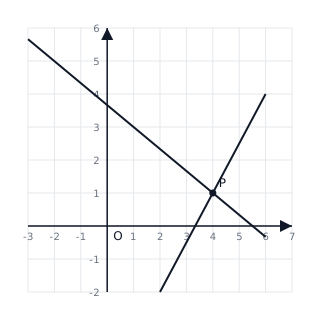
Find the vector equation of the line LL that passes through the point P(4,1)P(4, 1) and is perpendicular to the line L1:r=(−25)+λ(3−2)L_1: \mathbf{r} = \begin{pmatrix} -2 \\ 5 \end{pmatrix} + \lambda \begin{pmatrix} 3 \\ -2 \end{pmatrix}.

Graph showing L1 and the perpendicular line L passing through point P.

Solution:

  1. Identify the direction vector of L1L_1, which is d1=(3−2)\mathbf{d_1} = \begin{pmatrix} 3 \\ -2 \end{pmatrix}.
  2. For the new line LL to be perpendicular, its direction vector d\mathbf{d} must satisfy d⋅d1=0\mathbf{d} \cdot \mathbf{d_1} = 0. A suitable vector is d=(23)\mathbf{d} = \begin{pmatrix} 2 \\ 3 \end{pmatrix} (since 3(2)+(−2)(3)=03(2) + (-2)(3) = 0).
  3. Use the given point P(4,1)P(4, 1) as the position vector a=(41)\mathbf{a} = \begin{pmatrix} 4 \\ 1 \end{pmatrix}.
  4. The vector equation is r=(41)+t(23)\mathbf{r} = \begin{pmatrix} 4 \\ 1 \end{pmatrix} + t \begin{pmatrix} 2 \\ 3 \end{pmatrix}.

Explanation:

To find a perpendicular direction in 2D, swap the components of the original direction vector and negate one of them.

Problem 4:

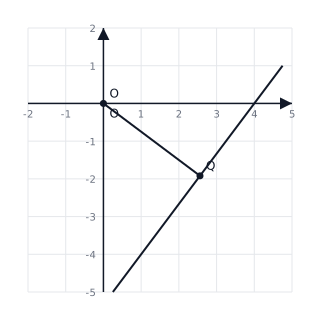
Find the coordinates of the point on the line r=(1−4)+t(34)\mathbf{r} = \begin{pmatrix} 1 \\ -4 \end{pmatrix} + t \begin{pmatrix} 3 \\ 4 \end{pmatrix} that is closest to the origin O(0,0)O(0, 0).

A line in the 2D plane with a perpendicular segment drawn from the origin to the closest point Q.

Solution:

  1. Any point QQ on the line has coordinates (1+3t,−4+4t)(1+3t, -4+4t).
  2. The vector OQ⃗=(1+3t−4+4t)\vec{OQ} = \begin{pmatrix} 1+3t \\ -4+4t \end{pmatrix}.
  3. For QQ to be the closest point, OQ⃗\vec{OQ} must be perpendicular to the direction vector d=(34)\mathbf{d} = \begin{pmatrix} 3 \\ 4 \end{pmatrix}.
  4. Set the dot product to zero: 3(1+3t)+4(−4+4t)=03(1+3t) + 4(-4+4t) = 0.
  5. 3+9t−16+16t=0  ⟹  25t−13=0  ⟹  t=1325=0.523 + 9t - 16 + 16t = 0 \implies 25t - 13 = 0 \implies t = \frac{13}{25} = 0.52.
  6. Substitute tt back: x=1+3(0.52)=2.56x = 1 + 3(0.52) = 2.56, y=−4+4(0.52)=−1.92y = -4 + 4(0.52) = -1.92.
  7. The point is (2.56,−1.92)(2.56, -1.92).

Explanation:

The shortest distance from a point to a line occurs along the perpendicular path. We solve for the parameter tt where the position vector is orthogonal to the line's direction.