
Review the key concepts, formulae, and examples before starting your quiz.
🔑Concepts
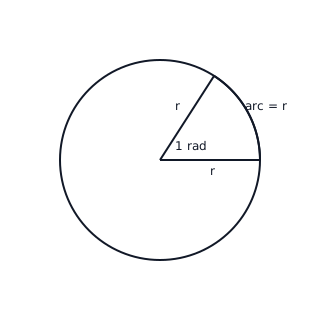
The Radian Measure: A radian is the angle subtended at the center of a circle by an arc equal in length to the radius. For any circle, the circumference is , meaning a full revolution is radians. Therefore, radians.
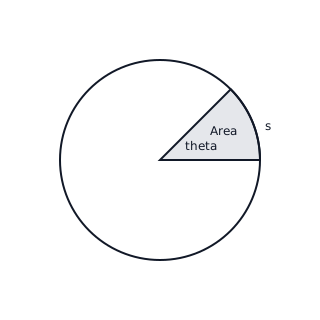
Arc Length and Sector Area: For a circle with radius and central angle (in radians), the arc length is proportional to the angle (). The sector area is the fraction of the total area corresponding to the angle , simplifying to .
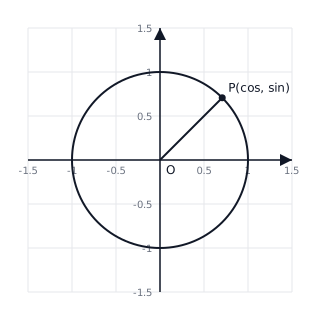
The Unit Circle: A circle centered at the origin with radius . The coordinates of any point on the circle are , where is the angle measured from the positive -axis. This relates geometry to the Pythagorean identity .
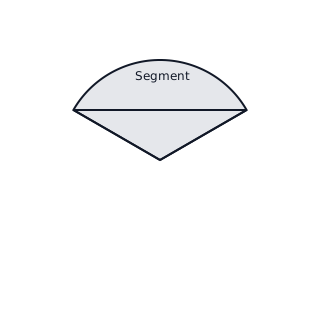
Segments of a Circle: A segment is the region bounded by a chord and its corresponding arc. Its area is calculated by subtracting the area of the triangle formed by the two radii and the chord () from the area of the whole sector.
📐Formulae
(where is in radians)
(Equation of the unit circle)
💡Examples
Problem 1:
A circle has a radius of cm. Find the length of an arc that subtends an angle of at the center. Give your answer in terms of .
Solution:
- Convert the angle from degrees to radians:
- Use the arc length formula :
Explanation:
First, we convert the given degree measure into radians because the formula requires to be in radians. Then, we substitute the radius and the angle into the formula.
Problem 2:
In a circle with radius cm, a sector has an area of . Find the angle of the sector in radians and the perimeter of the sector.
Solution:
- Use the area formula to find :
- Find the arc length :
- Calculate the perimeter (sum of two radii and the arc length):
Explanation:
We rearrange the sector area formula to solve for the unknown angle . Once is found, we calculate the arc length and add it to two lengths of the radius to find the total perimeter of the sector.
Problem 3:
Calculate the area of a segment of a circle with radius cm and a central angle of radians.
Solution:
- Use the segment area formula:
- Substitute and :
- Simplify the expression:
Explanation:
The area of the segment is found by subtracting the area of the triangle from the area of the sector . Since , we substitute the exact values to find the area.
Problem 4:
A windshield wiper of length cm rotates through an angle of radians. Calculate the area of the windshield cleaned by the blade, assuming the blade starts at a distance of cm from the center of rotation.
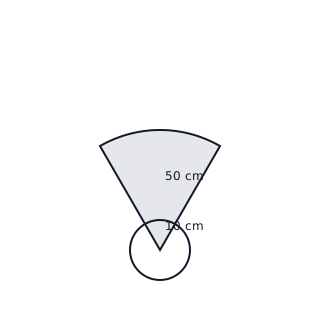
Solution:
- The region cleaned is an annulus sector (a large sector minus a small sector).
- Outer radius cm.
- Inner radius cm.
- Angle .
- Area .
- .
Explanation:
We treat the cleaned area as the difference between two sectors sharing the same central angle but having different radii.
Problem 5:
A chord divides a circle of radius cm into two segments. If the length of the chord is cm, find the area of the minor segment.
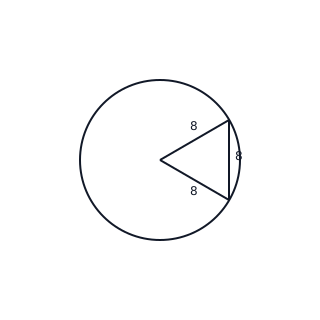
Solution:
- Since radius and chord , the triangle (where is the center) is equilateral.
- Therefore, the central angle radians.
- Area of sector .
- Area of triangle .
- Area of segment .
Explanation:
By identifying the triangle as equilateral, we find the central angle. Subtracting the triangle's area from the sector's area yields the segment's area.