krit.club logo

Geometry and Trigonometry - The unit circle and radian measure

Grade 9IB

Review the key concepts, formulae, and examples before starting your quiz.

🔑Concepts

•

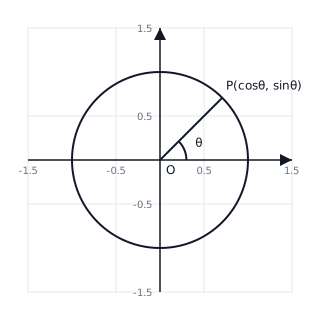
The Unit Circle: A circle with a radius of 11 centered at the origin (0,0)(0,0). For any point P(x,y)P(x, y) on the circle, x=cos⁡θx = \cos \theta and y=sin⁡θy = \sin \theta, where θ\theta is the angle measured counter-clockwise from the positive xx-axis.

A unit circle showing the relationship between coordinates and trigonometric functions.
•

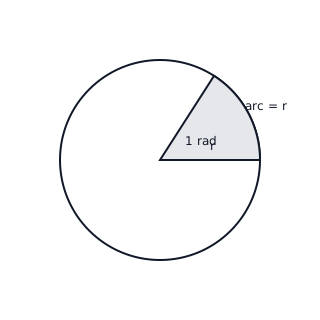
Radian Measure: One radian is the measure of the central angle subtended by an arc equal in length to the radius of the circle. Since the circumference of a circle is 2πr2\pi r, there are 2π2\pi radians in a full circle (360∘360^{\circ}).

Diagram showing 1 radian where the arc length equals the radius.
•

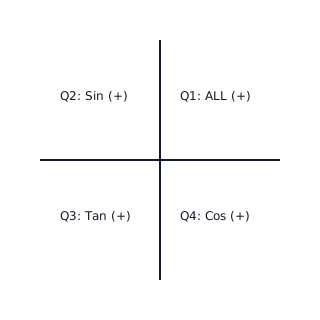
Quadrants and Signs: The signs of sin⁡θ\sin \theta, cos⁡θ\cos \theta, and tan⁡θ\tan \theta vary by quadrant. In Quadrant I, all are positive. In Quadrant II, only sin⁡\sin is positive. In Quadrant III, only tan⁡\tan is positive. In Quadrant IV, only cos⁡\cos is positive (CAST rule).

Coordinate plane showing the CAST rule for trigonometric signs.
•

Standard Values: Radians are often expressed in terms of π\pi. Key angles include π6\frac{\pi}{6} (30∘30^{\circ}), π4\frac{\pi}{4} (45∘45^{\circ}), π3\frac{\pi}{3} (60∘60^{\circ}), and π2\frac{\pi}{2} (90∘90^{\circ}).

📐Formulae

Radians=Degrees×π180\text{Radians} = \text{Degrees} \times \frac{\pi}{180}

Degrees=Radians×180π\text{Degrees} = \text{Radians} \times \frac{180}{\pi}

l=rθ (Arc length, where θ is in radians)l = r\theta \text{ (Arc length, where } \theta \text{ is in radians)}

A=12r2θ (Area of a sector, where θ is in radians)A = \frac{1}{2}r^2\theta \text{ (Area of a sector, where } \theta \text{ is in radians)}

cos⁡2θ+sin⁡2θ=1\cos^2 \theta + \sin^2 \theta = 1

💡Examples

Problem 1:

Convert 150∘150^{\circ} into radians, leaving your answer in terms of π\pi.

Solution:

150×π180=15π18=5π6150 \times \frac{\pi}{180} = \frac{15\pi}{18} = \frac{5\pi}{6}

Explanation:

To convert from degrees to radians, multiply the degree measure by π180\frac{\pi}{180} and simplify the fraction.

Problem 2:

A sector of a circle has a radius of 66 cm and a central angle of 2π3\frac{2\pi}{3} radians. Find the exact arc length of the sector.

Solution:

l=rθ=6×2π3=2×2π=4π cml = r\theta = 6 \times \frac{2\pi}{3} = 2 \times 2\pi = 4\pi \text{ cm}

Explanation:

Using the formula l=rθl = r\theta, substitute r=6r = 6 and θ=2π3\theta = \frac{2\pi}{3}. The units remain in cm.

Problem 3:

If a point PP on the unit circle has an xx-coordinate of 35\frac{3}{5} and is in the first quadrant, find the yy-coordinate.

Solution:

x2+y2=1x^2 + y^2 = 1 (35)2+y2=1\left(\frac{3}{5}\right)^2 + y^2 = 1 925+y2=1\frac{9}{25} + y^2 = 1 y2=1−925=1625y^2 = 1 - \frac{9}{25} = \frac{16}{25} y=1625=45y = \sqrt{\frac{16}{25}} = \frac{4}{5}

Explanation:

Since the point lies on the unit circle, it must satisfy x2+y2=1x^2 + y^2 = 1. We solve for yy and choose the positive root because the point is in the first quadrant.

Problem 4:

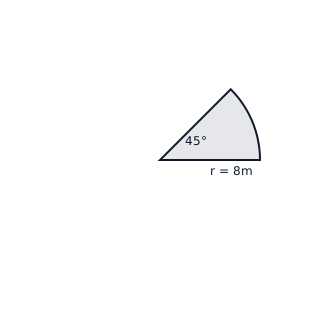
Calculate the area of a sector with a radius of 88 m and a central angle of 45∘45^{\circ}. Give your answer in terms of π\pi.

A sector with radius 8 and angle 45 degrees.

Solution:

  1. Convert the angle to radians: θ=45∘×π180=π4 rad\theta = 45^{\circ} \times \frac{\pi}{180} = \frac{\pi}{4} \text{ rad}
  2. Use the area formula A=12r2θA = \frac{1}{2}r^2\theta: A=12(8)2(π4)A = \frac{1}{2}(8)^2(\frac{\pi}{4}) A=12(64)(π4)A = \frac{1}{2}(64)(\frac{\pi}{4}) A=32(π4)=8πA = 32(\frac{\pi}{4}) = 8\pi
  3. The area is 8π m28\pi \text{ m}^2.

Explanation:

To use the area formula A=12r2θA = \frac{1}{2}r^2\theta, the angle must be in radians. 45∘45^{\circ} is equivalent to π4\frac{\pi}{4}. Plugging values into the formula yields the result.

Problem 5:

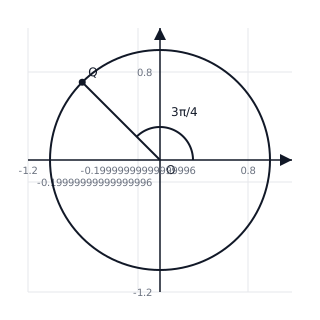
A point QQ on the unit circle lies in the second quadrant. If its yy-coordinate is 22\frac{\sqrt{2}}{2}, find the exact value of its xx-coordinate and the angle θ\theta in radians.

Point Q in the second quadrant of the unit circle.

Solution:

  1. Use cos⁡2θ+sin⁡2θ=1\cos^2 \theta + \sin^2 \theta = 1. Since y=sin⁡θ=22y = \sin \theta = \frac{\sqrt{2}}{2}: x2+(22)2=1x^2 + (\frac{\sqrt{2}}{2})^2 = 1 x2+24=1x^2 + \frac{2}{4} = 1 x2=12x^2 = \frac{1}{2} x=±12=±22x = \pm\sqrt{\frac{1}{2}} = \pm\frac{\sqrt{2}}{2}
  2. Since QQ is in the second quadrant, xx must be negative: x=−22x = -\frac{\sqrt{2}}{2}
  3. Find θ\theta: The reference angle for sin⁡θ=22\sin \theta = \frac{\sqrt{2}}{2} is π4\frac{\pi}{4}. In Quadrant II: θ=π−π4=3π4\theta = \pi - \frac{\pi}{4} = \frac{3\pi}{4}

Explanation:

Coordinates on the unit circle follow the Pythagorean identity. The sign of the xx-coordinate is determined by the quadrant (negative in Quadrant II).