
Review the key concepts, formulae, and examples before starting your quiz.
🔑Concepts
The metric system is a decimal-based system of measurement. Length conversions use powers of 10. To convert from a larger unit to a smaller unit, multiply by the conversion factor; to convert from a smaller unit to a larger unit, divide by the conversion factor.

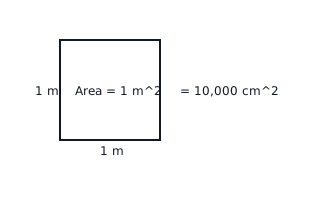
Area conversions use the square of the linear conversion factor. For example, since , then . Common units include hectares ().
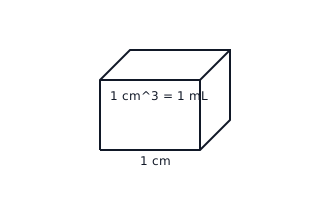
Volume and capacity are related: is equivalent to . Large volumes are often measured in cubic meters ().
Mass conversions in the metric system use the gram as the base unit. Common units are milligrams (mg), grams (g), kilograms (kg), and tonnes (t). and .
📐Formulae
💡Examples
Problem 1:
Convert into centimeters ().
Solution:
Explanation:
First, convert kilometers to meters by multiplying by (). Then, convert meters to centimeters by multiplying by .
Problem 2:
Calculate the area of a field in hectares () if its area is .
Solution:
Explanation:
Since , we divide the total square meters by to find the value in hectares.
Problem 3:
A water tank has a volume of . Find its capacity in liters ().
Solution:
Explanation:
There are in . Therefore, multiply the volume in by .
Problem 4:
Convert to .
Solution:
Explanation:
To convert from to , divide by the square of the linear conversion factor ().
Problem 5:
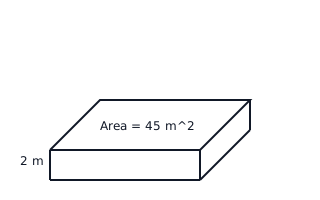
A rectangular swimming pool has a base area of and a depth of . Calculate the volume of the pool in liters ().
Solution:
- Calculate volume in :
- Convert to liters using the factor :
Explanation:
First, the volume is found in cubic meters by multiplying the base area by height. Since holds liters, we multiply the result by .
Problem 6:
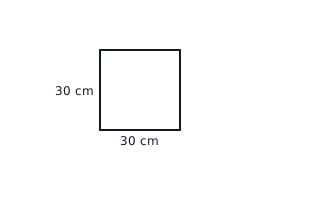
Convert the area of a square tile with side length into square meters ().
Solution:
- Calculate area in :
- Convert to by dividing by (since ):
Explanation:
To convert square units, you must divide by the square of the linear conversion factor. Since there are in , there are in .