
Review the key concepts, formulae, and examples before starting your quiz.
🔑Concepts
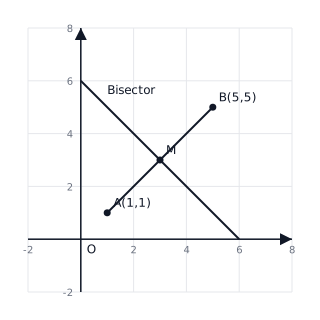
The perpendicular bisector of a line segment is a line that passes through the midpoint of at a angle. Every point on this bisector is equidistant from the endpoints and .
A Voronoi diagram partitions a plane into regions based on distance to specific points (sites). Each region consists of all points closer to its own site than to any other site. The boundaries (edges) of these regions are segments of perpendicular bisectors between adjacent sites.
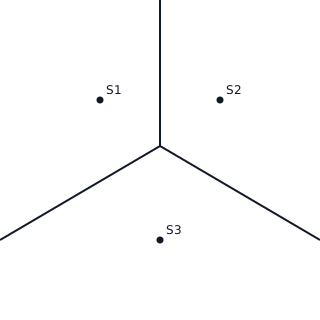
A Voronoi vertex is the point where three or more Voronoi edges meet. This vertex is equidistant from the three nearest sites and is the center of a circumcircle passing through those sites.
To find the equation of a perpendicular bisector: 1. Calculate the midpoint of the segment. 2. Find the gradient of the segment. 3. Determine the perpendicular gradient . 4. Use the point-slope form with and .
📐Formulae
(Midpoint Formula)
(Gradient Formula)
(Perpendicular Gradient)
(Point-Slope Equation of a line)
(Distance Formula)
💡Examples
Problem 1:
Find the equation of the perpendicular bisector of the line segment joining the points and .
Solution:
- Find the midpoint :
- Find the gradient of :
- Find the perpendicular gradient:
- Use the point-slope form with :
- Simplify:
Explanation:
To find the perpendicular bisector, we first determine the point it must pass through (the midpoint) and its slope (the negative reciprocal of the original line's slope).
Problem 2:
Three cell towers are located at , , and . Find the coordinates of the Voronoi vertex formed by these three sites.
Solution:
- The Voronoi vertex is the intersection of the perpendicular bisectors.
- Perpendicular bisector of and : The midpoint is and the line is vertical because is horizontal. Equation:
- Perpendicular bisector of and : The midpoint is and the line is horizontal because is vertical. Equation:
- The intersection of and is the point .
Explanation:
The Voronoi vertex is the point equidistant from all three sites. Since two of the bisectors are simple horizontal and vertical lines, their intersection is easily found and represents the vertex.
Problem 3:
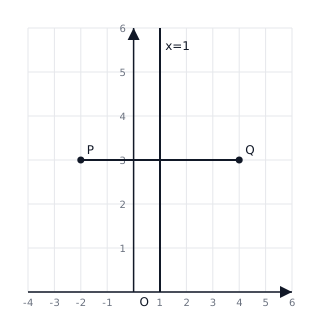
Determine the equation of the perpendicular bisector of the line segment connecting and .
Solution:
- Find the midpoint :
- Find the gradient of :
- Since the line is horizontal (), the perpendicular bisector must be a vertical line passing through the x-coordinate of the midpoint.
- The equation is .
Explanation:
Because the segment is horizontal, its perpendicular bisector is a vertical line. Vertical lines have the form , where is the x-coordinate of the midpoint.
Problem 4:
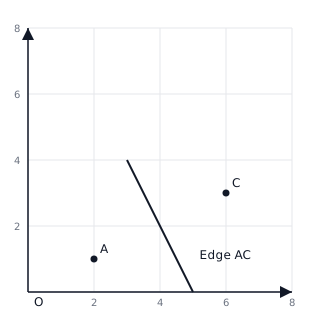
Two sites in a Voronoi diagram are located at and . A third site is at . Find the equation of the Voronoi edge separating sites and .
Solution:
- Midpoint
- Gradient
- Perpendicular gradient
- Equation:
Explanation:
The Voronoi edge between two sites is the perpendicular bisector of the segment connecting them. We find the midpoint and the negative reciprocal of the gradient of to construct the line equation.