
Review the key concepts, formulae, and examples before starting your quiz.
🔑Concepts
The naming of sides in a right-angled triangle depends on the position of the reference angle . The Hypotenuse is always opposite the right angle. The Opposite side is across from , and the Adjacent side is next to .
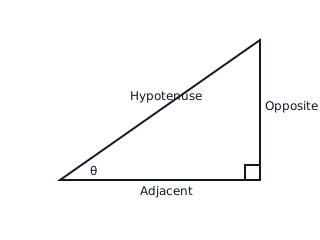
The mnemonic SOH CAH TOA helps remember the primary trigonometric ratios: , , and .
To find an unknown side length, identify the two known values (one angle and one side) and use the ratio that connects them to the unknown side.
To find an unknown angle, use the inverse trigonometric functions , , or when two side lengths are known.
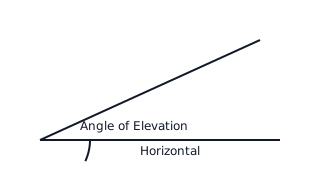
The Angle of Elevation is the angle measured upwards from the horizontal line of sight to an object.
📐Formulae
(Pythagorean Theorem)
💡Examples
Problem 1:
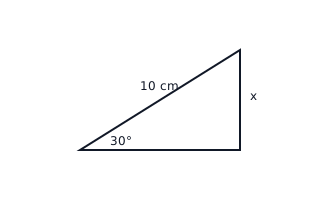
In a right-angled triangle, the hypotenuse is cm long and one of the acute angles is . Find the length of the side opposite to the angle, correct to 2 decimal places.
Solution:
- Identify the given information: Hypotenuse , , and we need to find the Opposite side ().
- Choose the correct ratio: Since we have the Hypotenuse and want the Opposite, we use SOH: .
- Set up the equation: .
- Rearrange to solve for : .
- Calculate: cm.
Explanation:
We use the Sine ratio because the problem involves the hypotenuse and the side opposite the given angle. Multiplying the hypotenuse by the sine of the angle isolates the unknown side length.
Problem 2:
A ladder is leaning against a wall. The foot of the ladder is m away from the base of the wall, and the ladder reaches m up the wall. Calculate the angle that the ladder makes with the ground.
Solution:
- Identify the given information: The distance from the wall is the Adjacent side ( m) and the height up the wall is the Opposite side ( m). We need to find the angle .
- Choose the correct ratio: Since we have Opposite and Adjacent, we use TOA: .
- Set up the equation: .
- Use the inverse tangent function to find : .
- Calculate: .
Explanation:
Because we know the two legs of the triangle (opposite and adjacent) but not the hypotenuse, the tangent ratio is the most direct way to find the angle. We use the inverse tangent function to convert the ratio of the sides back into an angle measurement.
Problem 3:
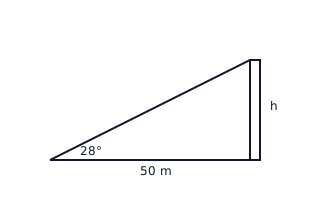
A surveyor stands m from the base of a tower. The angle of elevation to the top of the tower is . Calculate the height of the tower to the nearest meter.
Solution:
- Identify knowns: Adjacent m, .
- Identify unknown: Opposite (height ).
- Use the tangent ratio:
- Rearrange to solve for :
- Calculate:
- Round to the nearest meter: m.
Explanation:
We use the tangent ratio because we are relating the 'Opposite' side (height) and the 'Adjacent' side (distance from the base).
Problem 4:
A string of a kite is m long and makes an angle of with the horizontal ground. Determine the vertical height of the kite above the ground, assuming the string is taut.
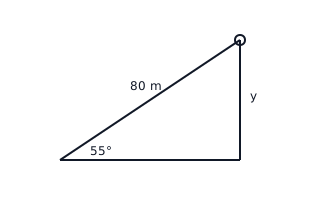
Solution:
- Identify knowns: Hypotenuse m, .
- Identify unknown: Opposite (vertical height ).
- Use the sine ratio:
- Rearrange to solve for :
- Calculate:
- The height is m (to 1 decimal place).
Explanation:
Since we know the length of the string (hypotenuse) and want to find the height (opposite), the sine ratio is the correct choice.