
Review the key concepts, formulae, and examples before starting your quiz.
🔑Concepts
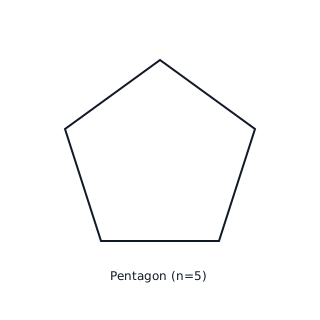
The sum of the interior angles of a polygon with sides is given by the formula . For a regular polygon, each interior angle is .
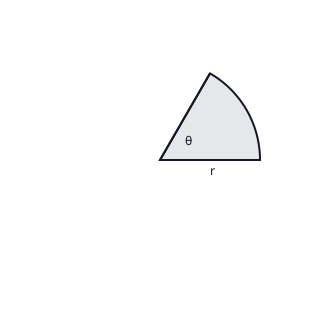
A sector is a portion of a circle enclosed by two radii and an arc. The area of a sector depends on the central angle and the radius , calculated as .
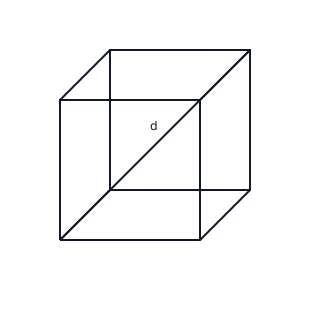
The 3D Pythagorean theorem relates the space diagonal of a rectangular cuboid to its length , width , and height using the relationship .
Right-angled trigonometry (SOH CAH TOA) is used to find missing side lengths and angles in 3D problems by identifying 2D right-angled triangles within the 3D shape.
📐Formulae
Sum of interior angles:
Area of a Circle:
Circumference of a Circle:
Area of a Sector:
Volume of a Prism:
Volume of a Cylinder:
Volume of a Pyramid or Cone:
Volume of a Sphere:
Surface Area of a Sphere:
3D Pythagoras Theorem:
SOH CAH TOA:
💡Examples
Problem 1:
A cylinder has a radius of cm and a height of cm. Calculate its total surface area. (Take )
Solution:
Step 1: Identify the components of the surface area. A cylinder has two circular bases and one curved surface area. Step 2: Calculate the area of the two circular bases: cm. Step 3: Calculate the curved surface area (circumference height): cm. Step 4: Add the areas together: Total SA cm.
Explanation:
To find the total surface area, we must sum the areas of the flat top and bottom faces with the area of the rectangular 'wrapper' (curved surface) that goes around the cylinder.
Problem 2:
Find the length of the space diagonal of a rectangular cuboid with dimensions cm by cm by cm.
Solution:
Step 1: Use the 3D version of Pythagoras' Theorem: . Step 2: Substitute the known values: . Step 3: Calculate the squares: . Step 4: Sum the values: . Step 5: Take the square root: cm.
Explanation:
The space diagonal represents the longest possible straight line that can fit inside the box, spanning from one bottom corner to the diagonally opposite top corner.
Problem 3:
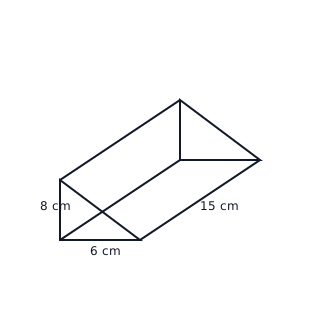
Calculate the volume of a right-angled triangular prism with a base length of cm, a base height of cm, and a prism length of cm.
Solution:
- Find the area of the triangular base:
- Multiply the base area by the length of the prism:
Explanation:
To find the volume of any prism, you must first calculate the area of the uniform cross-section (the base) and then multiply it by the length or depth of the prism.
Problem 4:
A square-based pyramid has a base side length of m and a vertical height of m. Determine its volume.
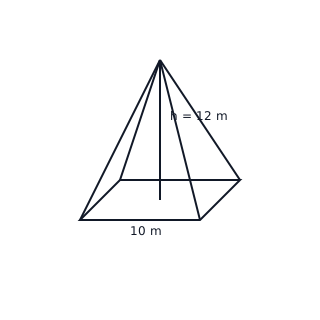
Solution:
- Calculate the area of the square base:
- Apply the volume formula for a pyramid:
Explanation:
The volume of a pyramid is exactly one-third of the volume of a prism with the same base and height. Start by finding the area of the base, then multiply by height and divide by three.