
Review the key concepts, formulae, and examples before starting your quiz.
🔑Concepts
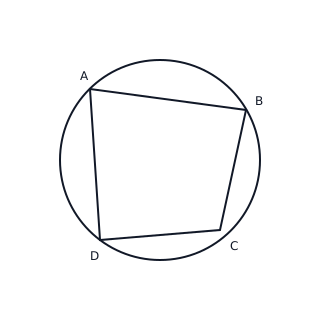
A cyclic quadrilateral is a four-sided polygon where all four vertices lie on the circumference of a circle. The sum of the opposite interior angles in a cyclic quadrilateral is always . For example, and .
The exterior angle of a cyclic quadrilateral is equal to the interior opposite angle. If side is extended to point , then the exterior angle is equal to .
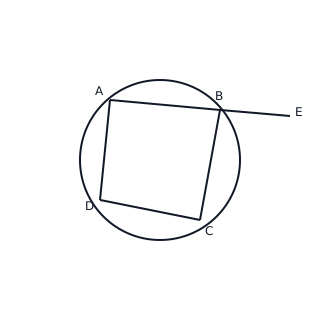
Ptolemy's Theorem states that for a cyclic quadrilateral, the product of the diagonals is equal to the sum of the products of the opposite sides: .

Brahmagupta's Formula calculates the area of a cyclic quadrilateral given sides : , where is the semi-perimeter.
📐Formulae
💡Examples
Problem 1:
In a cyclic quadrilateral , and . Find the value of and the measure of .
Solution:
Since is a cyclic quadrilateral, opposite angles sum to . Now, calculate :
Explanation:
We use the property that opposite angles in a cyclic quadrilateral are supplementary. By setting up a linear equation for , we solve for the variable and substitute it back into the expression for .
Problem 2:
A cyclic quadrilateral has side lengths , , , and . Calculate the area of the quadrilateral.
Solution:
First, find the semi-perimeter : Using Brahmagupta's Formula:
Explanation:
Brahmagupta's formula is specifically used for the area of cyclic quadrilaterals when all four side lengths are known. We first calculate the semi-perimeter and then apply the square root of the product of the differences between the semi-perimeter and each side.
Problem 3:
In cyclic quadrilateral , the exterior angle at vertex is . Find the measure of the interior angle .
Solution:
By the Exterior Angle Property of cyclic quadrilaterals, the exterior angle is equal to the interior opposite angle. Therefore, .
Explanation:
This property is a direct consequence of the fact that the exterior angle and the adjacent interior angle sum to (straight line), and the adjacent interior angle and the opposite interior angle also sum to (cyclic property).
Problem 4:
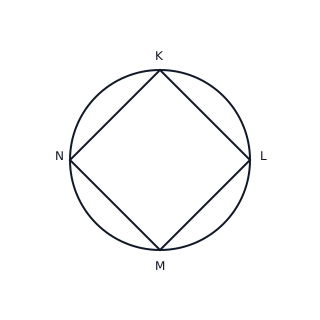
In the cyclic quadrilateral , find the value of and the measure of if and .
Solution:
- Opposite angles in a cyclic quadrilateral sum to . Therefore:
- Substitute the expressions:
- Solve for :
- Calculate :
- To find , note that without more information about , we can only state:
Explanation:
This problem uses the fundamental property that opposite angles of a cyclic quadrilateral are supplementary. By forming an equation with the algebraic expressions provided, we can solve for the unknown variable.
Problem 5:
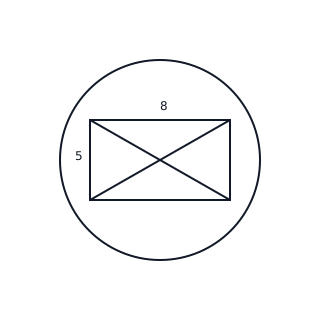
In the cyclic quadrilateral , sides cm, cm, cm, and cm. Determine if the diagonal is equal to the diagonal . Use Ptolemy's Theorem to find the product of the diagonals.
Solution:
- Using Ptolemy's Theorem:
- Substitute the given side lengths:
- Since the opposite sides are equal ( and ), is a rectangle (or an isosceles trapezoid that happens to be a rectangle in this symmetry). In a rectangle, .
- Therefore:
Explanation:
Ptolemy's theorem provides a direct relationship between the sides and diagonals. Because the opposite sides are equal, we can deduce properties about the diagonals through symmetry.