krit.club logo

Geometry and Trigonometry - Equation of a straight line

Grade 9IB

Review the key concepts, formulae, and examples before starting your quiz.

🔑Concepts

•

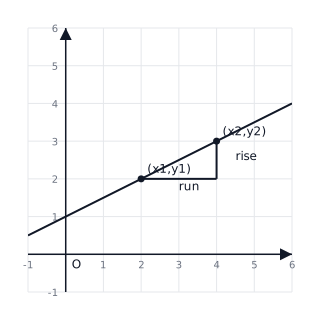
The gradient (slope) mm measures the steepness and direction of a line, calculated as m=riserun=y2−y1x2−x1m = \frac{\text{rise}}{\text{run}} = \frac{y_2 - y_1}{x_2 - x_1}.

A line showing the rise over run calculation for gradient.
•

The Slope-Intercept form y=mx+cy = mx + c identifies the gradient mm and the yy-intercept cc, which is the point where the line crosses the yy-axis (0,c)(0, c).

•

Parallel lines have the same gradient (m1=m2m_1 = m_2), meaning they never intersect and maintain a constant distance apart.

•

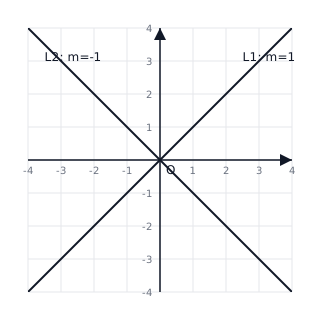
Perpendicular lines intersect at a right angle (90∘90^{\circ}), and the product of their gradients is −1-1 (m1×m2=−1m_1 \times m_2 = -1).

Two lines intersecting at a 90 degree angle showing perpendicularity.
•

Vertical lines have the equation x=ax = a (undefined gradient), and horizontal lines have the equation y=by = b (zero gradient).

📐Formulae

m=y2−y1x2−x1m = \frac{y_2 - y_1}{x_2 - x_1}

y=mx+cy = mx + c

y−y1=m(x−x1)y - y_1 = m(x - x_1),

Ax+By+D=0Ax + By + D = 0

m1=m2 (Parallel lines)m_1 = m_2 \text{ (Parallel lines)}

m1×m2=−1 (Perpendicular lines)m_1 \times m_2 = -1 \text{ (Perpendicular lines)}

💡Examples

Problem 1:

Find the equation of the line passing through the points A(2,5)A(2, 5) and B(4,9)B(4, 9) in the form y=mx+cy = mx + c.

Solution:

m=9−54−2=42=2m = \frac{9 - 5}{4 - 2} = \frac{4}{2} = 2 Using y−y1=m(x−x1)y - y_1 = m(x - x_1) with point (2,5)(2, 5): y−5=2(x−2)y - 5 = 2(x - 2) y−5=2x−4y - 5 = 2x - 4 y=2x+1y = 2x + 1

Explanation:

First, calculate the gradient using the slope formula. Then, substitute the gradient and one of the points into the point-gradient formula and rearrange it into gradient-intercept form.

Problem 2:

Determine the equation of the line that is perpendicular to y=−3x+4y = -3x + 4 and passes through the point (6,−2)(6, -2).

Solution:

The gradient of the given line is m1=−3m_1 = -3. For a perpendicular line: m2=−1m1=−1−3=13m_2 = -\frac{1}{m_1} = -\frac{1}{-3} = \frac{1}{3} Using y−y1=m(x−x1)y - y_1 = m(x - x_1): y−(−2)=13(x−6)y - (-2) = \frac{1}{3}(x - 6) y+2=13x−2y + 2 = \frac{1}{3}x - 2 y=13x−4y = \frac{1}{3}x - 4

Explanation:

Identify the gradient of the original line. Find the perpendicular gradient by taking the negative reciprocal. Use the point-gradient formula with the new gradient and the given point to find the final equation.

Problem 3:

Find the xx and yy intercepts of the line 3x−4y=123x - 4y = 12.

Solution:

To find the xx-intercept, let y=0y = 0: 3x−4(0)=123x - 4(0) = 12 3x=12⇒x=43x = 12 \Rightarrow x = 4 The xx-intercept is (4,0)(4, 0).

To find the yy-intercept, let x=0x = 0: 3(0)−4y=123(0) - 4y = 12 −4y=12⇒y=−3-4y = 12 \Rightarrow y = -3 The yy-intercept is (0,−3)(0, -3).

Explanation:

To find where a line crosses the xx-axis, yy must be zero. To find where it crosses the yy-axis, xx must be zero. Solve the resulting one-variable equations.

Problem 4:

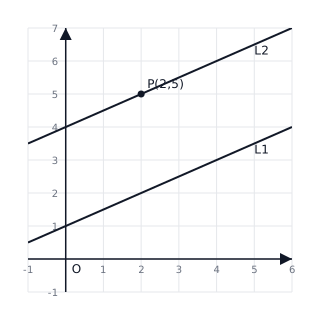
A line L1L_1 is defined by y=12x+1y = \frac{1}{2}x + 1. A second line L2L_2 is parallel to L1L_1 and passes through the point (2,5)(2, 5). Find the equation of L2L_2.

Two parallel lines L1 and L2 on a coordinate plane.

Solution:

1. Determine gradient of L2:1. \text{ Determine gradient of } L_2: Since L2∥L1,m2=m1=12\text{Since } L_2 \parallel L_1, m_2 = m_1 = \frac{1}{2} 2. Use point-slope form y−y1=m(x−x1):2. \text{ Use point-slope form } y - y_1 = m(x - x_1): y−5=12(x−2)y - 5 = \frac{1}{2}(x - 2) 3. Simplify to y=mx+c:3. \text{ Simplify to } y = mx + c: y−5=12x−1y - 5 = \frac{1}{2}x - 1 y=12x+4y = \frac{1}{2}x + 4

Explanation:

Parallel lines share the same gradient. Using the gradient of the first line and the coordinates of the given point, we can solve for the new equation.

Problem 5:

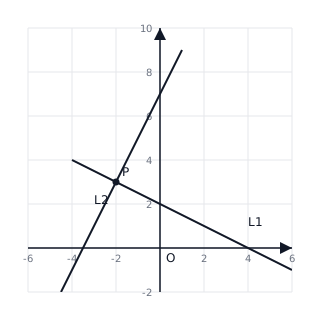
Find the equation of the line passing through the point P(−2,3)P(-2, 3) that is perpendicular to the line L1L_1 which has an xx-intercept at (4,0)(4, 0) and a yy-intercept at (0,2)(0, 2). Give your answer in the form ax+by+d=0ax + by + d = 0.

Coordinate plane showing two perpendicular lines. Line L1 passes through (4,0) and (0,2). Line L2 passes through point P(-2,3) and is perpendicular to L1.

Solution:

(x_1, y_1) = (4, 0), (x_2, y_2) = (0, 2) \\ m_1 = \frac{2 - 0}{0 - 4} = \frac{2}{-4} = -\frac{1}{2} \\ \text{Step 2: Find the gradient of the perpendicular line } m_2. \\ m_2 = -\frac{1}{m_1} = -\frac{1}{-1/2} = 2 \\ \text{Step 3: Use the point-slope form with } P(-2, 3) \text{ and } m = 2. \\ y - 3 = 2(x - (-2)) \\ y - 3 = 2(x + 2) \\ y - 3 = 2x + 4 \\ \text{Step 4: Rearrange into the form } ax + by + d = 0. \\ -2x + y - 7 = 0 \text{ or } 2x - y + 7 = 0$$

Explanation:

First, we determine the gradient of the reference line L1L_1 using the two intercepts provided. Since the required line is perpendicular to L1L_1, its gradient is the negative reciprocal. Finally, we use the point-slope formula with the given point and rearrange the terms into the general linear form.