krit.club logo

Geometry and Trigonometry - Enlargement by a rational factor-extended

Grade 9IB

Review the key concepts, formulae, and examples before starting your quiz.

🔑Concepts

•

An enlargement is a transformation that changes the size of an object based on a scale factor kk and a center of enlargement CC. When kk is a rational number such as 12\frac{1}{2} or 23\frac{2}{3}, the image is smaller than the original object (a reduction).
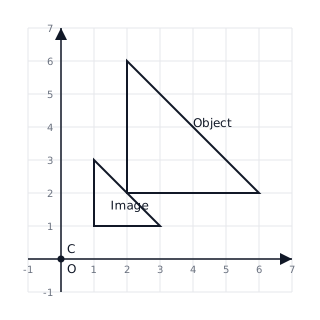
A coordinate plane showing a large triangle and its smaller image enlarged from the origin with k = 0.5
•

The relationship between the distances is linear: Distance from center to image=k×Distance from center to object\text{Distance from center to image} = k \times \text{Distance from center to object}. For negative rational factors, the image is inverted and appears on the opposite side of the center.
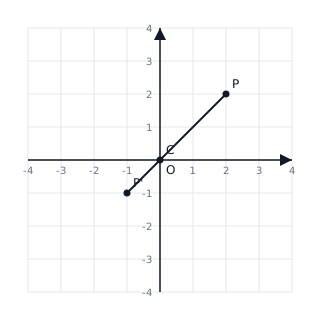
Diagram showing a point P and its image P' on opposite sides of center C for k = -0.5
•

The ratio of the areas between the image and the object is equal to the square of the scale factor: Area ratio=k2\text{Area ratio} = k^2. Even if kk is negative, k2k^2 is always positive.

•

To find the coordinates of an image (x′,y′)(x', y') when the center is (a,b)(a, b), use: x′=a+k(x−a)x' = a + k(x - a) and y′=b+k(y−b)y' = b + k(y - b).

📐Formulae

k=Image LengthObject Lengthk = \frac{\text{Image Length}}{\text{Object Length}}

Area of Image=k2×Area of Object\text{Area of Image} = k^2 \times \text{Area of Object}

Distance from Center to Image Point=k×Distance from Center to Object Point\text{Distance from Center to Image Point} = k \times \text{Distance from Center to Object Point}

Coordinate Mapping (Center at Origin):(x,y)→(kx,ky)\text{Coordinate Mapping (Center at Origin)}: (x, y) \rightarrow (kx, ky)

💡Examples

Problem 1:

A triangle ABCABC has coordinates A(2,2)A(2, 2), B(4,2)B(4, 2), and C(2,6)C(2, 6). Find the coordinates of the image A′B′C′A'B'C' after an enlargement with center (0,0)(0, 0) and a rational scale factor of k=32k = \frac{3}{2}.

Solution:

Multiply each coordinate by k=1.5k = 1.5: A′=(2×1.5,2×1.5)=(3,3)A' = (2 \times 1.5, 2 \times 1.5) = (3, 3) B′=(4×1.5,2×1.5)=(6,3)B' = (4 \times 1.5, 2 \times 1.5) = (6, 3) C′=(2×1.5,6×1.5)=(3,9)C' = (2 \times 1.5, 6 \times 1.5) = (3, 9)

Explanation:

Since the center of enlargement is the origin, we apply the mapping (x,y)→(kx,ky)(x, y) \rightarrow (kx, ky) directly to each vertex.

Problem 2:

A rectangle has an area of 20 cm220 \text{ cm}^2. It undergoes an enlargement with a scale factor of k=−12k = -\frac{1}{2}. Calculate the area of the resulting image.

Solution:

Area of Image=k2×Area of Object\text{Area of Image} = k^2 \times \text{Area of Object} Area of Image=(−12)2×20\text{Area of Image} = (-\frac{1}{2})^2 \times 20 Area of Image=14×20=5 cm2\text{Area of Image} = \frac{1}{4} \times 20 = 5 \text{ cm}^2

Explanation:

Even though the scale factor is negative, the area scale factor is always positive because kk is squared (k2k^2). The negative sign indicates the image is inverted, but the size reduction depends only on the magnitude ∣12∣|\frac{1}{2}|.

Problem 3:

A point P(5,8)P(5, 8) is enlarged to P′(7,13)P'(7, 13) from a center of enlargement C(3,3)C(3, 3). Determine the rational scale factor kk.

Solution:

Use the vector components from the center: Horizontal distance from CC to PP: 5−3=25 - 3 = 2 Horizontal distance from CC to P′P': 7−3=47 - 3 = 4 k=Image DistanceObject Distance=42=2k = \frac{\text{Image Distance}}{\text{Object Distance}} = \frac{4}{2} = 2 Check with vertical distances: Vertical distance from CC to PP: 8−3=58 - 3 = 5 Vertical distance from CC to P′P': 13−3=1013 - 3 = 10 k=105=2k = \frac{10}{5} = 2

Explanation:

The scale factor kk is the ratio of the distances from the center to the image and the center to the object. Both the xx and yy displacements must yield the same kk.

Problem 4:

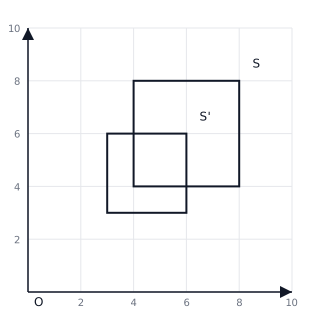
A square SS has vertices at A(4,4)A(4, 4), B(8,4)B(8, 4), C(8,8)C(8, 8), and D(4,8)D(4, 8). It is enlarged with a scale factor of k=34k = \frac{3}{4} and the center of enlargement at the origin (0,0)(0, 0). Find the coordinates of the vertices of the image S′S' and calculate the ratio of the area of S′S' to the area of SS.

Coordinate grid showing a square S from (4,4) to (8,8) and its image S' from (3,3) to (6,6)

Solution:

  1. Multiply each coordinate by k=34k = \frac{3}{4}: A′=(4×34,4×34)=(3,3)A' = (4 \times \frac{3}{4}, 4 \times \frac{3}{4}) = (3, 3) B′=(8×34,4×34)=(6,3)B' = (8 \times \frac{3}{4}, 4 \times \frac{3}{4}) = (6, 3) C′=(8×34,8×34)=(6,6)C' = (8 \times \frac{3}{4}, 8 \times \frac{3}{4}) = (6, 6) D′=(4×34,8×34)=(3,6)D' = (4 \times \frac{3}{4}, 8 \times \frac{3}{4}) = (3, 6)
  2. The ratio of the areas is k2=(34)2=916k^2 = (\frac{3}{4})^2 = \frac{9}{16}.

Explanation:

Since the center is the origin, we apply the scalar kk directly to the coordinates. The resulting square is smaller because ∣k∣<1|k| < 1.

Problem 5:

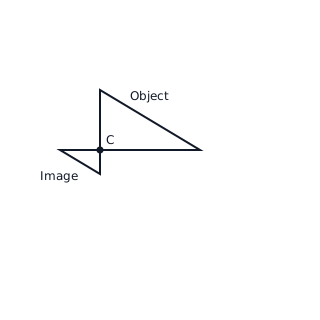
Triangle TT has a base of 1010 units and height of 66 units. It is enlarged by a scale factor k=−25k = -\frac{2}{5}. Determine the dimensions and the area of the image triangle T′T'.

A larger triangle and a smaller inverted triangle sharing a common vertex which acts as the center of enlargement

Solution:

  1. The new dimensions are found by taking the absolute value of the scale factor: Base′=∣k∣×10=25×10=4 units\text{Base}' = |k| \times 10 = \frac{2}{5} \times 10 = 4 \text{ units} Height′=∣k∣×6=25×6=2.4 units\text{Height}' = |k| \times 6 = \frac{2}{5} \times 6 = 2.4 \text{ units}
  2. Calculate Area of TT: 12×10×6=30 sq units\frac{1}{2} \times 10 \times 6 = 30 \text{ sq units}
  3. Calculate Area of T′T': k2×Area of T=(−25)2×30=425×30=4.8 sq unitsk^2 \times \text{Area of } T = (-\frac{2}{5})^2 \times 30 = \frac{4}{25} \times 30 = 4.8 \text{ sq units}.

Explanation:

A negative scale factor indicates the image is inverted. Lengths are always positive, so we use ∣k∣|k| for dimensions, but k2k^2 for area transformations.