
Review the key concepts, formulae, and examples before starting your quiz.
🔑Concepts
Two shapes are congruent if they are identical in size and shape. There are four criteria for triangle congruence: SSS (Side-Side-Side), SAS (Side-Angle-Side), ASA (Angle-Side-Angle), and RHS (Right angle-Hypotenuse-Side). When triangles are congruent, all corresponding sides and angles are equal.
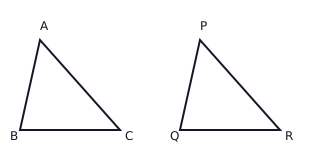
Similarity occurs when two shapes have the same shape but different sizes. One is an enlargement of the other. For triangles, similarity is established if corresponding angles are equal (AA) or if corresponding sides are in the same ratio ().
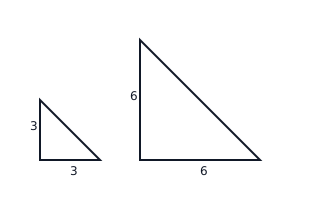
The Linear Scale Factor represents the ratio of corresponding side lengths. If the linear scale factor is , then the Area Scale Factor is and the Volume Scale Factor is . This is vital for solving problems involving similar 2D shapes or 3D solids.
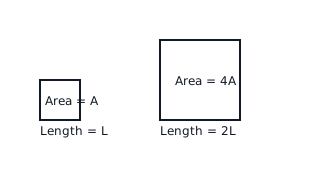
In similarity, the ratio of any linear measurement (height, radius, perimeter, median) follows the scale factor . For example, if two circles have radii in ratio , their circumferences are also in ratio , but their areas are in ratio .
📐Formulae
💡Examples
Problem 1:
In triangle , is parallel to . If cm, cm, and cm, find the length of .
Solution:
because is common and (corresponding angles). The scale factor is: Now, :
Explanation:
Since , triangles and are similar by criterion. We find the ratio of the full side to to get the scale factor, then multiply the base by this factor.
Problem 2:
Two similar solid cones have surface areas of and . If the height of the smaller cone is cm, find the height of the larger cone.
Solution:
First, find the area scale factor : Find the linear scale factor : The height of the larger cone is:
Explanation:
The ratio of areas is the square of the linear scale factor. By taking the square root of the area ratio, we find , which can then be applied to the height.
Problem 3:
A model car is built to a scale of . if the volume of the model's petrol tank is , calculate the volume of the actual car's tank in liters.
Solution:
The linear scale factor is . The volume scale factor is: Actual volume in : Convert to liters (since ):
Explanation:
Volume scale factor is the cube of the linear scale factor. After calculating the volume in cubic centimeters, we convert it to liters using the standard conversion.
Problem 4:
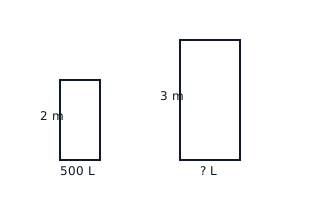
A cylindrical water tank has a height of m and a capacity of liters. A similar cylindrical tank has a height of m. Calculate the capacity of the larger tank.
Solution:
Explanation:
Since the tanks are similar, we first find the linear scale factor by dividing the heights. Because volume scales by , we cube the scale factor and multiply it by the original volume to find the new capacity.
Problem 5:
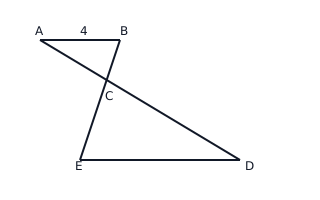
In the figure, is parallel to . If cm, cm, and cm, find the length of .
Solution:
Explanation:
Because , alternate interior angles are equal, making the triangles similar. We use the ratio of corresponding sides and to find the scale factor, then apply it to to find .