
Review the key concepts, formulae, and examples before starting your quiz.
🔑Concepts
Bearings are angles measured clockwise from the North direction and must always be written using three digits (e.g., instead of ).
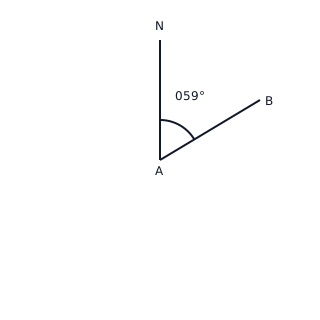
The back bearing (or reverse bearing) is the direction back to the starting point. It is calculated by adding if the bearing is less than , or subtracting if it is greater than .
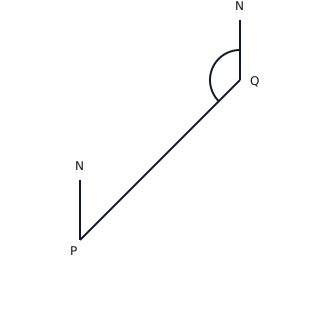
Bearings problems often involve creating right-angled triangles to use Trigonometry () or using the Sine and Cosine rules for non-right-angled triangles.
When the path involves multiple turns, it is helpful to draw a separate North line at every change of direction to identify geometric relationships like interior or alternate angles.
📐Formulae
💡Examples
Problem 1:
A ship sails km on a bearing of and then km on a bearing of . Find the bearing of the ship from its starting point.
Solution:
Let the starting point be . The ship moves km East to point and km South to point . In triangle , km and km. We need the angle clockwise from North at point . The internal angle at (let's call it ) is found using: Since the first movement was (East), the total bearing from North is:
Explanation:
We model the journey as a right-angled triangle. Since the ship first travels East () and then South (), the paths are perpendicular. We calculate the internal angle using trigonometry and add it to the initial displacement from North.
Problem 2:
The bearing of point from point is . Calculate the bearing of from .
Solution:
The given bearing . Since , we add :
Explanation:
To find a back bearing (the direction looking back at the start), we add or subtract . This is because North lines are parallel, making the interior angles between the two points supplementary ().
Problem 3:
Calculate the distance between two points and if is on a bearing of from and the horizontal distance (East) between them is km.
Solution:
The bearing forms an angle of with the North line. This means the angle with the East line is . However, it is simpler to use the angle from North. The East distance ( km) is the side opposite to the angle. Let be the direct distance (hypotenuse):
Explanation:
By drawing a right-angled triangle where the hypotenuse is the direct path and the 'Opposite' side is the Eastward displacement, we use the Sine ratio to find the total distance.
Problem 4:
A plane flies from airport on a bearing of for km to point . It then changes course and flies km on a bearing of to airport . Calculate the distance between and to one decimal place.
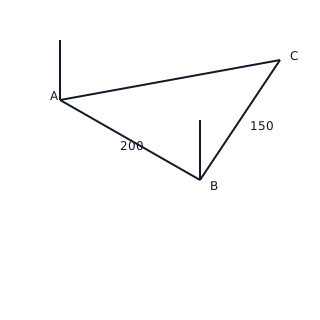
Solution:
Angle at can be found using interior angles. The angle between the North line at and the line is . The angle between North and is . Thus, the total angle is . Using Pythagoras:
Explanation:
By drawing North lines at and , we find that the path forms a right-angled triangle because the interior angle relative to the south-bound line and the next bearing add up to .
Problem 5:
Point is km from point on a bearing of . How far West is point from point ?
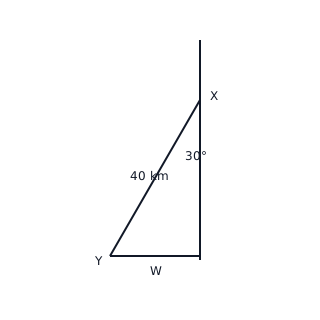
Solution:
The angle measured clockwise from North is . The angle from the South line is . In the right-angled triangle formed with the vertical South line:
Explanation:
To find the 'West' component, we determine the angle between the path and the North-South axis and use the sine function.