krit.club logo

Geometry and Trigonometry - Rotation around a given point

Grade 9IB

Review the key concepts, formulae, and examples before starting your quiz.

🔑Concepts

•

A rotation is a transformation that turns a figure about a fixed point called the center of rotation. The amount of turning is called the angle of rotation, and the direction can be clockwise (CW) or counter-clockwise (CCW).
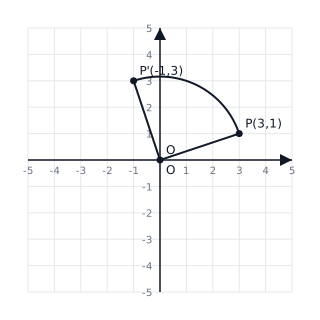
A coordinate plane showing a 90 degree counter-clockwise rotation of point P(3,1) to P'(-1,3) about the origin.
•

When rotating 90∘90^{\circ} counter-clockwise about the origin (0,0)(0,0), the point (x,y)(x, y) maps to (−y,x)(-y, x). This swaps the coordinates and negates the new xx-value.

•

A 180∘180^{\circ} rotation about the origin (0,0)(0,0) results in the point (x,y)(x, y) mapping to (−x,−y)(-x, -y). This is equivalent to reflecting the point through the origin.

•

To rotate a point about a center (h,k)(h, k) other than the origin, subtract the center coordinates, apply the origin rotation rule, and then add the center coordinates back: (x′,y′)=Rotate(x−h,y−k)+(h,k)(x', y') = \text{Rotate}(x-h, y-k) + (h, k).

📐Formulae

90∘ Counter-clockwise (or 270∘ Clockwise) about (0,0): (x,y)→(−y,x)90^{\circ} \text{ Counter-clockwise (or } 270^{\circ} \text{ Clockwise) about (0,0): } (x, y) \rightarrow (-y, x)文明

90∘ Clockwise (or 270∘ Counter-clockwise) about (0,0): (x,y)→(y,−x)90^{\circ} \text{ Clockwise (or } 270^{\circ} \text{ Counter-clockwise) about (0,0): } (x, y) \rightarrow (y, -x)

180∘ Rotation (either direction) about (0,0): (x,y)→(−x,−y)180^{\circ} \text{ Rotation (either direction) about (0,0): } (x, y) \rightarrow (-x, -y)

💡Examples

Problem 1:

Rotate the point A(3,5)A(3, 5) by 90∘90^{\circ} counter-clockwise about the origin (0,0)(0, 0).

Solution:

A(3,5)→A′(−5,3)A(3, 5) \rightarrow A'(-5, 3)

Explanation:

Using the rule for 90∘90^{\circ} counter-clockwise rotation (x,y)→(−y,x)(x, y) \rightarrow (-y, x), we take the yy-coordinate 55, negate it to get −5-5 (the new xx), and take the original xx-coordinate 33 to be the new yy.

Problem 2:

Rotate the point P(4,2)P(4, 2) by 180∘180^{\circ} about the point C(1,1)C(1, 1).

Solution:

P(4,2)→Translate(4−1,2−1)=(3,1)P(4, 2) \xrightarrow{\text{Translate}} (4-1, 2-1) = (3, 1) (3,1)→Rotate 180∘(−3,−1)(3, 1) \xrightarrow{\text{Rotate } 180^{\circ}} (-3, -1) (−3,−1)→Translate back(−3+1,−1+1)=(−2,0)(-3, -1) \xrightarrow{\text{Translate back}} (-3+1, -1+1) = (-2, 0) P′=(−2,0)P' = (-2, 0)

Explanation:

First, we translate the center of rotation to the origin by subtracting C(1,1)C(1, 1) from P(4,2)P(4, 2), resulting in (3,1)(3, 1). Next, we apply the 180∘180^{\circ} rotation rule (x,y)→(−x,−y)(x, y) \rightarrow (-x, -y) to get (−3,−1)(-3, -1). Finally, we translate back by adding C(1,1)C(1, 1) to get the final coordinates (−2,0)(-2, 0).

Problem 3:

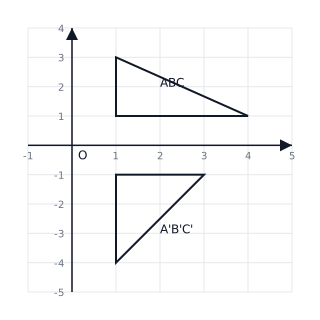
Rotate the triangle with vertices A(1,1)A(1, 1), B(4,1)B(4, 1), and C(1,3)C(1, 3) by 90∘90^{\circ} clockwise about the origin (0,0)(0, 0).

A coordinate plane showing triangle ABC in the first quadrant and its 90 degree clockwise rotation A'B'C' in the fourth quadrant.

Solution:

  1. Apply the rule for 90∘90^{\circ} clockwise rotation: (x,y)→(y,−x)(x, y) \rightarrow (y, -x).
  2. Calculate the new coordinates:
    • A(1,1)→A′(1,−1)A(1, 1) \rightarrow A'(1, -1)
    • B(4,1)→B′(1,−4)B(4, 1) \rightarrow B'(1, -4)
    • C(1,3)→C′(3,−1)C(1, 3) \rightarrow C'(3, -1)
  3. The vertices of the rotated triangle are A′(1,−1)A'(1, -1), B′(1,−4)B'(1, -4), and C′(3,−1)C'(3, -1).

Explanation:

A clockwise rotation of 90∘90^{\circ} moves points from the first quadrant to the fourth quadrant. The xx and yy values are swapped, and the new yy-coordinate becomes negative.

Problem 4:

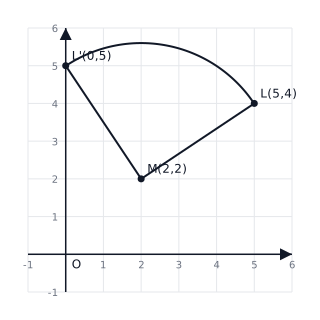
Rotate point L(5,4)L(5, 4) by 90∘90^{\circ} counter-clockwise about the point M(2,2)M(2, 2).

A coordinate plane showing point L rotated 90 degrees counter-clockwise about center M to point L'.

Solution:

  1. Translate the center M(2,2)M(2, 2) to the origin by subtracting its coordinates: Lshifted=(5−2,4−2)=(3,2)L_{shifted} = (5-2, 4-2) = (3, 2).
  2. Apply the 90∘90^{\circ} CCW rotation rule (x,y)→(−y,x)(x, y) \rightarrow (-y, x) to the shifted point: (3,2)→(−2,3)(3, 2) \rightarrow (-2, 3).
  3. Translate back by adding the coordinates of MM: L′=(−2+2,3+2)=(0,5)L' = (-2+2, 3+2) = (0, 5).
  4. The final coordinates are L′(0,5)L'(0, 5).

Explanation:

When the center is not the origin, we temporarily treat the center as (0,0)(0,0), rotate, and then shift back to the original position.