
Review the key concepts, formulae, and examples before starting your quiz.
🔑Concepts
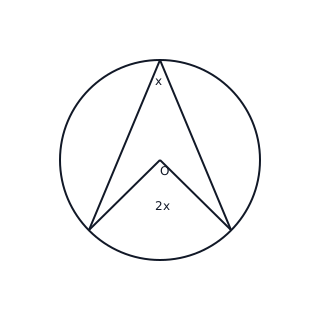
The angle at the center of a circle is twice the angle at the circumference when both angles are subtended by the same arc. This fundamental property leads to several other circle theorems.
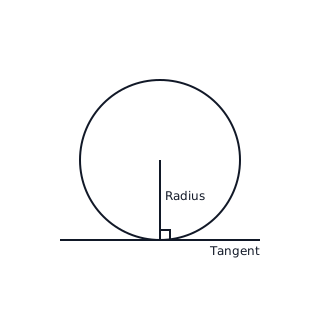
A tangent to a circle is a straight line that touches the circle at exactly one point. The radius of the circle is perpendicular () to the tangent at the point of contact.
Angles subtended by the same arc (or segment) in the same part of the circle are equal. This is often called 'angles in the same segment'.
In a cyclic quadrilateral, where all four vertices lie on the circumference of a circle, the opposite angles add up to (supplementary).
The angle in a semi-circle is always a right angle (). This occurs when the chord subtending the angle is the diameter of the circle.
📐Formulae
💡Examples
Problem 1:
Calculate the area of a sector with a radius of and a central angle of . Leave your answer in terms of .
Solution:
Explanation:
Substitute the given radius and angle into the sector area formula. Simplify the fraction and calculate the final value.
Problem 2:
In a circle with center , points , , and lie on the circumference. If (where is the center), find the size of .
Solution:
Explanation:
Using the 'Angle at the Center' theorem, the angle subtended at the circumference () is half the angle subtended at the center () by the same arc .
Problem 3:
A circle has a circumference of . Find its area.
Solution:
First, find : Now, find the area:
Explanation:
Use the circumference formula to solve for the radius . Once is known, substitute it into the area formula .
Problem 4:
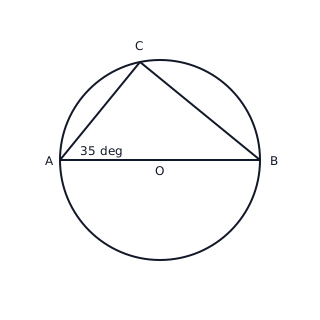
In the given circle with center , segment is a diameter. Point lies on the circumference. If , find the value of .
Solution:
- Identify that is inscribed in a semi-circle because is the diameter.
- According to the circle theorem, the angle in a semi-circle is , so .
- The sum of angles in a triangle is . Therefore:
Explanation:
This problem uses the theorem that any angle subtended by a diameter at the circumference is a right angle, combined with the basic triangle angle sum property.
Problem 5:
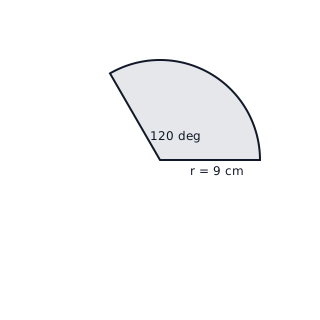
Calculate the length of an arc that subtends an angle of at the center of a circle with a radius of . Give your answer in terms of .
Solution:
- Use the arc length formula:
- Substitute the given values and :
- Simplify the fraction:
- Calculate the final value:
Explanation:
Arc length is a fraction of the total circumference. Since is one-third of , the arc length is one-third of the circumference.