krit.club logo

Geometry and Trigonometry - Vectors: Algebraic representation (HL)

Grade 12IB_AA

Review the key concepts, formulae, and examples before starting your quiz.

🔑Concepts

•

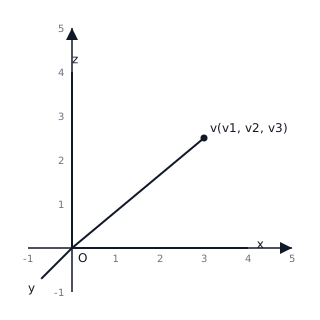
A vector in 3D space can be represented as a column vector v=(v1v2v3)\mathbf{v} = \begin{pmatrix} v_1 \\ v_2 \\ v_3 \end{pmatrix} or in component form v1i+v2j+v3kv_1\mathbf{i} + v_2\mathbf{j} + v_3\mathbf{k}, where i\mathbf{i}, j\mathbf{j}, and k\mathbf{k} are unit vectors along the xx, yy, and zz axes respectively.

3D coordinate system showing a vector v with components along x, y, and z axes.
•

The magnitude (or length) of a vector v\mathbf{v}, denoted by ∣v∣|\mathbf{v}|, represents the distance from the origin to the point (v1,v2,v3)(v_1, v_2, v_3) and is calculated using the 3D version of the Pythagorean theorem: ∣v∣=v12+v22+v32|\mathbf{v}| = \sqrt{v_1^2 + v_2^2 + v_3^2}.

•

Vector addition a+b\mathbf{a} + \mathbf{b} and subtraction a−b\mathbf{a} - \mathbf{b} are performed component-wise. Geometrically, addition follows the triangle law or parallelogram law, while subtraction finds the vector pointing from the tip of b\mathbf{b} to the tip of a\mathbf{a}.

•

The vector product (cross product) a×b\mathbf{a} \times \mathbf{b} produces a vector that is perpendicular to both a\mathbf{a} and b\mathbf{b}. Its magnitude ∣a×b∣|\mathbf{a} \times \mathbf{b}| is equal to the area of the parallelogram formed by the two vectors.

📐Formulae

∣v∣=v12+v22+v32|\mathbf{v}| = \sqrt{v_1^2 + v_2^2 + v_3^2}

Unit vector v^=v∣v∣\text{Unit vector } \hat{\mathbf{v}} = \frac{\mathbf{v}}{|\mathbf{v}|}

a⋅b=a1b1+a2b2+a3b3=∣a∣∣b∣cos⁡θ\mathbf{a} \cdot \mathbf{b} = a_1b_1 + a_2b_2 + a_3b_3 = |\mathbf{a}||\mathbf{b}| \cos \theta

cos⁡θ=a⋅b∣a∣∣b∣\cos \theta = \frac{\mathbf{a} \cdot \mathbf{b}}{|\mathbf{a}||\mathbf{b}|}

a×b=∣ijka1a2a3b1b2b3∣=(a2b3−a3b2a3b1−a1b3a1b2−a2b1)\mathbf{a} \times \mathbf{b} = \begin{vmatrix} \mathbf{i} & \mathbf{j} & \mathbf{k} \\ a_1 & a_2 & a_3 \\ b_1 & b_2 & b_3 \end{vmatrix} = \begin{pmatrix} a_2b_3 - a_3b_2 \\ a_3b_1 - a_1b_3 \\ a_1b_2 - a_2b_1 \end{pmatrix}

Area of a triangle=12∣a×b∣\text{Area of a triangle} = \frac{1}{2} |\mathbf{a} \times \mathbf{b}|

Area of a parallelogram=∣a×b∣\text{Area of a parallelogram} = |\mathbf{a} \times \mathbf{b}|

💡Examples

Problem 1:

Given vectors a=(2−13)\mathbf{a} = \begin{pmatrix} 2 \\ -1 \\ 3 \end{pmatrix} and b=(104)\mathbf{b} = \begin{pmatrix} 1 \\ 0 \\ 4 \end{pmatrix}, find the scalar product a⋅b\mathbf{a} \cdot \mathbf{b} and the angle θ\theta between them.

Solution:

a⋅b=(2)(1)+(−1)(0)+(3)(4)=2+0+12=14\mathbf{a} \cdot \mathbf{b} = (2)(1) + (-1)(0) + (3)(4) = 2 + 0 + 12 = 14 ∣a∣=22+(−1)2+32=14|\mathbf{a}| = \sqrt{2^2 + (-1)^2 + 3^2} = \sqrt{14} ∣b∣=12+02+42=17|\mathbf{b}| = \sqrt{1^2 + 0^2 + 4^2} = \sqrt{17} cos⁡θ=141417=1417\cos \theta = \frac{14}{\sqrt{14}\sqrt{17}} = \frac{\sqrt{14}}{\sqrt{17}} θ=arccos⁡(1417)≈25.1∘\theta = \arccos\left(\sqrt{\frac{14}{17}}\right) \approx 25.1^\circ

Explanation:

We use the algebraic definition of the dot product to find its value, calculate the magnitudes of both vectors, and then use the geometric definition cos⁡θ=a⋅b∣a∣∣b∣\cos \theta = \frac{\mathbf{a} \cdot \mathbf{b}}{|\mathbf{a}||\mathbf{b}|} to find the angle.

Problem 2:

Find a vector perpendicular to both u=i+2j−k\mathbf{u} = \mathbf{i} + 2\mathbf{j} - \mathbf{k} and v=2i−j+3k\mathbf{v} = 2\mathbf{i} - \mathbf{j} + 3\mathbf{k} using the cross product.

Solution:

u×v=∣ijk12−12−13∣\mathbf{u} \times \mathbf{v} = \begin{vmatrix} \mathbf{i} & \mathbf{j} & \mathbf{k} \\ 1 & 2 & -1 \\ 2 & -1 & 3 \end{vmatrix} =i(2(3)−(−1)(−1))−j(1(3)−(−1)(2))+k(1(−1)−2(2))= \mathbf{i}(2(3) - (-1)(-1)) - \mathbf{j}(1(3) - (-1)(2)) + \mathbf{k}(1(-1) - 2(2)) =i(6−1)−j(3+2)+k(−1−4)= \mathbf{i}(6 - 1) - \mathbf{j}(3 + 2) + \mathbf{k}(-1 - 4) =5i−5j−5k= 5\mathbf{i} - 5\mathbf{j} - 5\mathbf{k}

Explanation:

The cross product of two vectors yields a third vector that is orthogonal (perpendicular) to the plane containing the original two. We expand the determinant along the first row.

Problem 3:

Calculate the area of a triangle with vertices A(1,0,2)A(1, 0, 2), B(3,−1,5)B(3, -1, 5), and C(1,4,0)C(1, 4, 0).

Solution:

AB⃗=\vec{AB} = \begin{pmatrix} 3-1 \ -1-0 \ 5-2 \end{pmatrix}==\begin{pmatrix} 2 \ -1 \ 3 \end{pmatrix} \vec{AC} = \begin{pmatrix} 1-1 \ 4-0 \ 0-2 \end{pmatrix}==\begin{pmatrix} 0 \ 4 \ -2 \end{pmatrix} \vec{AB} \times \vec{AC} = \begin{vmatrix} \mathbf{i} & \mathbf{j} & \mathbf{k} \ 2 & -1 & 3 \ 0 & 4 & -2 \end{vmatrix} = \begin{pmatrix} (-1)(-2) - (3)(4) \ -(2(-2) - 0) \ 2(4) - 0 \end{pmatrix}=(−1048) = \begin{pmatrix} -10 \\ 4 \\ 8 \end{pmatrix} Area=12∣AB⃗×AC⃗∣=12(−10)2+42+82=12100+16+64=12180=35\text{Area} = \frac{1}{2} |\vec{AB} \times \vec{AC}| = \frac{1}{2} \sqrt{(-10)^2 + 4^2 + 8^2} = \frac{1}{2} \sqrt{100 + 16 + 64} = \frac{1}{2} \sqrt{180} = 3\sqrt{5}

Explanation:

First, find two displacement vectors originating from the same vertex. Then calculate their cross product. The area of the triangle is half the magnitude of this cross product vector.

Problem 4:

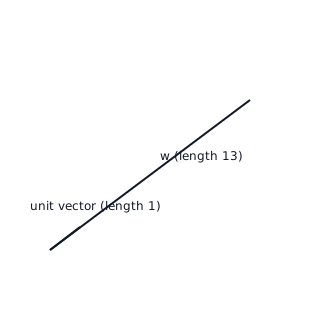
Calculate the magnitude of the vector w=3i−4j+12k\mathbf{w} = 3\mathbf{i} - 4\mathbf{j} + 12\mathbf{k} and determine the unit vector w^\hat{\mathbf{w}} in the same direction.

A long vector w and a shorter unit vector pointing in the same direction.

Solution:

  1. Find the magnitude: ∣w∣=32+(−4)2+122|\mathbf{w}| = \sqrt{3^2 + (-4)^2 + 12^2} ∣w∣=9+16+144=169=13|\mathbf{w}| = \sqrt{9 + 16 + 144} = \sqrt{169} = 13
  2. Find the unit vector: w^=1∣w∣w=113(3−412)\hat{\mathbf{w}} = \frac{1}{|\mathbf{w}|} \mathbf{w} = \frac{1}{13} \begin{pmatrix} 3 \\ -4 \\ 12 \end{pmatrix} w^=(313−4131213)\hat{\mathbf{w}} = \begin{pmatrix} \frac{3}{13} \\ -\frac{4}{13} \\ \frac{12}{13} \end{pmatrix}

Explanation:

The magnitude is the geometric length of the vector. Dividing the vector by its magnitude scales it to a length of 1 (a unit vector) while maintaining its direction.

Problem 5:

Given vectors p=(400)\mathbf{p} = \begin{pmatrix} 4 \\ 0 \\ 0 \end{pmatrix} and q=(030)\mathbf{q} = \begin{pmatrix} 0 \\ 3 \\ 0 \end{pmatrix}, find the area of the parallelogram formed by these two vectors using the cross product.
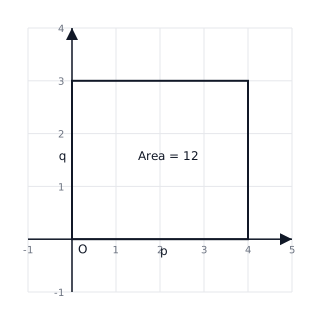
A rectangle on a coordinate plane with base 4 and height 3, representing the area calculated via the vector product.

Solution:

  1. Calculate the cross product p×q\mathbf{p} \times \mathbf{q}: p×q=∣ijk400030∣\mathbf{p} \times \mathbf{q} = \begin{vmatrix} \mathbf{i} & \mathbf{j} & \mathbf{k} \\ 4 & 0 & 0 \\ 0 & 3 & 0 \end{vmatrix} =i(0−0)−j(0−0)+k(12−0)=(0012)= \mathbf{i}(0-0) - \mathbf{j}(0-0) + \mathbf{k}(12-0) = \begin{pmatrix} 0 \\ 0 \\ 12 \end{pmatrix}
  2. The area is the magnitude of the cross product: Area=∣p×q∣=02+02+122=12\text{Area} = |\mathbf{p} \times \mathbf{q}| = \sqrt{0^2 + 0^2 + 12^2} = 12

Explanation:

Since p\mathbf{p} lies on the x-axis and q\mathbf{q} lies on the y-axis, they form a rectangle in the xy-plane. The cross product points in the z-direction (perpendicular to the plane), and its magnitude represents the area (4×3=124 \times 3 = 12).