krit.club logo

Geometry and Trigonometry - Triangles – Sine and Cosine rules

Grade 12IB_AA

Review the key concepts, formulae, and examples before starting your quiz.

🔑Concepts

•

In any triangle, the sides are labeled aa, bb, and cc opposite to the angles AA, BB, and CC respectively. The Sine Rule is used when we know either two angles and one side (AAS/ASA) or two sides and a non-included angle (SSA).
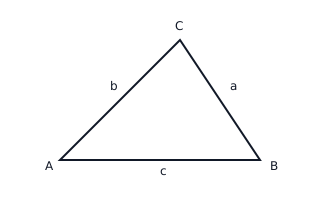
Standard labeling of a triangle with vertices A, B, C and opposite sides a, b, c.
•

The Cosine Rule relates three sides and one angle. Use it to find a side when given two sides and the included angle (SAS), or to find an angle when given all three sides (SSS).
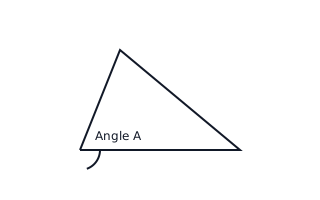
Triangle illustrating the included angle A between sides b and c.
•

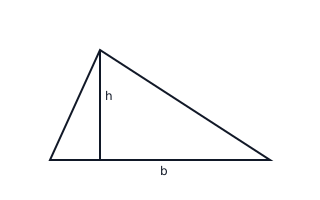
The Area of a Triangle can be calculated using the sine of the included angle: Area=12absin⁡C\text{Area} = \frac{1}{2}ab \sin C. This formula is derived from the standard base-height formula where h=bsin⁡Ah = b \sin A.

Triangle showing the perpendicular height h and base b.
•

The Sine Rule can lead to an 'Ambiguous Case' (SSA) where two different triangles can be formed. This occurs if the given angle is acute and the side opposite it is shorter than the other given side but longer than the altitude.

📐Formulae

asin⁡A=bsin⁡B=csin⁡C\frac{a}{\sin A} = \frac{b}{\sin B} = \frac{c}{\sin C}

sin⁡Aa=sin⁡Bb=sin⁡Cc\frac{\sin A}{a} = \frac{\sin B}{b} = \frac{\sin C}{c}

a2=b2+c2−2bccos⁡Aa^2 = b^2 + c^2 - 2bc \cos A

cos⁡A=b2+c2−a22bc\cos A = \frac{b^2 + c^2 - a^2}{2bc}

Area=12absin⁡C\text{Area} = \frac{1}{2}ab \sin C

💡Examples

Problem 1:

In △ABC\triangle ABC, b=7b = 7 cm, c=10c = 10 cm, and ∠A=45∘\angle A = 45^\circ. Find the length of side aa to two decimal places.

Solution:

Using the Cosine Rule: a2=b2+c2−2bccos⁡Aa^2 = b^2 + c^2 - 2bc \cos A a2=72+102−2(7)(10)cos⁡45∘a^2 = 7^2 + 10^2 - 2(7)(10) \cos 45^\circ a2=49+100−140(22)a^2 = 49 + 100 - 140 \left(\frac{\sqrt{2}}{2}\right) a2=149−702a^2 = 149 - 70\sqrt{2} a2≈149−98.9949=50.0051a^2 \approx 149 - 98.9949 = 50.0051 a≈50.0051≈7.07 cma \approx \sqrt{50.0051} \approx 7.07 \text{ cm}

Explanation:

Since we are given two sides and the included angle (SAS), we apply the Cosine Rule to find the missing opposite side.

Problem 2:

In △PQR\triangle PQR, q=12q = 12 cm, ∠P=40∘\angle P = 40^\circ, and ∠Q=60∘\angle Q = 60^\circ. Find the length of side pp.

Solution:

Using the Sine Rule: psin⁡P=qsin⁡Q\frac{p}{\sin P} = \frac{q}{\sin Q} psin⁡40∘=12sin⁡60∘\frac{p}{\sin 40^\circ} = \frac{12}{\sin 60^\circ} p=12sin⁡40∘sin⁡60∘p = \frac{12 \sin 40^\circ}{\sin 60^\circ} p≈12×0.64280.8660p \approx \frac{12 \times 0.6428}{0.8660} p≈8.91 cmp \approx 8.91 \text{ cm}

Explanation:

We use the Sine Rule because we have a known side-angle pair (qq and ∠Q\angle Q) and we need to find a side corresponding to another known angle (∠P\angle P).

Problem 3:

Find the area of a triangle with sides 88 cm and 55 cm and an included angle of 30∘30^\circ.

Solution:

Using the Area formula: Area=12absin⁡C\text{Area} = \frac{1}{2}ab \sin C Area=12(8)(5)sin⁡30∘\text{Area} = \frac{1}{2} (8)(5) \sin 30^\circ Area=20×0.5=10 cm2\text{Area} = 20 \times 0.5 = 10 \text{ cm}^2

Explanation:

The area of a triangle is half the product of two sides and the sine of the angle between them.

Problem 4:

In triangle XYZXYZ, XY=15XY = 15 cm, YZ=10YZ = 10 cm, and XZ=12XZ = 12 cm. Calculate the size of the largest angle in the triangle to the nearest degree.
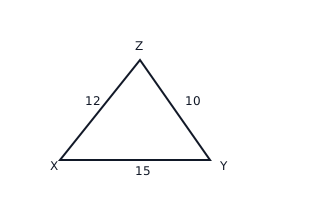
Triangle XYZ with sides 15, 12, and 10.

Solution:

  1. Identify the largest angle: The largest angle is opposite the longest side, XY=15XY = 15 cm. Let this be angle ZZ.
  2. Apply the Cosine Rule: cos⁡Z=102+122−1522×10×12\cos Z = \frac{10^2 + 12^2 - 15^2}{2 \times 10 \times 12}
  3. Calculate the value: cos⁡Z=100+144−225240=19240≈0.07917\cos Z = \frac{100 + 144 - 225}{240} = \frac{19}{240} \approx 0.07917
  4. Find the angle: Z=cos⁡−1(0.07917)≈85.46∘Z = \cos^{-1}(0.07917) \approx 85.46^\circ
  5. Rounding to the nearest degree gives 85∘85^\circ.

Explanation:

To find an angle when all three sides are known, the Cosine Rule is required. Since we want the largest angle, we target the one opposite the side with length 15.

Problem 5:

In triangle ABCABC, ∠A=35∘\angle A = 35^\circ, ∠B=75∘\angle B = 75^\circ, and side c=8c = 8 cm. Calculate the area of the triangle to one decimal place.
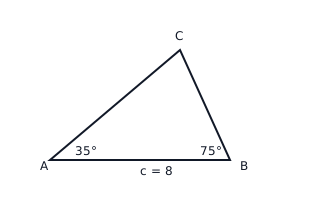
Triangle ABC with angles 35 and 75 and side c=8.

Solution:

  1. Find the third angle CC: C=180∘−(35∘+75∘)=70∘C = 180^\circ - (35^\circ + 75^\circ) = 70^\circ
  2. Use the Sine Rule to find side aa: asin⁡35∘=8sin⁡70∘\frac{a}{\sin 35^\circ} = \frac{8}{\sin 70^\circ} a=8sin⁡35∘sin⁡70∘≈8×0.57360.9397≈4.883 cma = \frac{8 \sin 35^\circ}{\sin 70^\circ} \approx \frac{8 \times 0.5736}{0.9397} \approx 4.883 \text{ cm}
  3. Calculate the area using sides a,ca, c and included angle BB: Area=12×a×c×sin⁡B\text{Area} = \frac{1}{2} \times a \times c \times \sin B Area=12×4.883×8×sin⁡75∘\text{Area} = \frac{1}{2} \times 4.883 \times 8 \times \sin 75^\circ Area≈19.532×0.9659≈18.9 cm2\text{Area} \approx 19.532 \times 0.9659 \approx 18.9 \text{ cm}^2

Explanation:

To find the area, we need two sides and their included angle. We first find the missing angle to use the Sine Rule for a second side, then apply the sine area formula.