krit.club logo

Geometry and Trigonometry - sin θ, cos θ, tan θ on the unit circle

Grade 12IB_AA

Review the key concepts, formulae, and examples before starting your quiz.

🔑Concepts

•

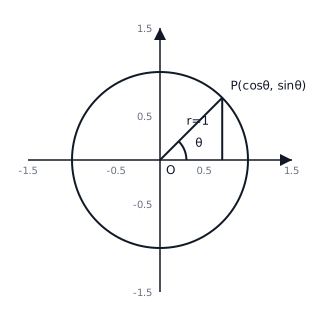
The Unit Circle is a circle with a radius of 1 centered at the origin (0,0)(0, 0) in the Cartesian plane. For any angle θ\theta measured counter-clockwise from the positive xx-axis, the terminal side intersects the circle at point P(x,y)P(x, y), where x=cos⁡θx = \cos \theta and y=sin⁡θy = \sin \theta.

A unit circle showing point P with coordinates (cos θ, sin θ) and radius 1.
•

The signs of the trigonometric functions depend on the quadrant in which the angle θ\theta terminates. In Quadrant I, all are positive; in Quadrant II, only sin⁡θ\sin \theta (and its reciprocal) is positive; in Quadrant III, only tan⁡θ\tan \theta is positive; and in Quadrant IV, only cos⁡θ\cos \theta is positive. This is often remembered by the acronym 'CAST' or 'ASTC'.
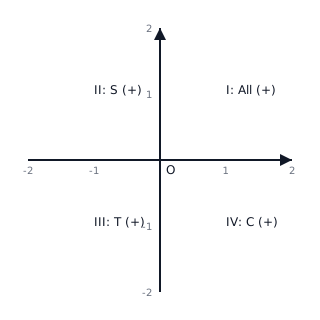
Coordinate plane showing the ASTC rule for trigonometric signs in each quadrant.
•

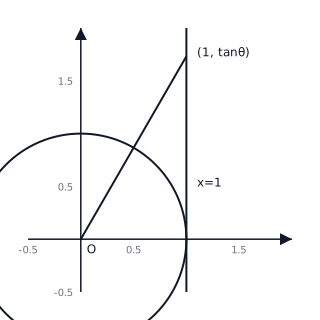
The tangent function tan⁡θ\tan \theta represents the slope of the terminal ray passing through the origin. Geometrically, it is the yy-coordinate of the point where the terminal ray intersects the vertical line x=1x = 1.

Diagram showing tangent as the intersection with the line x=1.
•

The Pythagorean Identity cos⁡2θ+sin⁡2θ=1\cos^2 \theta + \sin^2 \theta = 1 is derived directly from the equation of the unit circle x2+y2=1x^2 + y^2 = 1 by substituting x=cos⁡θx = \cos \theta and y=sin⁡θy = \sin \theta.

📐Formulae

cos⁡2θ+sin⁡2θ=1\cos^2 \theta + \sin^2 \theta = 1

tan⁡θ=sin⁡θcos⁡θ,cos⁡θ≠0\tan \theta = \frac{\sin \theta}{\cos \theta}, \cos \theta \neq 0

sin⁡(π−θ)=sin⁡θ\sin(\pi - \theta) = \sin \theta

cos⁡(π−θ)=−cos⁡θ\cos(\pi - \theta) = -\cos \theta

sin⁡(−θ)=−sin⁡θ\sin(-\theta) = -\sin \theta

cos⁡(−θ)=cos⁡θ\cos(-\theta) = \cos \theta

💡Examples

Problem 1:

Given that sin⁡θ=35\sin \theta = \frac{3}{5} and π2<θ<π\frac{\pi}{2} < \theta < \pi, find the exact value of cos⁡θ\cos \theta and tan⁡θ\tan \theta.

Solution:

sin⁡2θ+cos⁡2θ=1\sin^2 \theta + \cos^2 \theta = 1 (35)2+cos⁡2θ=1\left(\frac{3}{5}\right)^2 + \cos^2 \theta = 1 925+cos⁡2θ=1\frac{9}{25} + \cos^2 \theta = 1 cos⁡2θ=1−925=1625\cos^2 \theta = 1 - \frac{9}{25} = \frac{16}{25} cos⁡θ=±1625=±45\cos \theta = \pm \sqrt{\frac{16}{25}} = \pm \frac{4}{5} Since θ\theta is in the second quadrant (Q2Q2), cos⁡θ\cos \theta must be negative: cos⁡θ=−45\cos \theta = -\frac{4}{5} tan⁡θ=sin⁡θcos⁡θ=3/5−4/5=−34\tan \theta = \frac{\sin \theta}{\cos \theta} = \frac{3/5}{-4/5} = -\frac{3}{4}

Explanation:

We use the Pythagorean identity to find the magnitude of cos⁡θ\cos \theta. The quadrant information (π2<θ<π\frac{\pi}{2} < \theta < \pi) tells us the angle is in the second quadrant, where cosine and tangent are negative.

Problem 2:

Find the exact coordinates of the point on the unit circle corresponding to an angle of θ=7π6\theta = \frac{7\pi}{6}.

Solution:

The angle 7π6\frac{7\pi}{6} is in the third quadrant (Q3Q3). The reference angle is: θref=7π6−π=π6\theta_{ref} = \frac{7\pi}{6} - \pi = \frac{\pi}{6} The coordinates are (cos⁡θ,sin⁡θ)(\cos \theta, \sin \theta). In Q3Q3, both xx and yy are negative. cos⁡(7π6)=−cos⁡(π6)=−32\cos\left(\frac{7\pi}{6}\right) = -\cos\left(\frac{\pi}{6}\right) = -\frac{\sqrt{3}}{2} sin⁡(7π6)=−sin⁡(π6)=−12\sin\left(\frac{7\pi}{6}\right) = -\sin\left(\frac{\pi}{6}\right) = -\frac{1}{2} The coordinates are (−32,−12)\left(-\frac{\sqrt{3}}{2}, -\frac{1}{2}\right).

Explanation:

To find exact values for angles outside the first quadrant, identify the reference angle and apply the appropriate signs based on the quadrant (Quadrant III for 7π6\frac{7\pi}{6}).

Problem 3:

Determine the exact value of cos⁡(5π4)\cos(\frac{5\pi}{4}).

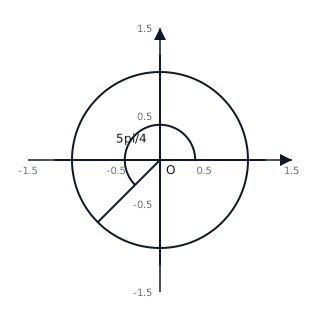
Unit circle showing an angle of 5pi/4 terminating in the third quadrant.

Solution:

  1. The angle θ=5π4\theta = \frac{5\pi}{4} lies in the third quadrant because π<5π4<3π2\pi < \frac{5\pi}{4} < \frac{3\pi}{2}.
  2. Calculate the reference angle θref=5π4−π=π4\theta_{ref} = \frac{5\pi}{4} - \pi = \frac{\pi}{4}.
  3. In the third quadrant, the cosine value is negative.
  4. cos⁡(5π4)=−cos⁡(π4)=−22\cos(\frac{5\pi}{4}) = -\cos(\frac{\pi}{4}) = -\frac{\sqrt{2}}{2}.

Explanation:

We identify the quadrant and the reference angle to apply the correct sign and known trigonometric ratio.

Problem 4:

Determine the exact value of sin⁡(5π3)\sin(\frac{5\pi}{3}) and identify the quadrant in which the terminal side of the angle lies.
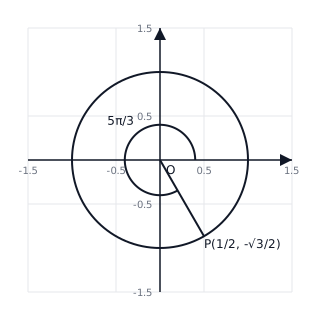
Unit circle diagram showing the angle 5π/3 terminating in the fourth quadrant at point (0.5, -0.866).

Solution:

  1. Identify the quadrant: 5π3\frac{5\pi}{3} is between 3π2\frac{3\pi}{2} (270∘270^\circ) and 2π2\pi (360∘360^\circ), so it lies in Quadrant IV.
  2. Find the reference angle: θref=2π−5π3=π3\theta_{ref} = 2\pi - \frac{5\pi}{3} = \frac{\pi}{3} (60∘60^\circ).
  3. Determine the sine value for the reference angle: sin⁡(π3)=32\sin(\frac{\pi}{3}) = \frac{\sqrt{3}}{2}.
  4. Apply the sign for Quadrant IV: In Quadrant IV, sine is negative. Therefore, sin⁡(5π3)=−32\sin(\frac{5\pi}{3}) = -\frac{\sqrt{3}}{2}.

Explanation:

The value is found by identifying the reference angle in the first quadrant and then applying the appropriate sign based on the ASTC rule (Quadrant IV: only Cosine is positive).