krit.club logo

Geometry and Trigonometry - Inverse trigonometric functions (HL)

Grade 12IB_AA

Review the key concepts, formulae, and examples before starting your quiz.

🔑Concepts

•

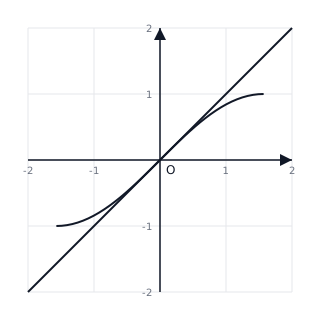
The function y=arcsin⁡(x)y = \arcsin(x) is the inverse of the sine function restricted to the domain [−π2,π2][-\frac{\pi}{2}, \frac{\pi}{2}]. Its domain is [−1,1][-1, 1] and its range is [−π2,π2][-\frac{\pi}{2}, \frac{\pi}{2}]. The graph is a reflection of the restricted sine curve over the line y=xy = x.

Graph of sine function and the line y=x illustrating the reflection for the inverse function.
•

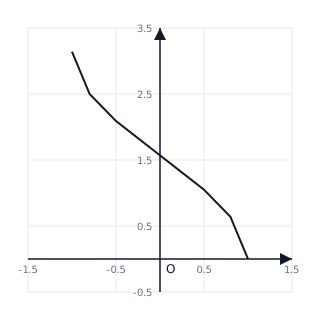
The function y=arccos⁡(x)y = \arccos(x) has a domain of [−1,1][-1, 1] and a range of [0,π][0, \pi]. It is strictly decreasing. Unlike arcsin⁡(x)\arcsin(x), which is an odd function, arccos⁡(x)\arccos(x) is neither even nor odd but satisfies the property arccos⁡(−x)=π−arccos⁡(x)\arccos(-x) = \pi - \arccos(x).

Graph showing the principal branch of arccos(x) from x=-1 to 1.
•

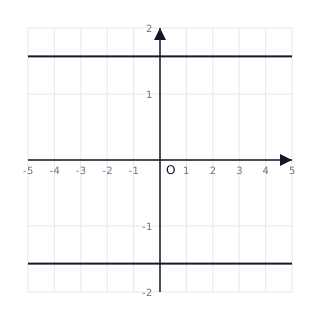
The function y=arctan⁡(x)y = \arctan(x) is defined for all x∈Rx \in \mathbb{R}. Its range is the open interval (−π2,π2)(-\frac{\pi}{2}, \frac{\pi}{2}). The graph has horizontal asymptotes at y=π2y = \frac{\pi}{2} and y=−π2y = -\frac{\pi}{2}.

Horizontal asymptotes for the arctan function.
•

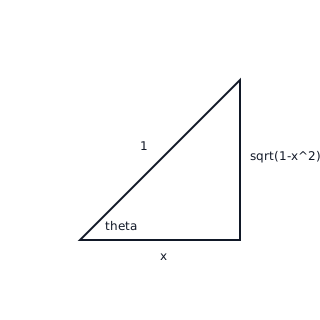
Right triangle relationships allow us to convert trigonometric expressions. For example, to find sin⁡(arccos⁡(x))\sin(\arccos(x)), we model a triangle with adjacent side xx and hypotenuse 11, leading to the opposite side 1−x2\sqrt{1-x^2} via Pythagoras.

Right triangle illustrating theta = arccos(x) with sides labeled.

📐Formulae

y=arcsin⁡(x)  ⟺  x=sin⁡(y),y∈[−π2,π2]y = \arcsin(x) \iff x = \sin(y), \quad y \in [-\frac{\pi}{2}, \frac{\pi}{2}]

y=arccos⁡(x)  ⟺  x=cos⁡(y),y∈[0,π]y = \arccos(x) \iff x = \cos(y), \quad y \in [0, \pi]

y=arctan⁡(x)  ⟺  x=tan⁡(y),y∈(−π2,π2)y = \arctan(x) \iff x = \tan(y), \quad y \in (-\frac{\pi}{2}, \frac{\pi}{2})

arcsin⁡(x)+arccos⁡(x)=π2,x∈[−1,1]\arcsin(x) + \arccos(x) = \frac{\pi}{2}, \quad x \in [-1, 1]

cos⁡(arcsin⁡(x))=1−x2\cos(\arcsin(x)) = \sqrt{1 - x^2}

sin⁡(arccos⁡(x))=1−x2\sin(\arccos(x)) = \sqrt{1 - x^2}

💡Examples

Problem 1:

Evaluate exactly: arccos⁡(−32)\arccos(-\frac{\sqrt{3}}{2}).

Solution:

Let θ=arccos⁡(−32)\theta = \arccos(-\frac{\sqrt{3}}{2}). This implies cos⁡(θ)=−32\cos(\theta) = -\frac{\sqrt{3}}{2} where θ∈[0,π]\theta \in [0, \pi]. Since the value is negative, θ\theta must be in the second quadrant. The reference angle for cos⁡(α)=32\cos(\alpha) = \frac{\sqrt{3}}{2} is π6\frac{\pi}{6}. Thus, θ=π−π6=5π6\theta = \pi - \frac{\pi}{6} = \frac{5\pi}{6}.

Explanation:

To evaluate inverse cosine, we find the unique angle in the range [0,π][0, \pi] that yields the given cosine value.

Problem 2:

Express tan⁡(arcsin⁡(x))\tan(\arcsin(x)) as an algebraic expression in terms of xx.

Solution:

Let θ=arcsin⁡(x)\theta = \arcsin(x), so sin⁡(θ)=x1\sin(\theta) = \frac{x}{1}. In a right-angled triangle, let the opposite side be xx and the hypotenuse be 11. Using Pythagoras' Theorem, the adjacent side is 12−x2\sqrt{1^2 - x^2}. Therefore, tan⁡(θ)=oppositeadjacent=x1−x2\tan(\theta) = \frac{\text{opposite}}{\text{adjacent}} = \frac{x}{\sqrt{1 - x^2}}.

Explanation:

By defining the inverse function as an angle in a right triangle, we can use the Pythagorean theorem to find the other trigonometric ratios.

Problem 3:

Solve for xx: 2arctan⁡(x)=π22\arctan(x) = \frac{\pi}{2}.

Solution:

2arctan⁡(x)=π2arctan⁡(x)=π4x=tan⁡(π4)x=1\begin{array}{r} 2\arctan(x) = \frac{\pi}{2} \\ \arctan(x) = \frac{\pi}{4} \\ x = \tan(\frac{\pi}{4}) \\ x = 1 \end{array}

Explanation:

Isolate the inverse trigonometric function and then apply the forward trigonometric function to both sides within the valid domain.

Problem 4:

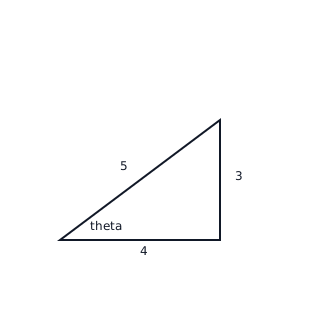
Given that θ=arctan⁡(34)\theta = \arctan(\frac{3}{4}), find the exact value of sin⁡(2θ)\sin(2\theta).

3-4-5 Right triangle representing arctan(3/4).

Solution:

  1. Let θ=arctan⁡(34)\theta = \arctan(\frac{3}{4}), then tan⁡(θ)=34\tan(\theta) = \frac{3}{4} for θ∈(0,π2)\theta \in (0, \frac{\pi}{2}).
  2. Construct a right triangle with opposite side 33 and adjacent side 44.
  3. Hypotenuse h=32+42=5h = \sqrt{3^2 + 4^2} = 5.
  4. Thus, sin⁡(θ)=35\sin(\theta) = \frac{3}{5} and cos⁡(θ)=45\cos(\theta) = \frac{4}{5}.
  5. Use the double angle identity: sin⁡(2θ)=2sin⁡(θ)cos⁡(θ)\sin(2\theta) = 2\sin(\theta)\cos(\theta).
  6. sin⁡(2θ)=2(35)(45)=2425\sin(2\theta) = 2(\frac{3}{5})(\frac{4}{5}) = \frac{24}{25}.

Explanation:

This problem uses the definition of inverse tangent to define a triangle and then applies double-angle trigonometric identities.

Problem 5:

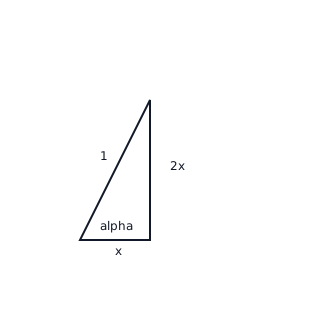
Solve for xx: arcsin⁡(2x)=arccos⁡(x)\arcsin(2x) = \arccos(x) for x>0x > 0.

Triangle with hypotenuse 1, base x, and height 2x representing the equation.

Solution:

  1. Let α=arcsin⁡(2x)\alpha = \arcsin(2x) and α=arccos⁡(x)\alpha = \arccos(x).
  2. This implies sin⁡(α)=2x\sin(\alpha) = 2x and cos⁡(α)=x\cos(\alpha) = x.
  3. Use the identity sin⁡2(α)+cos⁡2(α)=1\sin^2(\alpha) + \cos^2(\alpha) = 1.
  4. Substitute the values: (2x)2+(x)2=1(2x)^2 + (x)^2 = 1.
  5. 4x2+x2=1  ⟹  5x2=14x^2 + x^2 = 1 \implies 5x^2 = 1.
  6. x2=15  ⟹  x=15x^2 = \frac{1}{5} \implies x = \frac{1}{\sqrt{5}} (since x>0x > 0).

Explanation:

By setting the two inverse functions equal to an angle, we can relate xx to the Pythagorean identity.