krit.club logo

Geometry and Trigonometry - More trigonometric equations – identities

Grade 12IB_AA

Review the key concepts, formulae, and examples before starting your quiz.

🔑Concepts

•

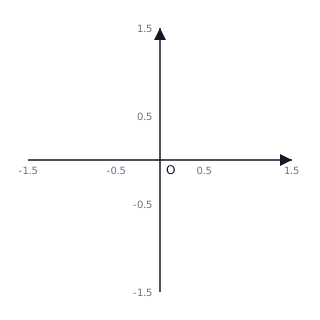
The Pythagorean identity sin⁡2θ+cos⁡2θ=1\sin^2 \theta + \cos^2 \theta = 1 is derived from the unit circle, where any point (x,y)(x, y) on the circumference satisfies x=cos⁡θx = \cos \theta and y=sin⁡θy = \sin \theta. This identity allows us to transform equations involving mixed terms of sin⁡2θ\sin^2 \theta and cos⁡2θ\cos^2 \theta into a single trigonometric ratio.

Unit circle demonstrating the relationship between coordinates and trigonometric ratios.
•

Double angle identities for cos⁡2θ\cos 2\theta provide three forms: cos⁡2θ−sin⁡2θ\cos^2 \theta - \sin^2 \theta, 2cos⁡2θ−12\cos^2 \theta - 1, and 1−2sin⁡2θ1 - 2\sin^2 \theta. Selecting the correct form is crucial for solving equations. For example, if the equation also contains a cos⁡θ\cos \theta term, use 2cos⁡2θ−12\cos^2 \theta - 1 to create a quadratic in terms of cosine.
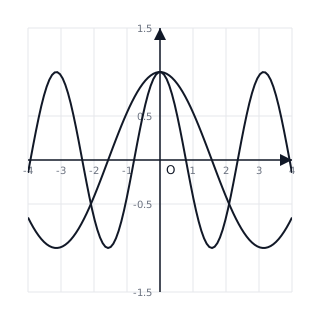
Comparison graph of cos(x) and cos(2x) showing period change.
•

Solving trigonometric equations often requires recognizing a quadratic structure. For an equation like asin⁡2x+bsin⁡x+c=0a \sin^2 x + b \sin x + c = 0, we substitute u=sin⁡xu = \sin x to solve for uu first, then determine the values of xx within the specified domain.

Flowchart showing the substitution method for solving quadratic trigonometric equations.
•

Compound angle identities such as sin⁡(A+B)\sin(A+B) allow us to expand or contract expressions. These are particularly useful when solving equations where the argument of the function is a sum or difference, or when finding exact values for non-standard angles.
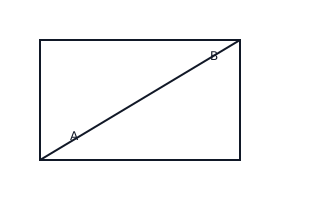
Geometry representation of compound angles.

📐Formulae

sin⁡2θ+cos⁡2θ=1\sin^2 \theta + \cos^2 \theta = 1

tan⁡θ=sin⁡θcos⁡θ\tan \theta = \frac{\sin \theta}{\cos \theta}

sin⁡2θ=2sin⁡θcos⁡θ\sin 2\theta = 2 \sin \theta \cos \theta

cos⁡2θ=cos⁡2θ−sin⁡2θ=2cos⁡2θ−1=1−2sin⁡2θ\cos 2\theta = \cos^2 \theta - \sin^2 \theta = 2\cos^2 \theta - 1 = 1 - 2\sin^2 \theta

tan⁡2θ=2tan⁡θ1−tan⁡2θ\tan 2\theta = \frac{2 \tan \theta}{1 - \tan^2 \theta}

sin⁡(A±B)=sin⁡Acos⁡B±cos⁡Asin⁡B\sin(A \pm B) = \sin A \cos B \pm \cos A \sin B

cos⁡(A±B)=cos⁡Acos⁡B∓sin⁡Asin⁡B\cos(A \pm B) = \cos A \cos B \mp \sin A \sin B

💡Examples

Problem 1:

Solve the equation cos⁡2x=sin⁡x\cos 2x = \sin x for 0≤x≤2π0 \le x \le 2\pi.

Solution:

1−2sin⁡2x=sin⁡x1 - 2\sin^2 x = \sin x 2sin⁡2x+sin⁡x−1=02\sin^2 x + \sin x - 1 = 0 (2sin⁡x−1)(sin⁡x+1)=0(2\sin x - 1)(\sin x + 1) = 0 sin⁡x=12 or sin⁡x=−1\sin x = \frac{1}{2} \text{ or } \sin x = -1 For sin⁡x=12\sin x = \frac{1}{2}, x=π6,5π6x = \frac{\pi}{6}, \frac{5\pi}{6}. For sin⁡x=−1\sin x = -1, x=3π2x = \frac{3\pi}{2}. The solution set is x∈{π6,5π6,3π2}x \in \{\frac{\pi}{6}, \frac{5\pi}{6}, \frac{3\pi}{2}\}.

Explanation:

First, the double angle identity cos⁡2x=1−2sin⁡2x\cos 2x = 1 - 2\sin^2 x is used to express the entire equation in terms of sin⁡x\sin x. The resulting quadratic equation is factored. Then, the basic trigonometric equations are solved within the given domain.

Problem 2:

Solve 2cos⁡2x+3sin⁡x−3=02\cos^2 x + 3\sin x - 3 = 0 for 0∘≤x≤360∘0^\circ \le x \le 360^\circ.

Solution:

2(1−sin⁡2x)+3sin⁡x−3=02(1 - \sin^2 x) + 3\sin x - 3 = 0 2−2sin⁡2x+3sin⁡x−3=02 - 2\sin^2 x + 3\sin x - 3 = 0 −2sin⁡2x+3sin⁡x−1=0-2\sin^2 x + 3\sin x - 1 = 0 2sin⁡2x−3sin⁡x+1=02\sin^2 x - 3\sin x + 1 = 0 (2sin⁡x−1)(sin⁡x−1)=0(2\sin x - 1)(\sin x - 1) = 0 sin⁡x=12  ⟹  x=30∘,150∘\sin x = \frac{1}{2} \implies x = 30^\circ, 150^\circ sin⁡x=1  ⟹  x=90∘\sin x = 1 \implies x = 90^\circ

Explanation:

The Pythagorean identity cos⁡2x=1−sin⁡2x\cos^2 x = 1 - \sin^2 x is substituted into the equation to create a quadratic in terms of sin⁡x\sin x. After simplifying and factoring, the values for xx are found in degrees.

Problem 3:

Given that sin⁡A=35\sin A = \frac{3}{5} and AA is obtuse, find the exact value of sin⁡2A\sin 2A.

Solution:

Since sin⁡2A+cos⁡2A=1\sin^2 A + \cos^2 A = 1: cos⁡2A=1−(35)2=1625\cos^2 A = 1 - (\frac{3}{5})^2 = \frac{16}{25} Since AA is obtuse (Quadrant II), cos⁡A\cos A must be negative: cos⁡A=−45\cos A = -\frac{4}{5} Now use the double angle formula: sin⁡2A=2sin⁡Acos⁡A=2(35)(−45)=−2425\sin 2A = 2\sin A \cos A = 2(\frac{3}{5})(-\frac{4}{5}) = -\frac{24}{25}

Explanation:

To find sin⁡2A\sin 2A, we need both sin⁡A\sin A and cos⁡A\cos A. We find cos⁡A\cos A using the Pythagorean identity, being careful to choose the negative root because the angle is in the second quadrant. Finally, we apply the double angle identity.

Problem 4:

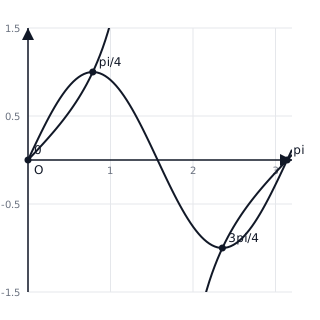
Solve the equation sin⁡2x=tan⁡x\sin 2x = \tan x for 0≤x≤π0 \le x \le \pi.

Graph of sin(2x) and tan(x) showing intersections at 0, pi/4, 3pi/4, and pi.

Solution:

  1. Use the double angle identity sin⁡2x=2sin⁡xcos⁡x\sin 2x = 2 \sin x \cos x and the identity tan⁡x=sin⁡xcos⁡x\tan x = \frac{\sin x}{\cos x}: 2sin⁡xcos⁡x=sin⁡xcos⁡x2 \sin x \cos x = \frac{\sin x}{\cos x}
  2. Rearrange the equation (multiply by cos⁡x\cos x, noting cos⁡x≠0\cos x \neq 0): 2sin⁡xcos⁡2x−sin⁡x=02 \sin x \cos^2 x - \sin x = 0
  3. Factor out sin⁡x\sin x: sin⁡x(2cos⁡2x−1)=0\sin x (2 \cos^2 x - 1) = 0
  4. Set each factor to zero: sin⁡x=0  ⟹  x=0,π\sin x = 0 \implies x = 0, \pi 2cos⁡2x−1=0  ⟹  cos⁡2x=12  ⟹  cos⁡x=±122 \cos^2 x - 1 = 0 \implies \cos^2 x = \frac{1}{2} \implies \cos x = \pm \frac{1}{\sqrt{2}}
  5. Solve for xx in the interval [0,π][0, \pi]: For cos⁡x=12\cos x = \frac{1}{\sqrt{2}}, x=π4x = \frac{\pi}{4} For cos⁡x=−12\cos x = -\frac{1}{\sqrt{2}}, x=3π4x = \frac{3\pi}{4} Final solutions: x∈{0,π4,3π4,π}x \in \{0, \frac{\pi}{4}, \frac{3\pi}{4}, \pi\}.

Explanation:

This example uses the substitution of both a double angle identity and the tangent identity to factorize the equation. It is important to factorize rather than divide by sin⁡x\sin x to avoid losing solutions.

Problem 5:

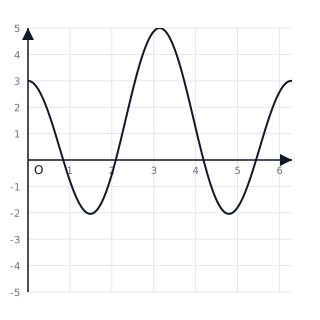
Solve 3cos⁡2x−cos⁡x+1=03\cos 2x - \cos x + 1 = 0 for 0≤x≤2π0 \le x \le 2\pi.

Plot of f(x) = 3cos(2x) - cos(x) + 1 showing the four x-intercepts in the given range.

Solution:

  1. Replace cos⁡2x\cos 2x with the form that involves only cos⁡x\cos x: 3(2cos⁡2x−1)−cos⁡x+1=03(2\cos^2 x - 1) - \cos x + 1 = 0
  2. Expand and simplify to form a quadratic equation: 6cos⁡2x−3−cos⁡x+1=06\cos^2 x - 3 - \cos x + 1 = 0 6cos⁡2x−cos⁡x−2=06\cos^2 x - \cos x - 2 = 0
  3. Let u=cos⁡xu = \cos x. Factor the quadratic 6u2−u−2=06u^2 - u - 2 = 0: (3u−2)(2u+1)=0(3u - 2)(2u + 1) = 0
  4. Solve for uu: u=23u = \frac{2}{3} or u=−12u = -\frac{1}{2}
  5. Find values of xx for cos⁡x=23\cos x = \frac{2}{3}: x≈0.841,5.44x \approx 0.841, 5.44 (using calculator)
  6. Find values of xx for cos⁡x=−12\cos x = -\frac{1}{2}: x=2π3,4π3x = \frac{2\pi}{3}, \frac{4\pi}{3} (x≈2.09,4.19x \approx 2.09, 4.19) Final solution set: x≈{0.841,2.09,4.19,5.44}x \approx \{0.841, 2.09, 4.19, 5.44\}.

Explanation:

By choosing the cos⁡2x=2cos⁡2x−1\cos 2x = 2\cos^2 x - 1 identity, we transform the equation into a standard quadratic form which can be factored.