
Review the key concepts, formulae, and examples before starting your quiz.
🔑Concepts
The length of the space diagonal in a rectangular prism (cuboid) is the distance between two opposite vertices. For a cuboid with dimensions , , and , it is given by .
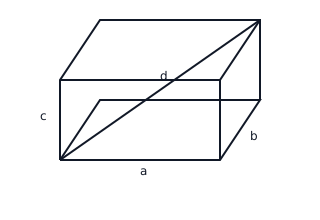
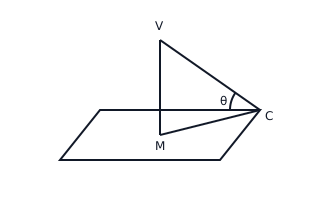
The angle between a line and a plane is the angle between the line and its orthogonal projection onto that plane. In a right pyramid, this often involves finding the angle between a slant edge and the diagonal of the base.
The distance between two points and in 3D Cartesian space is the length of the straight line segment connecting them, derived from the Pythagorean theorem.
Surface area and volume of 3D shapes often require finding 'hidden' lengths, such as the slant height () of a cone or pyramid, using where is the vertical height.
📐Formulae
💡Examples
Problem 1:
Calculate the distance between the points and .
Solution:
Explanation:
Apply the 3D distance formula by substituting the coordinates of and into .
Problem 2:
A square-based pyramid has a base side length of cm and a vertical height of cm. Find the angle that a slant edge makes with the base.
Solution:
- Find the distance from a corner of the base to the center of the base: The diagonal of the base is . The distance from the corner to the center is .
- Use the tangent ratio in the right-angled triangle formed by the height (), the distance to center (), and the slant edge:
Explanation:
First, find the horizontal distance from the base corner to the center of the base (half the diagonal). Then, use the vertical height and this horizontal distance as the opposite and adjacent sides of a right-angled triangle to find the angle.
Problem 3:
A cuboid has dimensions cm by cm by cm. Find the length of the space diagonal.
Solution:
Explanation:
Use the 3D Pythagorean theorem to find the distance between two opposite corners of the cuboid.
Problem 4:
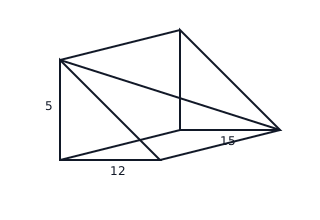
A right triangular prism has a length of cm. The triangular cross-section is a right-angled triangle with legs of cm and cm. Find the distance between the two furthest vertices of the prism.
Solution:
- Identify the dimensions: , , and height (length of prism) .
- The distance between the two furthest vertices is the space diagonal of the bounding box (or the hypotenuse of the triangle formed by the base hypotenuse and the prism length).
- First, find the hypotenuse of the triangular base:
- Now find the space diagonal () using the base hypotenuse and the prism length:
Explanation:
The furthest distance in a prism is between opposite corners. We first solve for the diagonal of one face (the hypotenuse of the triangle) and then use that result with the prism's length in a second Pythagorean calculation.
Problem 5:
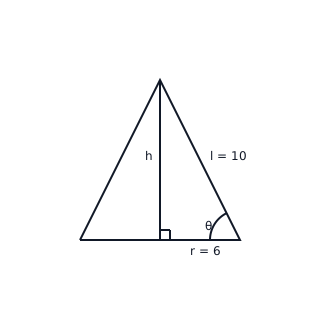
A right cone has a base radius of cm and a slant height cm. Calculate the vertical height of the cone and the angle that the slant edge makes with the horizontal base.
Solution:
-
Using the Pythagorean theorem in the right-angled triangle formed by the radius, vertical height, and slant height:
-
To find the angle between the slant height and the base radius:
Explanation:
In 3D geometry, many problems involving cones or pyramids can be reduced to 2D right-angled triangle problems. Here, the vertical height, radius, and slant height form a right triangle. We apply the Pythagorean theorem for length and basic trigonometry for the angle of elevation.