🚀 50 free questions/month

Geometry and Trigonometry - Planes (HL)

Grade 12IB_AA

🔑Concepts

•

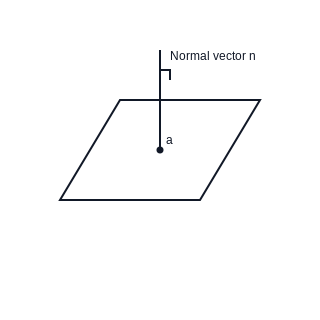
The vector equation of a plane can be defined using a position vector a\mathbf{a} of a point on the plane and two non-parallel direction vectors u\mathbf{u} and v\mathbf{v} that lie within (or are parallel to) the plane: r=a+λu+μv\mathbf{r} = \mathbf{a} + \lambda \mathbf{u} + \mu \mathbf{v}. Alternatively, the normal form uses a vector n\mathbf{n} perpendicular to the plane: r⋅n=a⋅n\mathbf{r} \cdot \mathbf{n} = \mathbf{a} \cdot \mathbf{n}.

A parallelogram representing a plane with a perpendicular normal vector n and a point a on the surface.
•

The Cartesian equation of a plane is given by ax+by+cz=dax + by + cz = d, where the vector (abc)\begin{pmatrix} a \\ b \\ c \end{pmatrix} represents the normal vector n\mathbf{n} to the plane. The constant dd is determined by substituting a known point on the plane into the equation.

•

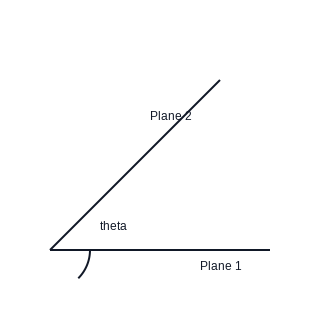
The angle between two planes is equivalent to the acute angle between their normal vectors n1\mathbf{n_1} and n2\mathbf{n_2}. It is calculated using the dot product: cos⁡θ=∣n1⋅n2∣∣n1∣∣n2∣\cos \theta = \frac{|\mathbf{n_1} \cdot \mathbf{n_2}|}{|\mathbf{n_1}| |\mathbf{n_2}|}.

Two intersecting lines representing planes viewed from the edge, showing the angle theta between them.
•

The shortest distance from a point to a plane is the length of the perpendicular segment from the point (x0,y0,z0)(x_0, y_0, z_0) to the plane ax+by+cz=dax + by + cz = d. This is given by the formula D=∣ax0+by0+cz0−d∣a2+b2+c2D = \frac{|ax_0 + by_0 + cz_0 - d|}{\sqrt{a^2 + b^2 + c^2}}.

📐Formulae

r=a+λu+μv\mathbf{r} = \mathbf{a} + \lambda \mathbf{u} + \mu \mathbf{v}

r⋅n=d\mathbf{r} \cdot \mathbf{n} = d

ax+by+cz=dax + by + cz = d

cos⁡θ=∣n1⋅n2∣∣n1∣∣n2∣\cos \theta = \frac{|\mathbf{n_1} \cdot \mathbf{n_2}|}{|\mathbf{n_1}| |\mathbf{n_2}|}

sin⁡ϕ=∣d⋅n∣∣d∣∣n∣\sin \phi = \frac{|\mathbf{d} \cdot \mathbf{n}|}{|\mathbf{d}| |\mathbf{n}|}

D=∣ax0+by0+cz0−d∣a2+b2+c2D = \frac{|ax_0 + by_0 + cz_0 - d|}{\sqrt{a^2 + b^2 + c^2}}

💡Examples

Problem 1:

Find the Cartesian equation of the plane passing through the point P(1,−2,3)P(1, -2, 3) with normal vector n=(25−1)\mathbf{n} = \begin{pmatrix} 2 \\ 5 \\ -1 \end{pmatrix}.

Solution:

Using the scalar product form r⋅n=a⋅n\mathbf{r} \cdot \mathbf{n} = \mathbf{a} \cdot \mathbf{n}: 2(x)+5(y)−1(z)=2(1)+5(−2)−1(3)2(x) + 5(y) - 1(z) = 2(1) + 5(-2) - 1(3) 2x+5y−z=2−10−32x + 5y - z = 2 - 10 - 3 2x+5y−z=−112x + 5y - z = -11

Explanation:

The coefficients of x,y,zx, y, z in the Cartesian equation are the components of the normal vector. We calculate the constant dd by substituting the coordinates of point PP into the equation.

Problem 2:

Find the acute angle between the plane x+2y−2z=5x + 2y - 2z = 5 and the line r=\mathbf{r} = (012)\begin{pmatrix} 0 \\ 1 \\ 2 \end{pmatrix} +t(1−11) + t \begin{pmatrix} 1 \\ -1 \\ 1 \end{pmatrix}.

Solution:

The normal vector of the plane is n=(12−2)\mathbf{n} = \begin{pmatrix} 1 \\ 2 \\ -2 \end{pmatrix} and the direction vector of the line is d=(1−11)\mathbf{d} = \begin{pmatrix} 1 \\ -1 \\ 1 \end{pmatrix}. Calculate ∣n∣=12+22+(−2)2=3|\mathbf{n}| = \sqrt{1^2 + 2^2 + (-2)^2} = 3. Calculate ∣d∣=12+(−1)2+12=3|\mathbf{d}| = \sqrt{1^2 + (-1)^2 + 1^2} = \sqrt{3}. Calculate ∣n⋅d∣=∣(1)(1)+(2)(−1)+(−2)(1)∣=∣1−2−2∣=∣−3∣=3|\mathbf{n} \cdot \mathbf{d}| = |(1)(1) + (2)(-1) + (-2)(1)| = |1 - 2 - 2| = |-3| = 3. Using sin⁡ϕ=∣n⋅d∣∣n∣∣d∣\sin \phi = \frac{|\mathbf{n} \cdot \mathbf{d}|}{|\mathbf{n}| |\mathbf{d}|}: sin⁡ϕ=333=13\sin \phi = \frac{3}{3\sqrt{3}} = \frac{1}{\sqrt{3}} ϕ=arcsin⁡(13)≈35.3∘\phi = \arcsin\left(\frac{1}{\sqrt{3}}\right) \approx 35.3^\circ

Explanation:

The angle between a line and a plane is the complement of the angle between the line's direction and the plane's normal. Therefore, we use the sine function instead of cosine.

Problem 3:

Determine the coordinates of the point of intersection between the line x−12=y+13=z1\frac{x-1}{2} = \frac{y+1}{3} = \frac{z}{1} and the plane 3x−y+2z=123x - y + 2z = 12.

Solution:

Express the line in parametric form: x=1+2tx = 1 + 2t, y=−1+3ty = -1 + 3t, z=tz = t. Substitute these into the plane equation: 3(1+2t)−(−1+3t)+2(t)=123(1 + 2t) - (-1 + 3t) + 2(t) = 12 3+6t+1−3t+2t=123 + 6t + 1 - 3t + 2t = 12 5t+4=125t + 4 = 12 5t=8  ⟹  t=1.65t = 8 \implies t = 1.6 Substitute t=1.6t = 1.6 back into parametric equations: x=1+2(1.6)=4.2x = 1 + 2(1.6) = 4.2 y=−1+3(1.6)=3.8y = -1 + 3(1.6) = 3.8 z=1.6z = 1.6 Point of intersection: (4.2,3.8,1.6)(4.2, 3.8, 1.6)

Explanation:

To find where a line intersects a plane, convert the line to parametric form, substitute the expressions for x,y,zx, y, z into the plane's Cartesian equation, solve for the parameter tt, and then find the coordinates.

Problem 4:

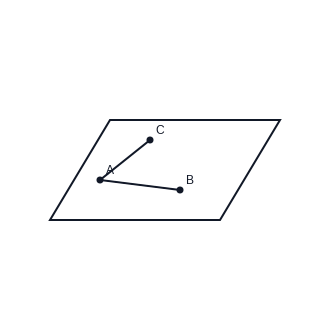
Find the equation of the plane that contains the points A(1,0,2)A(1, 0, 2), B(2,−1,3)B(2, -1, 3), and C(0,2,4)C(0, 2, 4). Express the answer in the form ax+by+cz=dax + by + cz = d.

A plane containing three points A, B, and C with vectors AB and AC drawn.

Solution:

  1. Find two vectors in the plane: AB⃗=(2−1−1−03−2)=(1−11)\vec{AB} = \begin{pmatrix} 2-1 \\ -1-0 \\ 3-2 \end{pmatrix} = \begin{pmatrix} 1 \\ -1 \\ 1 \end{pmatrix} and AC⃗=(0−12−04−2)=(−122)\vec{AC} = \begin{pmatrix} 0-1 \\ 2-0 \\ 4-2 \end{pmatrix} = \begin{pmatrix} -1 \\ 2 \\ 2 \end{pmatrix}.
  2. Find the normal vector n=AB⃗×AC⃗\mathbf{n} = \vec{AB} \times \vec{AC}: n=∣ijk1−11−122∣=i(−2−2)−j(2−(−1))+k(2−1)=(−4−31)\mathbf{n} = \begin{vmatrix} \mathbf{i} & \mathbf{j} & \mathbf{k} \\ 1 & -1 & 1 \\ -1 & 2 & 2 \end{vmatrix} = \mathbf{i}(-2-2) - \mathbf{j}(2 - (-1)) + \mathbf{k}(2 - 1) = \begin{pmatrix} -4 \\ -3 \\ 1 \end{pmatrix}.
  3. Use the point A(1,0,2)A(1, 0, 2): −4(1)−3(0)+1(2)=−4+2=−2-4(1) - 3(0) + 1(2) = -4 + 2 = -2.
  4. The equation is −4x−3y+z=−2-4x - 3y + z = -2, or 4x+3y−z=24x + 3y - z = 2.

Explanation:

To define a plane, we need a normal vector. We find this by taking the cross product of two vectors that lie within the plane (formed by the three given points). Then, use the scalar product with a point to find the constant dd.

Problem 5:

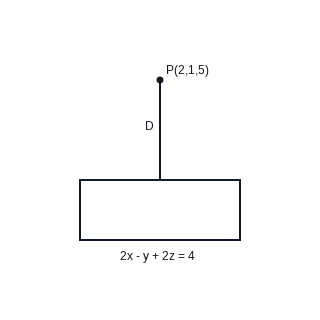
Calculate the shortest distance from the point P(2,1,5)P(2, 1, 5) to the plane 2x−y+2z=42x - y + 2z = 4.

A point P above a plane with a vertical dashed line labeled D representing the shortest distance.

Solution:

  1. Identify a=2,b=−1,c=2,d=4a=2, b=-1, c=2, d=4 and the point (x0,y0,z0)=(2,1,5)(x_0, y_0, z_0) = (2, 1, 5).
  2. Substitute into the distance formula: D=∣2(2)+(−1)(1)+2(5)−4∣22+(−1)2+22D = \frac{|2(2) + (-1)(1) + 2(5) - 4|}{\sqrt{2^2 + (-1)^2 + 2^2}}.
  3. Simplify the numerator: ∣4−1+10−4∣=∣9∣=9|4 - 1 + 10 - 4| = |9| = 9.
  4. Simplify the denominator: 4+1+4=9=3\sqrt{4 + 1 + 4} = \sqrt{9} = 3.
  5. D=93=3D = \frac{9}{3} = 3.

Explanation:

The shortest distance is the perpendicular distance. We apply the standard formula which projects the vector from the plane to the point onto the normal vector.

Finished reading?

Practice Planes (HL) with a worksheet. Answers included.