πŸš€ 50 free questions/month

Geometry and Trigonometry - Vector (Cross) product (HL)

Grade 12IB_AA

πŸ”‘Concepts

β€’

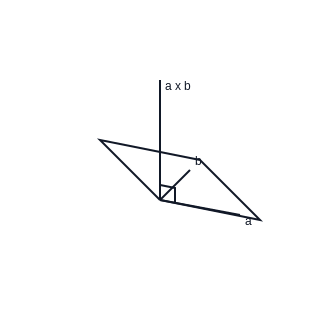
The vector (cross) product a⃗×b⃗\vec{a} \times \vec{b} results in a vector that is perpendicular to both a⃗\vec{a} and b⃗\vec{b}, satisfying the right-hand rule. If a⃗\vec{a} and b⃗\vec{b} are parallel, their cross product is the zero vector 0⃗\vec{0}.

Diagram showing vectors a and b in a plane with their cross product vector perpendicular to that plane.
β€’

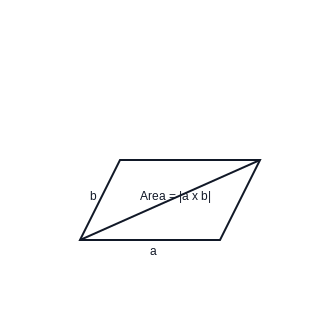
The magnitude of the cross product, ∣aβƒ—Γ—bβƒ—βˆ£|\vec{a} \times \vec{b}|, represents the area of the parallelogram formed by the two vectors. Consequently, the area of a triangle formed by these vectors is 12∣aβƒ—Γ—bβƒ—βˆ£\frac{1}{2}|\vec{a} \times \vec{b}|.

A parallelogram defined by vectors a and b showing the area calculation.
β€’

The cross product is anti-commutative, meaning aβƒ—Γ—bβƒ—=βˆ’(bβƒ—Γ—aβƒ—)\vec{a} \times \vec{b} = -(\vec{b} \times \vec{a}). It is also distributive over addition: aβƒ—Γ—(bβƒ—+cβƒ—)=aβƒ—Γ—bβƒ—+aβƒ—Γ—cβƒ—\vec{a} \times (\vec{b} + \vec{c}) = \vec{a} \times \vec{b} + \vec{a} \times \vec{c}.

β€’

Algebraically, the cross product is calculated using the determinant of a 3Γ—33 \times 3 matrix with unit vectors i,j,k\mathbf{i}, \mathbf{j}, \mathbf{k} in the first row.

πŸ“Formulae

aβƒ—Γ—bβƒ—=(a2b3βˆ’a3b2a3b1βˆ’a1b3a1b2βˆ’a2b1)\vec{a} \times \vec{b} = \begin{pmatrix} a_2b_3 - a_3b_2 \\ a_3b_1 - a_1b_3 \\ a_1b_2 - a_2b_1 \end{pmatrix}

aβƒ—Γ—bβƒ—=∣ijka1a2a3b1b2b3∣\vec{a} \times \vec{b} = \begin{vmatrix} \mathbf{i} & \mathbf{j} & \mathbf{k} \\ a_1 & a_2 & a_3 \\ b_1 & b_2 & b_3 \end{vmatrix}

∣aβƒ—Γ—bβƒ—βˆ£=∣aβƒ—βˆ£βˆ£bβƒ—βˆ£sin⁑θ|\vec{a} \times \vec{b}| = |\vec{a}| |\vec{b}| \sin \theta

AreaΒ ofΒ aΒ parallelogram=∣aβƒ—Γ—bβƒ—βˆ£\text{Area of a parallelogram} = |\vec{a} \times \vec{b}|

AreaΒ ofΒ aΒ triangle=12∣aβƒ—Γ—bβƒ—βˆ£\text{Area of a triangle} = \frac{1}{2} |\vec{a} \times \vec{b}|

πŸ’‘Examples

Problem 1:

Given vectors aβƒ—=(12βˆ’1)\vec{a} = \begin{pmatrix} 1 \\ 2 \\ -1 \end{pmatrix} and bβƒ—=(302)\vec{b} = \begin{pmatrix} 3 \\ 0 \\ 2 \end{pmatrix}, calculate aβƒ—Γ—bβƒ—\vec{a} \times \vec{b}.

Solution:

We use the determinant method: aβƒ—Γ—bβƒ—=∣ijk12βˆ’1302∣\vec{a} \times \vec{b} = \begin{vmatrix} \mathbf{i} & \mathbf{j} & \mathbf{k} \\ 1 & 2 & -1 \\ 3 & 0 & 2 \end{vmatrix} =i(2Γ—2βˆ’(βˆ’1)Γ—0)βˆ’j(1Γ—2βˆ’(βˆ’1)Γ—3)+k(1Γ—0βˆ’2Γ—3)= \mathbf{i}(2 \times 2 - (-1) \times 0) - \mathbf{j}(1 \times 2 - (-1) \times 3) + \mathbf{k}(1 \times 0 - 2 \times 3) =i(4)βˆ’j(2+3)+k(βˆ’6)= \mathbf{i}(4) - \mathbf{j}(2 + 3) + \mathbf{k}(-6) =4iβˆ’5jβˆ’6k= 4\mathbf{i} - 5\mathbf{j} - 6\mathbf{k} So, aβƒ—Γ—bβƒ—=(4βˆ’5βˆ’6)\vec{a} \times \vec{b} = \begin{pmatrix} 4 \\ -5 \\ -6 \end{pmatrix}.

Explanation:

To find the cross product, we set up a 3×33 \times 3 determinant with unit vectors i,j,k\mathbf{i}, \mathbf{j}, \mathbf{k} in the first row and the components of a⃗\vec{a} and b⃗\vec{b} in the subsequent rows.

Problem 2:

Find the area of the triangle with vertices A(1,3,2)A(1, 3, 2), B(2,βˆ’1,0)B(2, -1, 0), and C(βˆ’1,2,3)C(-1, 2, 3).

Solution:

First, find two vectors forming the sides of the triangle: ABβƒ—=(2βˆ’1βˆ’1βˆ’30βˆ’2)=(1βˆ’4βˆ’2)\vec{AB} = \begin{pmatrix} 2-1 \\ -1-3 \\ 0-2 \end{pmatrix} = \begin{pmatrix} 1 \\ -4 \\ -2 \end{pmatrix} ACβƒ—=(βˆ’1βˆ’12βˆ’33βˆ’2)=(βˆ’2βˆ’11)\vec{AC} = \begin{pmatrix} -1-1 \\ 2-3 \\ 3-2 \end{pmatrix} = \begin{pmatrix} -2 \\ -1 \\ 1 \end{pmatrix}

Next, calculate the cross product ABβƒ—Γ—ACβƒ—\vec{AB} \times \vec{AC}: ABβƒ—Γ—ACβƒ—=∣ijk1βˆ’4βˆ’2βˆ’2βˆ’11∣=((βˆ’4)(1)βˆ’(βˆ’2)(βˆ’1)βˆ’[(1)(1)βˆ’(βˆ’2)(βˆ’2)](1)(βˆ’1)βˆ’(βˆ’4)(βˆ’2))\vec{AB} \times \vec{AC} = \begin{vmatrix} \mathbf{i} & \mathbf{j} & \mathbf{k} \\ 1 & -4 & -2 \\ -2 & -1 & 1 \end{vmatrix} = \begin{pmatrix} (-4)(1) - (-2)(-1) \\ -[(1)(1) - (-2)(-2)] \\ (1)(-1) - (-4)(-2) \end{pmatrix} = (βˆ’63βˆ’9)\begin{pmatrix} -6 \\ 3 \\ -9 \end{pmatrix}

Now, find the magnitude of this vector: ∣ABβƒ—Γ—ACβƒ—βˆ£=(βˆ’6)2+32+(βˆ’9)2=36+9+81=126|\vec{AB} \times \vec{AC}| = \sqrt{(-6)^2 + 3^2 + (-9)^2} = \sqrt{36 + 9 + 81} = \sqrt{126}

The area of the triangle is 12∣ABβƒ—Γ—ACβƒ—βˆ£\frac{1}{2} |\vec{AB} \times \vec{AC}|: Area=12126=129Γ—14=3142\text{Area} = \frac{1}{2} \sqrt{126} = \frac{1}{2} \sqrt{9 \times 14} = \frac{3\sqrt{14}}{2}

Explanation:

The area of a triangle formed by two vectors is half the magnitude of their cross product. We first determine the vectors relative to a common vertex, then compute the cross product and its magnitude.

Problem 3:

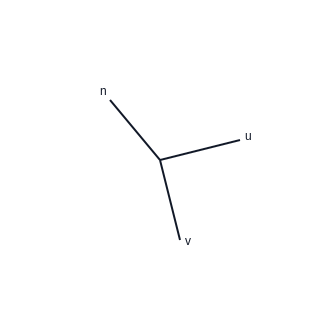
Find a unit vector that is perpendicular to both uβƒ—=2i+jβˆ’2k\vec{u} = 2\mathbf{i} + \mathbf{j} - 2\mathbf{k} and vβƒ—=3iβˆ’2j+k\vec{v} = 3\mathbf{i} - 2\mathbf{j} + \mathbf{k}.

Illustration of two vectors u and v and the resulting perpendicular unit vector n.

Solution:

Step 1: Calculate the cross product uβƒ—Γ—vβƒ—\vec{u} \times \vec{v}. uβƒ—Γ—vβƒ—=∣ijk21βˆ’23βˆ’21∣\vec{u} \times \vec{v} = \begin{vmatrix} \mathbf{i} & \mathbf{j} & \mathbf{k} \\ 2 & 1 & -2 \\ 3 & -2 & 1 \end{vmatrix} uβƒ—Γ—vβƒ—=i(1βˆ’4)βˆ’j(2βˆ’(βˆ’6))+k(βˆ’4βˆ’3)\vec{u} \times \vec{v} = \mathbf{i}(1 - 4) - \mathbf{j}(2 - (-6)) + \mathbf{k}(-4 - 3) uβƒ—Γ—vβƒ—=βˆ’3iβˆ’8jβˆ’7k\vec{u} \times \vec{v} = -3\mathbf{i} - 8\mathbf{j} - 7\mathbf{k} Step 2: Find the magnitude of the resulting vector. ∣uβƒ—Γ—vβƒ—βˆ£=(βˆ’3)2+(βˆ’8)2+(βˆ’7)2=9+64+49=122|\vec{u} \times \vec{v}| = \sqrt{(-3)^2 + (-8)^2 + (-7)^2} = \sqrt{9 + 64 + 49} = \sqrt{122} Step 3: Normalize the vector to find the unit vector n^\hat{n}. n^=Β±1122(βˆ’3βˆ’8βˆ’7)\hat{n} = \pm \frac{1}{\sqrt{122}} \begin{pmatrix} -3 \\ -8 \\ -7 \end{pmatrix}

Explanation:

To find a vector perpendicular to two given vectors, use the cross product. Normalizing the resulting vector (dividing by its magnitude) produces the unit vector.

Problem 4:

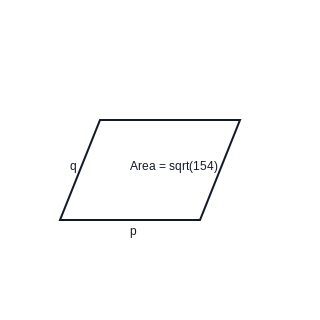
Calculate the area of a parallelogram where two adjacent sides are defined by the vectors p⃗=(401)\vec{p} = \begin{pmatrix} 4 \\ 0 \\ 1 \end{pmatrix} and q⃗=(130)\vec{q} = \begin{pmatrix} 1 \\ 3 \\ 0 \end{pmatrix}.

Parallelogram with base vector p and side vector q.

Solution:

Step 1: Calculate the cross product pβƒ—Γ—qβƒ—\vec{p} \times \vec{q}. pβƒ—Γ—qβƒ—=∣ijk401130∣\vec{p} \times \vec{q} = \begin{vmatrix} \mathbf{i} & \mathbf{j} & \mathbf{k} \\ 4 & 0 & 1 \\ 1 & 3 & 0 \end{vmatrix} pβƒ—Γ—qβƒ—=i(0βˆ’3)βˆ’j(0βˆ’1)+k(12βˆ’0)\vec{p} \times \vec{q} = \mathbf{i}(0 - 3) - \mathbf{j}(0 - 1) + \mathbf{k}(12 - 0) pβƒ—Γ—qβƒ—=βˆ’3i+j+12k\vec{p} \times \vec{q} = -3\mathbf{i} + \mathbf{j} + 12\mathbf{k} Step 2: Calculate the magnitude of the cross product vector to find the area. Area=∣pβƒ—Γ—qβƒ—βˆ£=(βˆ’3)2+12+122\text{Area} = |\vec{p} \times \vec{q}| = \sqrt{(-3)^2 + 1^2 + 12^2} Area=9+1+144=154β‰ˆ12.41Β units2\text{Area} = \sqrt{9 + 1 + 144} = \sqrt{154} \approx 12.41 \text{ units}^2

Explanation:

The magnitude of the cross product of two vectors originating from the same point gives the area of the parallelogram they span.

Finished reading?

Practice Vector (Cross) product (HL) with a worksheet. Answers included.