
Review the key concepts, formulae, and examples before starting your quiz.
🔑Concepts
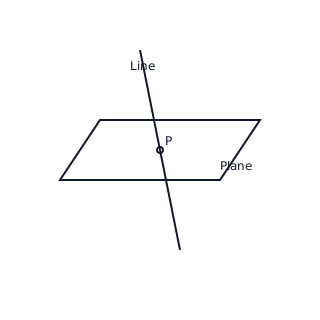
The intersection of a line and a plane occurs at a unique point unless the line is parallel to the plane. To find this point, substitute the parametric components of the line into the Cartesian equation of the plane and solve for the scalar parameter .
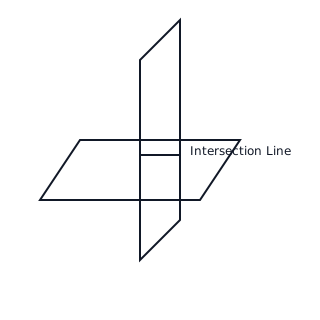
Two non-parallel planes intersect in a unique line. This line is perpendicular to both normal vectors and , meaning its direction vector can be found using the cross product .
The relationship between a line and a plane is determined by the dot product of the line's direction vector and the plane's normal vector . If , the line is either parallel to the plane or lies entirely within it.
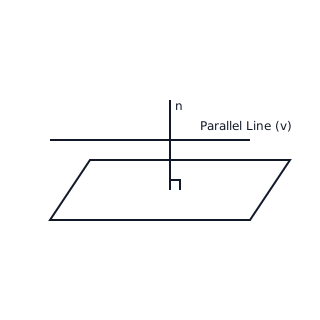
To find the angle between a line and a plane, calculate the angle between the line's direction and the plane's normal using . Then, , leading to the formula .
Systems of linear equations in three variables can represent the intersection of three planes. Possible outcomes include a single point of intersection (unique solution), a line of intersection (infinitely many solutions), or no common intersection (inconsistent system).
📐Formulae
💡Examples
Problem 1:
Find the coordinates of the point of intersection between the line and the plane .
Solution:
- Write the parametric equations of the line:
- Substitute these into the plane equation:
- Substitute back into the line equation: The intersection point is .
Explanation:
We use the parametric form of the line to represent any point on the line in terms of . By substituting these into the plane's equation, we find the specific value of where the point also lies on the plane.
Problem 2:
Determine if the lines and + intersect.
Solution:
Equate the components: Check the component with and : and . Since , the system is consistent. The lines intersect at the point where : . The intersection point is .
Explanation:
To check for intersection, we solve for the parameters using two coordinates and verify with the third. Consistency across all three coordinates confirms an intersection.
Problem 3:
Find the Cartesian equation of the line of intersection of the two planes and .
Solution:
- Find the direction vector of the line using the cross product of the normals and : .
- Find a point on the line by setting : Adding the equations: . Substituting back: . Point: .
- Vector equation: + .
Explanation:
The line of intersection is perpendicular to both normal vectors, hence the use of the cross product. We then find a specific point that satisfies both plane equations to define the position vector.
Problem 4:
Find the point of intersection between the line and the plane .
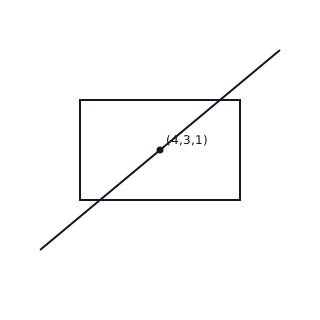
Solution:
- Express the line in parametric form: , , .
- Substitute these into the plane equation: .
- Expand and simplify: .
- Combine terms: .
- Find the point: , , .
- Point of intersection is .
Explanation:
To find where a line meets a plane, we find the specific value of the parameter that satisfies the plane's equation. This represents the unique point shared by both objects.
Problem 5:
Determine if the line intersects the plane .
Solution:
- Parametric form: , , .
- Substitute into plane equation: .
- Simplify: .
- Since is a contradiction, there is no value of that satisfies the equation.
- Conclusion: The line is parallel to the plane and does not intersect it.
Explanation:
If the substitution leads to a contradiction, the line and plane are parallel and distinct. If it led to an identity (e.g., ), the line would lie entirely within the plane.