
Review the key concepts, formulae, and examples before starting your quiz.
🔑Concepts
A vector equation of a line represents the position vector of any point on the line as , where is the position vector of a known point on the line and is the direction vector. The parameter determines the distance moved along the direction vector from the fixed point.
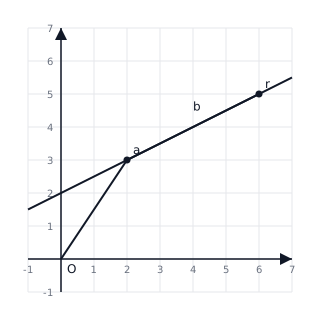
The direction vector determines the gradient of the line in 2D, which is given by . If two lines are parallel, their direction vectors are multiples of each other ().
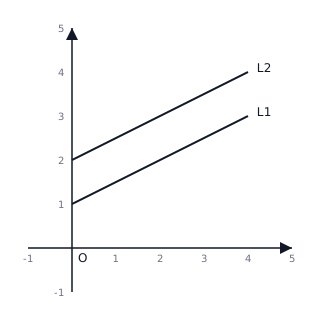
Two lines are perpendicular if the scalar product (dot product) of their direction vectors is zero: . For a direction vector , a perpendicular direction vector is .
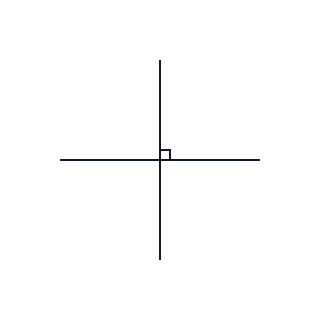
The angle between two lines is the angle between their direction vectors and , calculated using .
📐Formulae
\begin{pmatrix} x \ y \end{pmatrix}\begin{pmatrix} a_1 \ a_2 \end{pmatrix}
💡Examples
Problem 1:
Find the vector equation of the line passing through points and .
Solution:
- Find the position vector of point : .
- Find the direction vector : = .
- Write the vector equation: + .
Explanation:
The position vector provides a starting point on the line, and the difference between the two points gives the direction in which the line extends.
Problem 2:
Determine the point of intersection of the lines and .
Solution:
- Equate the and components: (Eq 1) (Eq 2)
- Subtract Eq 1 from Eq 2: .
- Substitute into : .
- The intersection point is .
Explanation:
To find where two lines meet, set their vector expressions equal to each other and solve the resulting system of linear equations for the parameters and .
Problem 3:
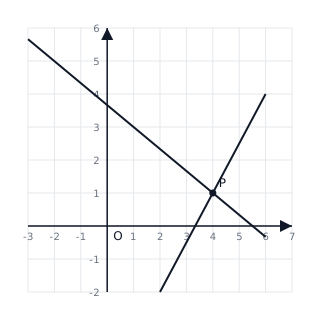
Find the vector equation of the line that passes through the point and is perpendicular to the line .
Solution:
- Identify the direction vector of , which is .
- For the new line to be perpendicular, its direction vector must satisfy . A suitable vector is (since ).
- Use the given point as the position vector .
- The vector equation is .
Explanation:
To find a perpendicular direction in 2D, swap the components of the original direction vector and negate one of them.
Problem 4:
Find the coordinates of the point on the line that is closest to the origin .
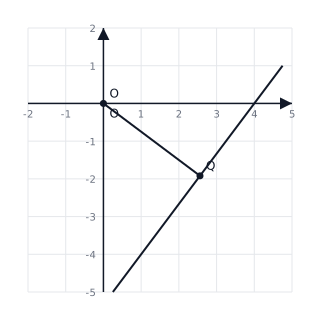
Solution:
- Any point on the line has coordinates .
- The vector .
- For to be the closest point, must be perpendicular to the direction vector .
- Set the dot product to zero: .
- .
- Substitute back: , .
- The point is .
Explanation:
The shortest distance from a point to a line occurs along the perpendicular path. We solve for the parameter where the position vector is orthogonal to the line's direction.