
Electricity: Circuits and their Components - Making an electric lamp glow using an electric cell
Review the key concepts, formulae, and examples before starting your quiz.
🔑Concepts
An electric cell serves as the source of electricity. It has two terminals: a positive terminal () and a negative terminal (). For electricity to flow, a continuous path must exist between these two terminals.
An electric bulb consists of a thin wire called the filament, which glows when electricity passes through it. The filament is fixed to two thicker wires that provide support and act as terminals for the bulb.

To make a bulb glow, it must be part of a closed circuit. This means the wires must connect one terminal of the electric cell to one terminal of the bulb, and the other terminal of the bulb back to the second terminal of the cell.
Electric current flows from the positive terminal of the cell to the negative terminal of the cell through the external circuit. If there is any break in this path (an open circuit), the current stops and the bulb will not glow.
📐Formulae
💡Examples
Problem 1:
A student connects a bulb to an electric cell using two wires. If one wire is disconnected from the negative terminal, will the bulb glow? Explain using physics terminology.
Solution:
No, the bulb will not glow.
Explanation:
For electricity to flow, there must be a complete, unbroken path called a closed circuit. By disconnecting the wire, the student creates an 'open circuit'. Since the path for the flow of current from the positive terminal () to the negative terminal () is broken, the filament does not heat up and the bulb remains dark.
Problem 2:
Calculate the current flowing through a circuit if the voltage provided by the cell is V and the resistance of the bulb is .
Solution:
Explanation:
Using Ohm's Law: Substituting the given values:
Problem 3:
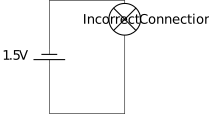
Determine if the bulb in the circuit shown will glow. The circuit consists of an electric cell where both the positive and negative wires are connected only to the metal casing of the bulb, avoiding the metal tip at the base.
Solution:
The bulb will not glow. For a bulb to glow, the electric current must pass through its filament. This requires one wire to be connected to the metal casing (one terminal) and the other wire to be connected to the metal tip at the base (the second terminal). By connecting both wires to the casing, the circuit is not completed through the filament, and it effectively represents a short circuit of the cell.
Explanation:
An electric bulb has two terminals: the metal case and the metal tip at the bottom. These are fixed such that they do not touch each other. For the bulb to function, the current must enter through one terminal, pass through the filament, and exit through the other terminal.
Problem 4:
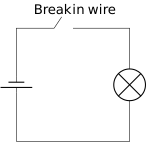
Identify the state of the bulb (ON/OFF) in a circuit where the wire from the positive terminal of the cell is broken in the middle, but both ends are still touching the bulb terminals. Calculate the total charge that flows through the bulb in seconds if the current is A due to the break.
Solution:
The bulb will be OFF. Even if the wires are touching the terminals, a break in the wire creates an 'open circuit'. Since the path is not continuous, the current A. To find the charge:
Explanation:
Electricity requires a continuous, unbroken path (closed circuit) to flow from the positive terminal to the negative terminal of the electric cell. A break in the wire stops the flow of electrons, resulting in zero current and zero charge transfer.