
Review the key concepts, formulae, and examples before starting your quiz.
🔑Concepts
Electrical Conductors are materials that allow electric current to pass through them easily because they contain free-moving electrons. Most metals like copper, aluminum, and silver are excellent conductors.
Electrical Insulators are materials that do not allow electric current to pass through them because their electrons are tightly bound to their atoms. Examples include rubber, plastic, wood, and glass.
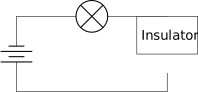
Safety and Protection: Hand tools like screwdrivers and pliers have handles made of plastic or rubber (insulators) to protect the user from electric shocks while the working tip is made of steel (conductor).
Human Body Conductivity: The human body is a relatively good conductor of electricity. This is why we must never touch open wires or electrical sockets with wet hands, as water increases conductivity and the risk of shock.

📐Formulae
💡Examples
Problem 1:
A student uses a plastic scale to bridge a gap in a circuit. Will the bulb in the circuit glow? Explain using the concept of conductivity.
Solution:
No, the bulb will not glow.
Explanation:
A plastic scale is made of plastic, which is an insulator. Insulators do not allow electric current to pass through them. Since the current cannot pass through the plastic scale, the circuit remains 'open' or incomplete, and the bulb does not light up.
Problem 2:
Calculate the total voltage of a battery formed by connecting cells, where each cell has a voltage of .
Solution:
Explanation:
When cells are connected in series to form a battery, the total voltage is the sum of the individual voltages of all the cells. Using the formula , we get .
Problem 3:
Why are the copper wires used in household circuits covered with PVC (Polyvinyl Chloride)?
Solution:
PVC acts as an insulator to prevent electric shocks.
Explanation:
Copper is an excellent conductor of electricity. If the bare wires are touched, the current would flow through the human body (which is also a conductor), causing a shock. PVC is an insulator that blocks the flow of current, making the wires safe to handle.
Problem 4:
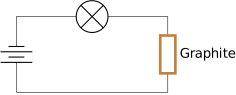
In the given circuit, the switch is replaced with a graphite pencil lead. Observe if the bulb glows and determine if graphite is a conductor or an insulator.
Solution:
The bulb glows when the graphite pencil lead is used to complete the circuit. This indicates that graphite allows electric current to flow through it.
Explanation:
Even though graphite is a non-metal (a form of carbon), it has free electrons that allow it to conduct electricity, making it a conductor.
Problem 5:
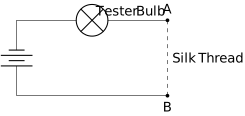
An electrician is testing a circuit using a tester. Between two points and , he places a piece of dry silk thread. Will the tester bulb glow? Why?
Solution:
No, the tester bulb will not glow when a dry silk thread is placed between points and .
Explanation:
Silk is an insulator. Insulators do not have free electrons to carry current, so the circuit remains open and no electricity flows to light the bulb.