
Review the key concepts, formulae, and examples before starting your quiz.
🔑Concepts
An electric lamp (bulb) is a device that converts electrical energy into light and heat energy. It consists of a thin, coiled wire called a filament, usually made of tungsten, which glows when an electric current passes through it.

The filament of a bulb is supported by two thicker wires. One of these wires is connected to the metal case at the base, and the other is connected to the metal tip at the center of the base. These two points are the terminals of the bulb.

A bulb is said to be 'fused' if its filament is broken. A broken filament means the path for the electric current is interrupted (an open circuit), and the bulb will not glow even if the switch is in the 'ON' position.
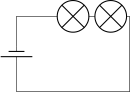
The brightness of a lamp depends on the amount of current flowing through it. In a series circuit, adding more lamps increases total resistance and decreases the current, making each lamp dimmer.
📐Formulae
(Where is Current, is Charge, and is Time)
(Joule's Law of Heating: is Heat produced, is Resistance)
(Electrical Power where is Voltage)
💡Examples
Problem 1:
A student connects a bulb to a cell, but the bulb does not glow even though the switch is 'ON'. List two possible reasons related to the bulb's components.
Solution:
- The filament of the bulb might be broken (the bulb is fused). 2. The terminals of the bulb might not be properly connected to the wires, creating an open circuit.
Explanation:
For a bulb to glow, there must be a continuous path for the current. A broken filament or loose terminal connection breaks the continuity of the circuit.
Problem 2:
If the heat produced in a lamp filament is over a period of seconds, calculate the rate of heat production (Power).
Solution:
Given: Heat , Time . Rate of heat production (Power ) is given by . Substituting the values:
Explanation:
Power is defined as the rate at which energy (heat in this case) is consumed or produced per unit time.
Problem 3:
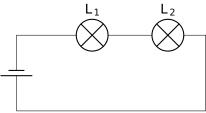
Observe the provided circuit diagram. If the lamp has a broken filament, will lamp continue to glow? Explain your answer.
Solution:
No, lamp will not glow. In a series circuit, the current must pass through every component. If the filament of is broken, the circuit becomes 'open' or incomplete, stopping the flow of electricity to .
Explanation:
Electricity requires a continuous loop to flow. A broken filament acts like an open switch, breaking the electrical path for the entire series loop.
Problem 4:
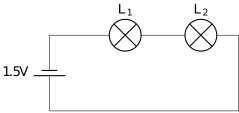
A student builds a circuit as shown in the diagram with a cell and two identical electric lamps, and , connected in a series arrangement. If the current flowing through is measured to be , what will be the current flowing through ? If lamp is unscrewed, what happens to ?
Solution:
Explanation:
In a series circuit, the same current flows through all components. Therefore, the current through is identical to , which is . If lamp is unscrewed, the circuit becomes open (broken). Since there is no continuous path for the electrons to flow, the current becomes and lamp will stop glowing.