
Review the key concepts, formulae, and examples before starting your quiz.
🔑Concepts
The Torchlight Circuit: A basic torch consists of a power source (dry cells), a conductor (metal strips/wires), a control device (switch), and a load (the bulb). The circuit is completed when the switch is in the 'ON' position, allowing charges to flow from the battery through the bulb filament.
The Slide Switch: In a commercial torch, a sliding plastic piece moves a metal contact. When the metal strip touches both the battery terminal and the bulb base, the circuit is closed (ON). Moving it away creates an air gap, making it an open circuit (OFF).
Reflector and Casing: To make the light travel in a parallel beam rather than scattering, a concave reflector is placed around the bulb. The bulb is positioned at the focus of this reflector.

Cell Polarity in Torches: For the torch to work, the positive terminal () of one cell must touch the negative terminal () of the next cell. This is known as a series connection, which increases the total voltage available to the bulb.
📐Formulae
💡Examples
Problem 1:
A torch uses three electric cells, each having a voltage of . Calculate the total voltage supplied to the torch bulb when the cells are connected in series.
Solution:
Total voltage =
Explanation:
When cells are connected in series (positive terminal of one to the negative terminal of the next), their individual voltages are added to find the total potential difference supplied to the circuit.
Problem 2:
Calculate the total number of terminals in a circuit consisting of cells and bulb.
Solution:
Explanation:
Each electric cell has terminals (positive and negative), and each bulb has terminals. Therefore, cells have terminals and bulb has terminals, totaling .
Problem 3:
Why does a torch bulb not glow if there is a gap in the connecting wires?
Solution:
The gap creates an Open Circuit.
Explanation:
For electricity to flow, there must be a continuous, unbroken path from the positive terminal to the negative terminal. A gap prevents the flow of electrons (), resulting in the bulb remaining off.
Problem 4:
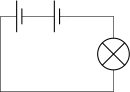
A student builds a torch circuit with two cells. If the bulb requires a minimum of to glow and the cells are connected as shown in the diagram, will the bulb glow? Justify using the total voltage.
Solution:
Since , the bulb will glow.
Explanation:
When cells are connected in series ( and ), their voltages add up. The resulting exceeds the threshold voltage of the bulb.
Problem 5:
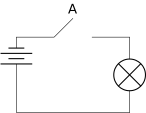
In the provided torch circuit diagram, the switch is moved to position . Identify if the circuit is 'Open' or 'Closed' and determine the current flow ().
Solution:
The circuit is Open.
Explanation:
Position creates a physical gap in the metal conductor. Because air is an insulator, the electricity cannot jump the gap, resulting in zero current flow.