
Review the key concepts, formulae, and examples before starting your quiz.
🔑Concepts
An electric circuit is a closed loop through which electric current flows, consisting of components like a cell (source), a switch (control), and a bulb (load) connected by wires.
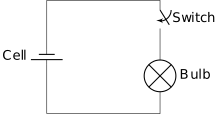
Symbols are used to represent electrical components in circuit diagrams for simplicity and consistency. For example, a single cell is represented by a long vertical line (positive terminal) and a shorter, thicker vertical line (negative terminal).

When the switch is in the 'ON' position, the circuit is 'closed' and the path is complete, allowing current to flow and the bulb to glow.
In the 'OFF' position, the circuit is 'open' or broken, preventing the flow of electricity, and the bulb will not glow.
A battery is formed by connecting two or more cells together, usually with the positive terminal of one cell connected to the negative terminal of the next.

📐Formulae
💡Examples
Problem 1:
Ravi connects four cells in a battery holder to power a toy car. If each cell provides a potential difference of , calculate the total voltage provided to the toy car using vertical addition.
Solution:
The total voltage is .
Explanation:
In a battery, cells are usually connected in series. Therefore, the total voltage is the sum of the voltages of each individual cell: .
Problem 2:
In a circuit containing a battery, a switch, and a bulb, the bulb does not glow even when the switch is in the 'ON' position. List two possible reasons involving the circuit components.
Solution:
- The bulb might be fused (the filament is broken, creating an open circuit).
- The cells might be connected incorrectly (e.g., positive terminal to positive terminal).
Explanation:
For current to flow, the circuit must be 'Closed' and have a continuous conducting path. A fused bulb breaks the path (), and incorrect cell polarity prevents the flow of electrons effectively.
Problem 3:
If a charge () of passes through a point in a circuit in seconds (), calculate the electric current ().
Solution:
Given and . Using the formula:
Explanation:
Electric current is defined as the rate of flow of electric charge. By dividing the total charge by the time taken, we find the current in Amperes ().
Problem 4:
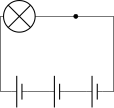
Draw a circuit diagram where three cells are connected in series to form a battery that powers a single bulb. Ensure the switch is closed.
Solution:
The diagram represents a battery (three cells) connected to a bulb with a closed switch. The total voltage would be the sum of the three cells.
Explanation:
In a series connection, the positive terminal of one cell connects to the negative of the next. A closed switch ensures the bulb glows.
Problem 5:
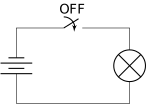
A simple electric circuit consists of a battery (formed by two cells), an electric bulb, and a switch in the 'OFF' position. Represent this circuit using a circuit diagram and determine if the bulb will glow in this state.
Solution:
The circuit is in an 'Open' state because the switch is 'OFF'. In an open circuit, the path for the flow of current is broken.
Since no current flows through the filament, the bulb will not glow.
Explanation:
An electric circuit must be a continuous and closed path for current to flow. When the switch is in the 'OFF' position, it creates a gap in the circuit, preventing the flow of electrons from the battery to the bulb.