
Review the key concepts, formulae, and examples before starting your quiz.
🔑Concepts
An electric cell is a device that converts chemical energy into electrical energy. It has two terminals: a positive terminal (represented by a long, thin line) and a negative terminal (represented by a shorter, thicker line).
To create a battery with higher voltage, cells are connected in series. This means the positive terminal of one cell is connected to the negative terminal of the next cell.

The flow of electric current in a circuit is traditionally considered to move from the positive terminal to the negative terminal of the cell.
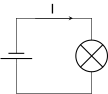
A battery is defined as a combination of two or more cells. In many devices like torches or TV remotes, cells are placed side-by-side, but they are still connected electrically in a series arrangement using metal strips.

📐Formulae
💡Examples
Problem 1:
A toy car requires a power supply. If you are using electric cells that provide each, how many cells must be connected in series to form the battery?
Solution:
Number of cells
Explanation:
Since the total voltage in a series circuit is the sum of individual voltages, we divide the required total voltage by the voltage of a single cell: . Thus, cells are needed.
Problem 2:
Calculate the total voltage of a battery formed by connecting four cells in series, where each cell has a potential of .
Solution:
Explanation:
Using the formula for cells in series: . Adding the values: .
Problem 3:
A student connects three cells of each. Calculate the total voltage using vertical addition.
Solution:
Explanation:
The total voltage is the sum of the individual voltages of the three cells: .
Problem 4:
A flashlight uses five rechargeable cells connected in series. Using vertical addition, calculate the total voltage supplied to the flashlight bulb.

Solution:
Total Voltage =
Explanation:
In a series combination, the total voltage is the sum of the voltages of all individual cells. Adding five times gives .
Problem 5:
A scientific equipment requires a total voltage of . If you are using identical electric cells each providing , how many cells need to be connected in series? Represent the final circuit with a battery, a switch, and a resistor.
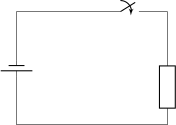
Solution:
Explanation:
To achieve a higher voltage, cells are connected in series where the positive terminal of one cell is connected to the negative terminal of the next. By dividing the required total voltage () by the voltage of a single cell (), we find that 3 cells are needed.