
Review the key concepts, formulae, and examples before starting your quiz.
🔑Concepts
A circuit diagram is a simplified graphical representation of an electrical circuit using standardized symbols for components such as cells, bulbs, switches, and wires.
The long thin line in a cell symbol represents the positive terminal (), while the short thick line represents the negative terminal ().

A battery is formed by connecting two or more cells in series, where the positive terminal of one cell is connected to the negative terminal of the next.

When the switch is in the 'ON' position, the circuit is closed, allowing current to flow from the positive terminal to the negative terminal.
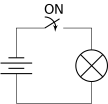
An electric circuit is incomplete or 'open' when the switch is in the 'OFF' position, preventing the flow of electric current.
📐Formulae
💡Examples
Problem 1:
A student wants to make a battery using cells, where each cell has a potential of . Calculate the total voltage of the battery.
Solution:
Explanation:
In a battery, the total voltage is the sum of the voltages of the individual cells connected in series. To calculate this using vertical addition:
Problem 2:
Identify the state of the bulb if the switch is in the 'OFF' position and the circuit is connected to a battery.
Solution:
The bulb will not glow.
Explanation:
When the switch is in the 'OFF' position, the circuit is 'open'. An open circuit has a break in the path, which means the electric current cannot flow from the positive terminal to the negative terminal of the battery. Therefore, the bulb remains dark.
Problem 3:
If a current of flows through a circuit for seconds, how much charge has passed through the wire?
Solution:
Explanation:
Using the formula for current , we can rearrange it to find charge . Here, and .
Problem 4:
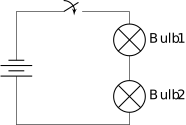
Draw a circuit diagram for a setup containing two bulbs connected in series, a closed switch, and a battery. If one bulb fuses, will the other bulb glow?
Solution:
No, the other bulb will not glow. In a series circuit, if one component (like a bulb) breaks, the circuit becomes open and the flow of electricity stops for all components.
Explanation:
Current has only one path to follow. A fused bulb acts like an open switch, breaking the entire path.
Problem 5:
Observe the diagram. If the total voltage of the battery is and it is made of equal cells of each, how many cells are in the battery?

Solution:
There are cells in the battery.
Explanation:
A battery is a combination of cells. The total voltage is the sum of the voltages of individual cells connected in series.