
Review the key concepts, formulae, and examples before starting your quiz.
🔑Concepts
An electric switch is a simple device that either breaks the electric circuit or completes it. When the switch is in the 'ON' position, the gap in the circuit is closed, allowing current to flow. When in the 'OFF' position, it creates an air gap (an insulator), making the circuit open.
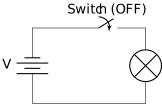
The placement of the switch in a circuit does not matter for its function; it can be placed anywhere in the loop to control the flow of current. Whether it is near the positive terminal or the negative terminal, opening it will stop the flow of electrons throughout the entire series loop.
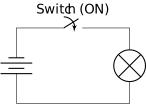
In a domestic circuit, switches are used to control individual appliances. A switch acts as a bridge; when the bridge is 'down' (ON), the 'traffic' (current) can cross; when the bridge is 'up' (OFF), the traffic stops.
Safety Note: A switch should never be operated with wet hands. Water containing impurities is a conductor of electricity, and a thin film of water on a switch can create a conductive path to your body, leading to an electric shock.
📐Formulae
💡Examples
Problem 1:
In a simple circuit consisting of a battery, a bulb, and a switch, the bulb does not glow even when the switch is in the 'ON' position. State two possible reasons related to the circuit components.
Solution:
- The battery may be dead or exhausted ().
- The bulb filament might be broken (fused bulb), creating an open circuit even when the switch is 'ON'.
Explanation:
For a bulb to glow, there must be a continuous path and a source of power. If the filament is broken, it acts like an open switch, preventing the flow of current .
Problem 2:
A student builds a circuit where the switch is placed after the bulb in the path toward the negative terminal. Will the switch still be able to turn the bulb off?
Solution:
Yes, the switch will still be able to turn the bulb off.
Explanation:
An electric circuit requires a complete, unbroken loop for current to flow. If the switch is 'OFF', it creates a gap in the circuit. Whether that gap is before or after the bulb, it breaks the loop, making current throughout the entire series circuit.
Problem 3:
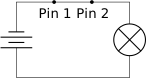
Identify the state of the bulb in the circuit shown below and explain what happens if the metal safety pin (acting as a switch) is removed from the drawing pins.
Solution:
The bulb is currently 'ON' because the safety pin completes the path. If the safety pin is removed, the circuit becomes an 'Open Circuit'.
Explanation:
In the diagram, the safety pin connects two drawing pins. Removing it introduces a gap. Since air is a poor conductor of electricity, the current becomes , and the bulb stops glowing.
Problem 4:
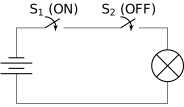
A student sets up a circuit with two switches, and , connected in a single loop (series) with a battery and a bulb. If is closed (ON) but is open (OFF), will the bulb glow?
Solution:
No, the bulb will not glow.
Explanation:
For current to flow in a series circuit, there must be a continuous, unbroken path from the positive to the negative terminal. Even though is closed, the open creates a break in the circuit, resulting in .