
Review the key concepts, formulae, and examples before starting your quiz.
🔑Concepts
The basic parent function for quadratics is . This is a parabola with its vertex at and an axis of symmetry at . Every transformation is defined relative to this starting shape.
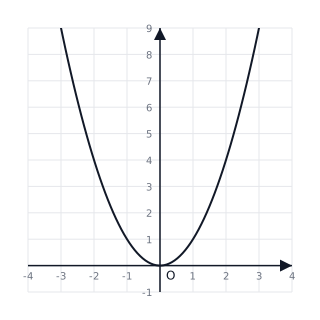
Horizontal and vertical translations are shifts in the position of the vertex. In vertex form , the value shifts the graph left () or right (), and shifts it down () or up ().
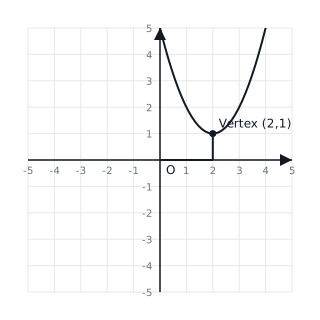
Vertical stretching and shrinking are controlled by the coefficient . If , the parabola is vertically stretched (it looks narrower). If , it is vertically compressed (it looks wider). If , the parabola is reflected across the -axis.
The vertex form is the most useful form for identifying transformations immediately. The point is the vertex, and the vertical line is the axis of symmetry.
📐Formulae
💡Examples
Problem 1:
Describe the transformations required to map onto .
Solution:
.
- Horizontal translation: 4 units to the left ().
- Vertical stretch: Factor of 3 ().
- Reflection: Reflected across the -axis ( is negative).
- Vertical translation: 2 units downwards ().
Explanation:
Compare the given equation to the vertex form . Identify , , and .
Problem 2:
Convert the quadratic function into vertex form.
Solution:
Explanation:
Factor out the coefficient of from the first two terms. Complete the square inside the bracket by adding and subtracting , which is . Simplify to reach the vertex form.
Problem 3:
Find the equation of a parabola that has been reflected across the -axis, stretched vertically by a factor of 2, shifted 5 units right, and 3 units up.
Solution:
Substituting into :
Explanation:
The reflection makes negative. The stretch factor 2 sets . Right shift sets as positive 5. Upward shift sets as positive 3.
Problem 4:
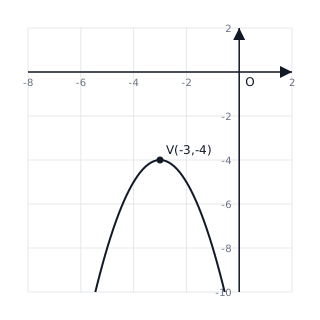
Identify the function that results from reflecting over the -axis, then shifting it units to the left and units down. Sketch the result.
Solution:
- Reflection over the -axis: Multiply by , so .
- Shift units left: Replace with , so .
- Shift units down: Subtract , so .
Explanation:
Starting from the origin, the vertex moves to . The negative sign in front of the bracket indicates the parabola opens downwards.
Problem 5:
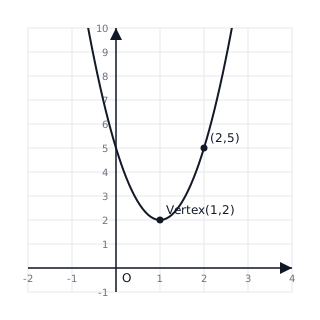
A quadratic function has its vertex at and passes through the point . Find the equation of the function in vertex form.
Solution:
- Use the vertex form with and : .
- Substitute the point into the equation to find :
- The final equation is .
Explanation:
The vertex determines the horizontal and vertical shifts. The second point allows us to solve for the vertical stretch factor .