
Review the key concepts, formulae, and examples before starting your quiz.
🔑Concepts
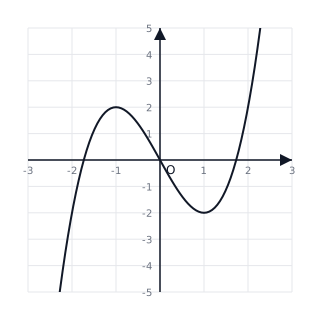
The cubic function can have up to two turning points (a local maximum and a local minimum) and cross the x-axis at most three times. The 'S' shape depends on the sign of ; if , the graph starts low and ends high, whereas if , it starts high and ends low.
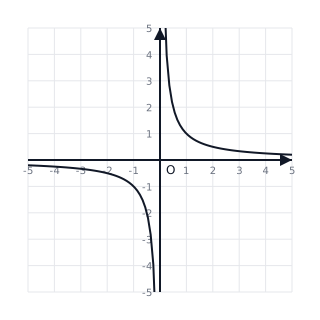
Reciprocal functions of the form are hyperbolas with two branches. They feature a vertical asymptote at (where the denominator is zero) and a horizontal asymptote at (the value approaches as becomes very large).
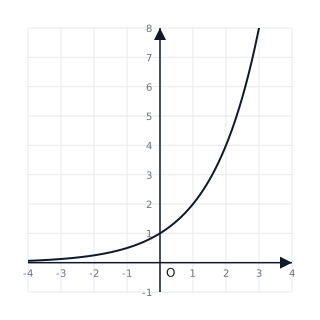
Exponential functions (where ) represent rapid growth () or decay (). These functions have a horizontal asymptote at and never touch or cross it. The y-intercept occurs at .
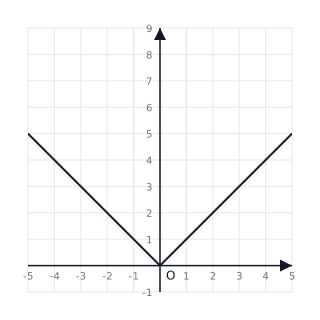
Absolute value functions create a distinct 'V' shape. The vertex of the graph is located at . The graph is symmetric about the vertical line .
📐Formulae
💡Examples
Problem 1:
Find the -intercepts and the -intercept of the cubic function .
Solution:
To find the -intercept, set : So, the -intercept is .
To find the -intercepts, set : Solving for , we get , , and .
Explanation:
We use factoring to solve the cubic equation. Setting allows us to find where the graph crosses the horizontal axis.
Problem 2:
Identify the equations of the asymptotes for the reciprocal function .
Solution:
The vertical asymptote occurs where the denominator is zero: The horizontal asymptote is determined by the constant term added to the fraction:
Explanation:
In the form , the vertical asymptote is and the horizontal asymptote is .
Problem 3:
A population of bacteria doubles every hour. If the initial population is 50, write a function to represent the population after hours and find the population after 3 hours.
Solution:
The general form for exponential growth is . Initial population , growth factor . For :
Explanation:
We model the growth using an exponential function where the base represents the doubling effect and the coefficient represents the starting value.
Problem 4:
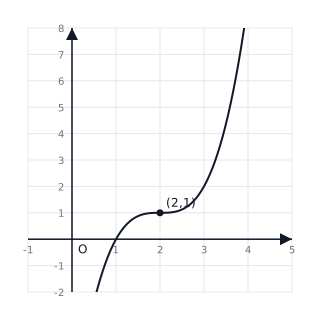
Sketch the graph of and label the point of inflection.
Solution:
- Identify the parent function: .
- Identify transformations: The graph is shifted 2 units to the right () and 1 unit up ().
- The point of inflection for is . For , the point of inflection is .
- Calculate -intercept: .
Explanation:
Translating a cubic function involves moving the point where the curvature changes (the point of inflection) according to the constants added to and the function value.
Problem 5:
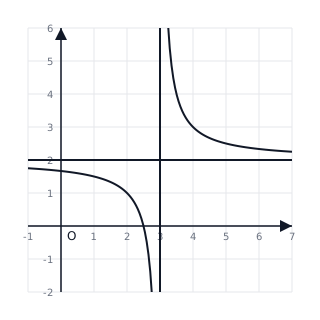
Determine the horizontal and vertical asymptotes for and sketch the graph.
Solution:
- Vertical Asymptote: Set the denominator to zero: .
- Horizontal Asymptote: As , , so . The horizontal asymptote is .
- Intercepts: -intercept: . -intercept: .
Explanation:
Asymptotes act as boundaries that the curve approaches but never reaches. The vertical shift moves the horizontal asymptote, and the horizontal shift moves the vertical asymptote.