
Review the key concepts, formulae, and examples before starting your quiz.
🔑Concepts
An exponential function is of the form . The horizontal asymptote is the line , which the graph approaches but never reaches as becomes very large or very small.
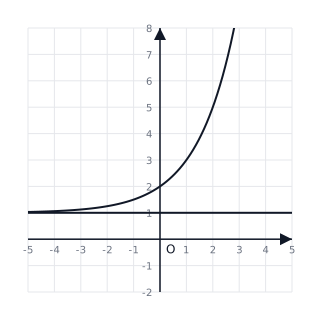
The base determines the shape: if , the function shows exponential growth; if , it shows exponential decay. The value of affects the vertical stretch and can reflect the graph across the asymptote.
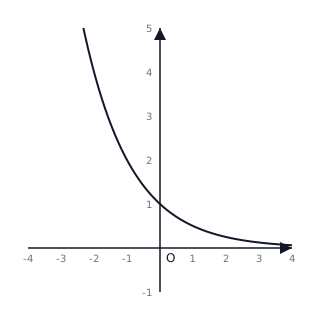
The -intercept is found by setting . For , the -intercept is . This point is a fixed distance from the horizontal asymptote .
The range of an exponential function depends on the sign of . If , the range is . If , the range is .
📐Formulae
💡Examples
Problem 1:
Given the function , determine the horizontal asymptote, the -intercept, and whether the function represents growth or decay.
Solution:
- The horizontal asymptote is . Here , so the asymptote is .
- To find the -intercept, set : . The intercept is .
- Since the base and , the function represents exponential growth.
Explanation:
The value of shifted the natural asymptote down to . Since the base is greater than 1, the values of increase as increases.
Problem 2:
Find the equation of an exponential function of the form that has a horizontal asymptote at , a -intercept at , and passes through the point .
Solution:
- From the horizontal asymptote, we know . The equation is .
- Use the -intercept : .
- Now the equation is . Use the point : .
- The final equation is .
Explanation:
Identify the parameters in order: (from asymptote), then (from -intercept), then (from the second point).
Problem 3:
Consider the function . State the range of the function.
Solution:
- The horizontal asymptote is .
- The coefficient is . Since is negative, the graph is reflected across the horizontal line and exists below the asymptote.
- Therefore, the range is .
Explanation:
For any , if is negative, the outputs will always be less than the vertical shift because is always positive.
Problem 4:
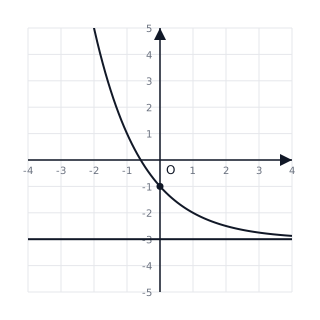
Sketch the graph of . Identify the horizontal asymptote and the -intercept.
Solution:
Explanation:
The graph starts high on the left, crosses the -axis at , and flattens out towards the line as increases.
Problem 5:
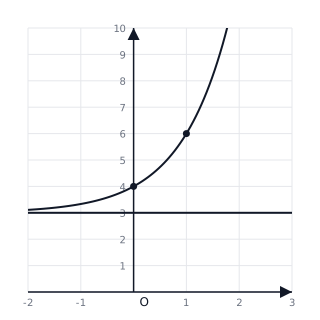
An exponential function passes through and with a horizontal asymptote at . Find the equation in the form .
Solution:
Explanation:
We first use the asymptote to find , then the -intercept to find , and finally a second point to solve for the base .