
Review the key concepts, formulae, and examples before starting your quiz.
🔑Concepts
The graph of a rational function is a hyperbola. The value determines the vertical asymptote where the function is undefined, and determines the horizontal asymptote representing the value the function approaches as becomes very large or very small.
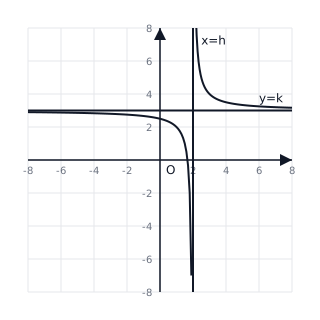
Vertical asymptotes occur at the -values that make the denominator of a simplified rational function equal to zero. For , if and , then is a vertical asymptote.
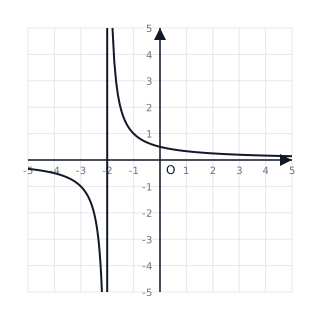
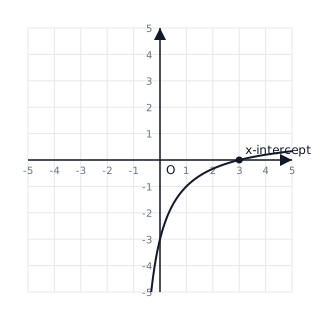
The -intercepts of a rational function are found by setting the numerator equal to zero and solving for , provided those values do not also make the denominator zero.
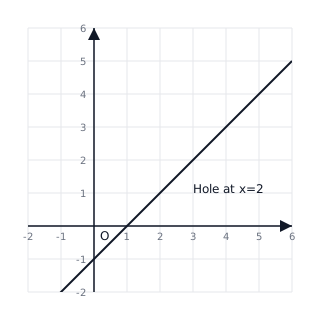
A hole (removable discontinuity) occurs in the graph of a rational function at if is a common factor of both the numerator and the denominator and is cancelled out during simplification.
📐Formulae
💡Examples
Problem 1:
Identify the asymptotes and intercepts for the function .
Solution:
- Vertical Asymptote: Set the denominator to zero: .
- Horizontal Asymptote: Since the degree of the numerator and denominator are the same (degree 1), the HA is the ratio of leading coefficients: .
- -intercept: Set the numerator to zero: .
- -intercept: Substitute : .
Explanation:
Asymptotes define the boundary lines of the graph, while intercepts show where the graph crosses the axes.
Problem 2:
Simplify the expression and state the excluded values.
Solution:
Factor the numerator using difference of squares: . Factor the denominator: . Rewrite the expression: Cancel the common factor : Excluded values (where denominator was originally zero): and .
Explanation:
Simplification involves factoring polynomials and canceling common factors. Excluded values are determined from the original denominator before cancellation.
Problem 3:
Perform the subtraction: .
Solution:
Find a common denominator: . Adjust the numerators: Combine into a single fraction:
Explanation:
To add or subtract rational expressions, you must find a least common denominator (LCD) and distribute signs carefully.
Problem 4:
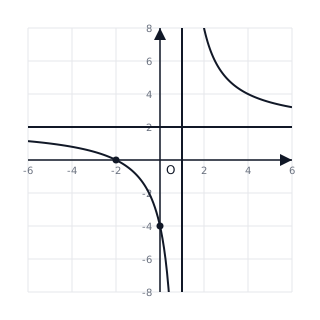
Sketch the graph and determine the horizontal asymptote of the function .
Solution:
Vertical Asymptote: Set . Horizontal Asymptote: Ratio of leading coefficients . Therefore, . -intercept: Set . -intercept: Set .
Explanation:
The horizontal asymptote is found by comparing the degrees of the numerator and denominator. Since they are equal, the asymptote is the ratio of the leading coefficients.
Problem 5:
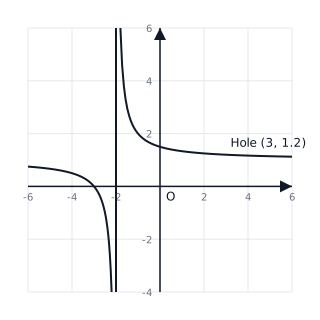
Identify the coordinates of the hole and the vertical asymptote for the function .
Solution:
Factor the numerator and denominator: Cancel the common factor : Vertical Asymptote: . Hole: Occurs at . To find the -coordinate, substitute into the simplified expression: Coordinates of hole: .
Explanation:
A hole exists where a factor is common to both the top and bottom. The vertical asymptote remains where the denominator is zero after simplification.