
Review the key concepts, formulae, and examples before starting your quiz.
🔑Concepts
A composite function is formed when the output of one function becomes the input of another. For example, in , the function is applied first, and its result is then passed into function . It is helpful to visualize this as a chain of processes.
The inverse function, denoted as , reverses the operation of . If maps to , then maps back to . Geometrically, the graph of is a reflection of the graph of across the line .
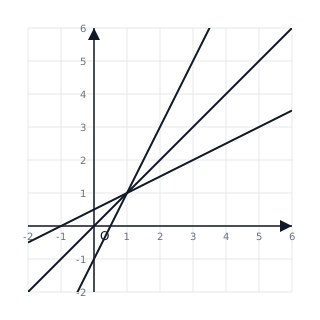
To find the inverse of a function algebraically: 1. Replace with . 2. Swap and . 3. Solve the resulting equation for . 4. Replace with .
Domain and Range: The domain of becomes the range of , and the range of becomes the domain of . This relationship is essential when dealing with restricted domains.
📐Formulae
💡Examples
Problem 1:
Given and , find the expression for .
Solution:
Explanation:
To find the composite function, we substitute the entire expression of into every instance of in .
Problem 2:
Find the inverse function for .
Solution:
Step 1: Write as : Step 2: Swap and : Step 3: Solve for : Therefore,
Explanation:
To find the inverse, we swap the roles of the input and output variables and rearrange the equation to make the new the subject.
Problem 3:
If , find the value of such that .
Solution:
If , then by the property of inverses: Substitute into the original function:
Explanation:
Using the property that if , then allows us to solve for without finding the inverse expression first.
Problem 4:
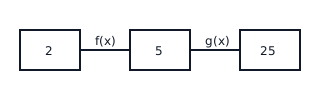
Given and , determine the composite function and calculate the value of . Show the mapping of input .
Solution:
- Find the expression: .
- Substitute : .
Explanation:
The inner function adds 3 to the input. The outer function squares the result. By applying them in sequence, we transform 2 into 5, then 5 into 25.
Problem 5:
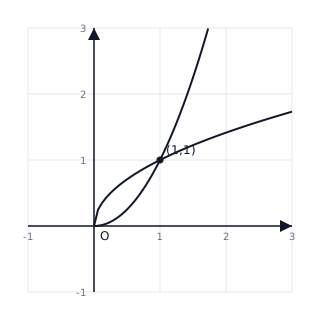
Sketch the function for and its inverse for on the same coordinate plane. Identify the point where they intersect.
Solution:
- Set .
- Square both sides: .
- Factor: or .
- Since , the intersection points are and .
Explanation:
Inverse functions are reflections over . Since the square root and squaring functions are inverses (for positive ), they intersect at points where , specifically at and .