
Review the key concepts, formulae, and examples before starting your quiz.
🔑Concepts
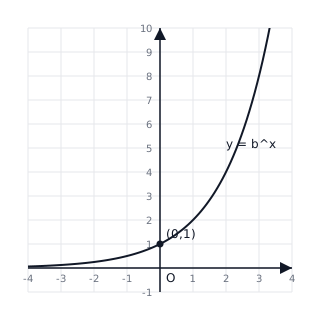
The exponential function where represents exponential growth. The graph passes through the point and has a horizontal asymptote at . As increases, the value of increases rapidly.
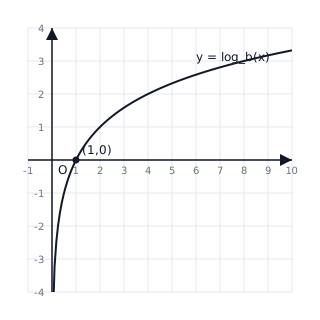
The logarithmic function is the inverse of the exponential function . Its graph is a reflection of across the line . It has a vertical asymptote at and passes through .
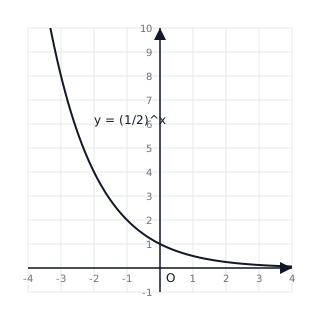
Exponential decay occurs when the base is between and (). The graph of still passes through , but as increases, approaches from above.
Solving logarithmic equations often involves using the definition of a logarithm to convert the equation into exponential form: . Ensure that the argument of any logarithm is always positive.
📐Formulae
💡Examples
Problem 1:
Solve the exponential equation for .
Solution:
Write both sides with the same base: Equate the exponents:
Explanation:
To solve an exponential equation where the bases can be made equal, rewrite the terms such that , then set .
Problem 2:
Simplify the expression .
Solution:
Apply the power rule: Apply the quotient rule:
Explanation:
Used the power rule to move the coefficient into the exponent, then used the quotient rule to combine the logs, and finally simplified based on the definition of logarithms.
Problem 3:
Solve for : . Give your answer to 3 decimal places.
Solution:
Take the logarithm of both sides: Apply the power rule: Isolate :
Explanation:
When the bases cannot be easily equated, take the logarithm of both sides and use the power rule to bring the variable down from the exponent.
Problem 4:
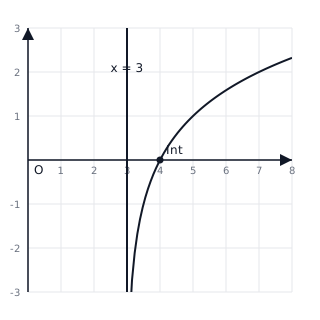
Given the function , find the domain of the function and the coordinates of the point where the graph crosses the -axis.
Solution:
- For the domain, the argument of the logarithm must be positive: Domain:
- To find the -intercept, set : The graph crosses the -axis at .
Explanation:
The domain is restricted because logarithms are only defined for positive values. The -intercept is found by converting the logarithmic equation to its equivalent exponential form.
Problem 5:
Solve for : . Give your answer to 2 decimal places.
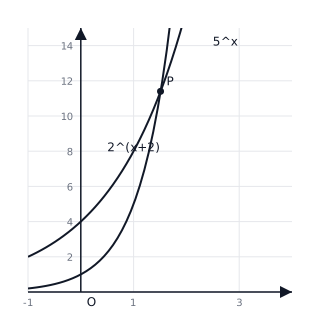
Solution:
- Take the natural logarithm () of both sides:
- Use the power rule :
- Expand and rearrange:
- Solve for :
Explanation:
When the bases of an exponential equation cannot be made the same, we apply logarithms to both sides to bring the exponents down using the power property.