
Review the key concepts, formulae, and examples before starting your quiz.
🔑Concepts
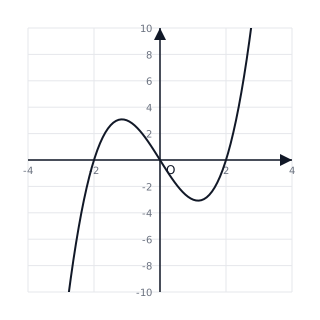
Cubic functions follow the general form . The leading coefficient determines the end behavior: if , the graph starts in the third quadrant and ends in the first; if , it starts in the second and ends in the fourth. The graph can have up to two turning points and between one and three -intercepts.
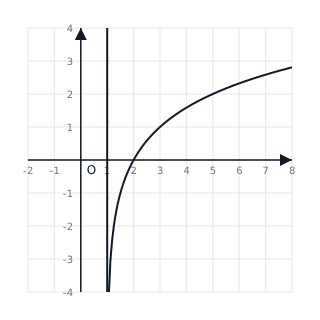
The logarithmic function is the inverse of the exponential function. It possesses a vertical asymptote at , which defines the boundary of the domain (). The function is only defined for positive arguments.
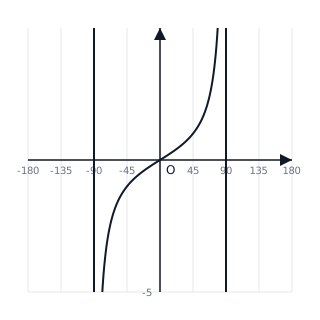
Trigonometric functions like exhibit periodic behavior with vertical asymptotes where the function is undefined (i.e., where ). For , these occur at . The period of the tangent function is or radians.
The -intercept of any function is found by evaluating . For cubic functions , the -intercept is always . For logarithmic functions, a -intercept only exists if the domain includes .
📐Formulae
💡Examples
Problem 1:
Find the -intercepts and the general shape of the cubic function .
Solution:
To find the -intercepts, set : Thus, .
Explanation:
The graph crosses the -axis at three points: , , and . Since the leading coefficient is positive, the graph starts from the bottom-left and ends at the top-right.
Problem 2:
Determine the vertical asymptote and domain of the function .
Solution:
The argument of the logarithm must be strictly greater than zero: The vertical asymptote occurs when the argument is zero:
Explanation:
The domain of the function is and the vertical asymptote is the line .
Problem 3:
Identify the first two positive vertical asymptotes for the function in degrees.
Solution:
The function is defined as . Asymptotes occur where . In the interval , at:
Explanation:
The first two positive vertical asymptotes are the lines and .
Problem 4:
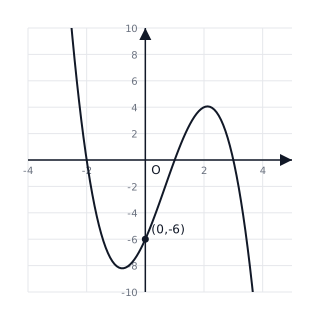
Sketch the function and identify the -intercept.
Solution:
- Identify the -intercepts by setting : .
- Find the -intercept by setting : .
- Determine end behavior: Since the leading term is (negative coefficient), the graph goes from the second quadrant to the fourth quadrant.
Explanation:
Expanding the roots helps identify the leading term and the constant . Plotting the intercepts first provides the skeleton for the cubic curve.
Problem 5:
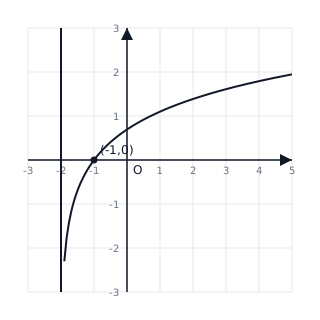
Given the logarithmic function , determine the vertical asymptote and the -intercept.
Solution:
- The vertical asymptote occurs where the argument of the log is zero: .
- To find the -intercept, set : .
Explanation:
The vertical asymptote marks the domain boundary. The x-intercept is found by solving the logarithmic equation for when the result is zero.