
Review the key concepts, formulae, and examples before starting your quiz.
🔑Concepts
A transversal is a line that intersects two or more lines at distinct points. When a transversal intersects two lines, eight angles are formed.
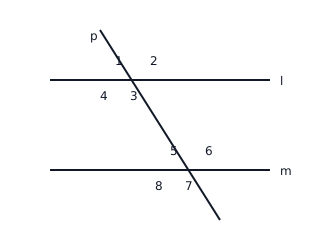
Corresponding Angles are in the same relative position at each intersection where a straight line crosses two others. If the lines are parallel, these angles are equal (e.g., ).
Alternate Interior Angles are pairs of angles on opposite sides of the transversal and between the two lines. When lines are parallel, these angles form a 'Z' shape and are equal (e.g., ).
Interior Angles on the Same Side (Co-interior angles) are supplementary () if the lines being intersected are parallel. They form a 'C' or 'U' shape.
To check if two lines are parallel, verify if: 1. Any pair of corresponding angles are equal, 2. Any pair of alternate interior angles are equal, or 3. Interior angles on the same side are supplementary.
📐Formulae
💡Examples
Problem 1:
In the given figure, and is a transversal. If one of the angles is , find the measure of its alternate interior angle.
Solution:
Explanation:
Since the lines and are parallel, the property of transversals states that the pairs of alternate interior angles are equal. Therefore, the alternate interior angle to the given angle is also .
Problem 2:
Two parallel lines are intersected by a transversal. If the measure of one interior angle is and the other interior angle on the same side of the transversal is , find the value of .
Solution:
Explanation:
Interior angles on the same side of a transversal for parallel lines are supplementary. Therefore:
Problem 3:
If and are corresponding angles formed by a transversal cutting two lines and , are the lines and parallel?
Solution:
Yes, .
Explanation:
According to the converse of the corresponding angles axiom, if a transversal intersects two lines such that a pair of corresponding angles are equal (), then the two lines must be parallel.
Problem 4:
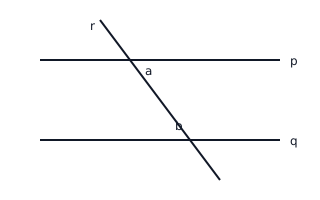
In the following figure, line and line is a transversal. If , find the measure of .
Solution:
- and are interior angles on the same side of the transversal .
- Since , these angles are supplementary.
Explanation:
Because the lines are parallel, the sum of the co-interior angles must be .
Problem 5:
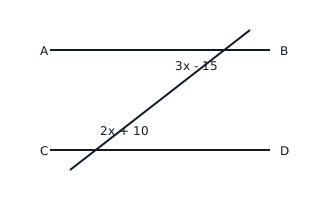
Given , find the value of if the alternate interior angles are and .
Solution:
- Since , alternate interior angles are equal.
- Subtract from both sides:
- Add to both sides:
Explanation:
The property of parallel lines states that alternate interior angles formed by a transversal are always equal.