
Review the key concepts, formulae, and examples before starting your quiz.
🔑Concepts
When two lines are intersected by a transversal, the angles that occupy the same relative position at each intersection where a straight line crosses two others are called corresponding angles.
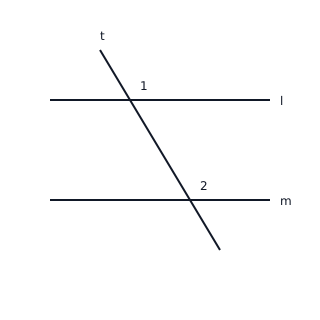
If two parallel lines are cut by a transversal, then each pair of corresponding angles is equal in measure. For example, if , then .
Conversely, if a transversal cuts two lines such that a pair of corresponding angles are equal, then the two lines must be parallel ().
In the 'F-shape' configuration, the interior angles of the 'F' are corresponding angles. The 'F' can be facing any direction (up, down, backward).
📐Formulae
💡Examples
Problem 1:
In the given figure, line is parallel to line () and line is a transversal. If one of the corresponding angles is and the other is , find the value of .
Solution:
Since , the corresponding angles must be equal.
Explanation:
According to the corresponding angles axiom, when two parallel lines are intersected by a transversal, the corresponding angles are equal. We set the expressions equal to each other and solve for .
Problem 2:
Two lines and are cut by a transversal . The measures of a pair of corresponding angles are and . What value of would make the lines and parallel?
Solution:
For lines and to be parallel, the corresponding angles must be equal.
Explanation:
By the converse of the corresponding angles axiom, if the corresponding angles are equal, the lines are parallel. Therefore, we equate the two angles to find the value of that satisfies this condition.
Problem 3:
If and are corresponding angles formed by a transversal of two parallel lines, and , find the supplement of .
Solution:
Step 1: Find . Since the lines are parallel, corresponding angles are equal: Step 2: Find the supplement of . Supplement of So, the supplement is .
Explanation:
First, we use the property of parallel lines to determine that the corresponding angle is also . Then, we calculate the supplement by subtracting the angle from .
Problem 4:
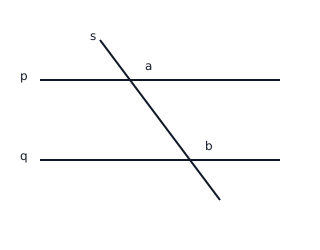
In the figure, and is the transversal. If and are corresponding angles, find the value of .
Solution:
Explanation:
Since the lines and are parallel, the corresponding angles formed by the transversal are equal. We set the algebraic expressions for and equal to each other and solve for .
Problem 5:
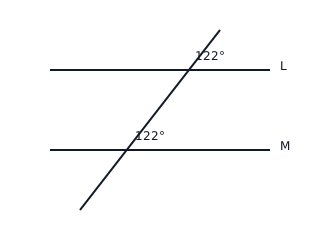
Determine if line is parallel to line if the corresponding angles shown are and .
Solution:
Explanation:
If a transversal intersects two lines such that the corresponding angles are equal, then the lines are parallel. Here, both angles measure , confirming the lines are parallel.