
Review the key concepts, formulae, and examples before starting your quiz.
🔑Concepts
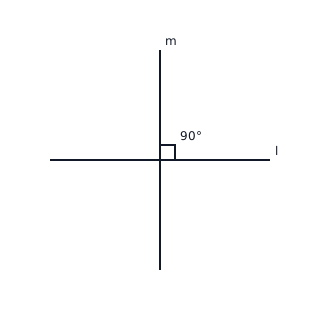
Two lines are called perpendicular if they intersect each other at a right angle, which is exactly . This is denoted by the symbol . For example, if line is perpendicular to line , we write it as .
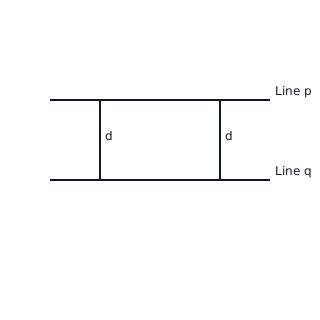
Parallel lines are lines in a plane that never meet, no matter how far they are extended. The perpendicular distance between two parallel lines remains constant everywhere. This is often seen in railway tracks or the opposite edges of a ruler.
In a coordinate system or on a grid, the horizontal axis (X-axis) and the vertical axis (Y-axis) are always perpendicular to each other, meeting at the origin .
A perpendicular bisector is a line that is perpendicular to a segment and passes through its midpoint, dividing the segment into two equal halves.
📐Formulae
💡Examples
Problem 1:
If a line is perpendicular to line at point , what is the measure of ?
Solution:
Given , the angle formed at the intersection point must be a right angle. Therefore, .
Explanation:
By definition, perpendicular lines meet at an angle of .
Problem 2:
Two parallel lines and are intersected by a transversal. If the interior angles on the same side of the transversal are and , find the value of .
Solution:
Interior angles on the same side of a transversal are supplementary (sum up to ). Calculation for :
Explanation:
We use the property that consecutive interior angles formed by a transversal intersecting parallel lines are supplementary.
Problem 3:
In a rectangle , identify which sides are perpendicular to each other.
Solution:
In rectangle , the adjacent sides meet at . Therefore:
Explanation:
A rectangle is a quadrilateral where all internal angles are , meaning every pair of adjacent sides is perpendicular.
Problem 4:
In the given figure, if line is perpendicular to line at point , and the angle is represented as , find the value of .
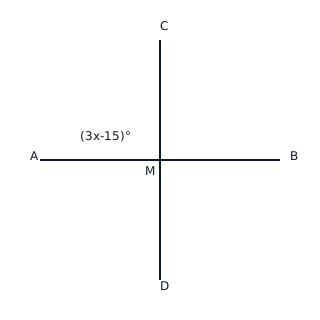
Solution:
- Since , the angle between them is .
- Therefore, .
- Set up the equation: .
- .
- .
- .
Explanation:
Because the lines are perpendicular, any of the four angles formed at the intersection is . Solving the linear equation gives the value of the unknown variable.
Problem 5:
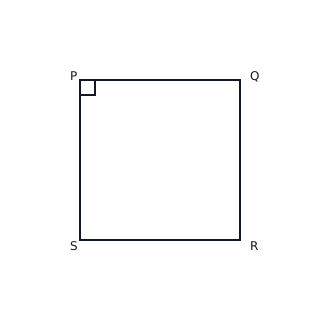
Given a square . Identify the pairs of adjacent sides that are perpendicular and the pairs of opposite sides that are parallel.
Solution:
- In a square, all internal angles are .
- Perpendicular pairs (adjacent): , , , and .
- Parallel pairs (opposite): and .
Explanation:
By definition, a square has four right angles, making adjacent sides perpendicular, and two pairs of equal, parallel opposite sides.