
Review the key concepts, formulae, and examples before starting your quiz.
🔑Concepts
When a transversal intersects two lines and , several pairs of angles are formed including interior angles, exterior angles, and corresponding angles.
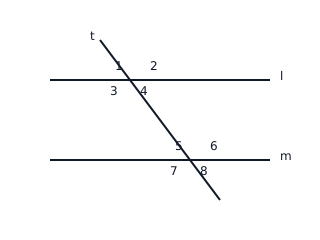
If two parallel lines are cut by a transversal, each pair of alternate interior angles are equal (e.g., and ).
If two parallel lines are cut by a transversal, each pair of interior angles on the same side of the transversal (co-interior angles) are supplementary (e.g., ).
If two parallel lines are cut by a transversal, each pair of corresponding angles are equal (e.g., , , etc.).
📐Formulae
💡Examples
Problem 1:
In the given figure, line is parallel to line () and a transversal cuts them. If one of the interior angles is , find the measure of its adjacent interior angle on the same side of the transversal.
Solution:
Let the given interior angle be and the required angle be . Since the lines are parallel, the sum of interior angles on the same side of the transversal is . Therefore, . To find : Thus, .
Explanation:
We use the property of co-interior angles (interior angles on the same side of the transversal), which states that they are supplementary when the lines are parallel.
Problem 2:
Two lines and are intersected by a transversal . If the alternate interior angles are and , find the value of for which .
Solution:
For lines and to be parallel, the alternate interior angles must be equal. Therefore: Subtract from both sides: Add to both sides:
Explanation:
Parallel lines require alternate interior angles to be equal. We set up an algebraic equation based on this property and solve for the unknown variable .
Problem 3:
In the following figure, and is the transversal. If , find the value of .
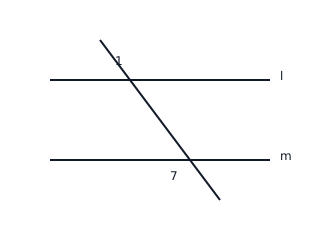
Solution:
Given: Since and are vertically opposite angles: Since , alternate interior angles and are equal: Now, and are vertically opposite angles: Alternatively, and are corresponding angles, so , and then by vertically opposite angles property.
Explanation:
The problem uses properties of parallel lines (corresponding angles) and the property of vertically opposite angles to find the unknown angle.
Problem 4:
In the figure, line is parallel to line . Find the value of if the co-interior angles are and .
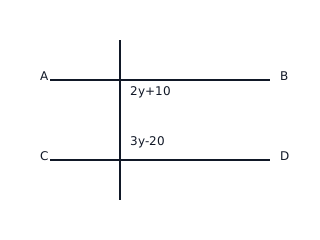
Solution:
Given . The sum of co-interior angles is . Thus, the value of is .
Explanation:
Since the lines are parallel, the interior angles on the same side of the transversal are supplementary, allowing us to set up and solve a linear equation.