
Review the key concepts, formulae, and examples before starting your quiz.
🔑Concepts
When a transversal intersects two parallel lines and , the alternate interior angles formed on opposite sides of the transversal and between the lines are equal. For example, and .
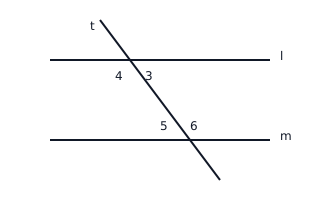
Alternate exterior angles are those on opposite sides of the transversal and outside the parallel lines. These angles are also equal when the lines are parallel ( and ).
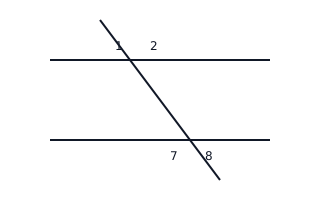
The 'Z' shape rule: A quick way to identify alternate interior angles is to look for a 'Z' or 'N' shape. The angles inside the corners of the 'Z' are the alternate interior angles.
Converse property: If two lines are intersected by a transversal and a pair of alternate interior (or alternate exterior) angles are equal, then the two lines must be parallel.
📐Formulae
💡Examples
Problem 1:
In a figure, two parallel lines and are intersected by a transversal . If one of the alternate interior angles is , find the measure of the other alternate interior angle .
Solution:
Explanation:
According to the property of parallel lines, when two lines are parallel (), the alternate interior angles are always equal. Therefore, the value of the other angle is also .
Problem 2:
Two parallel lines are cut by a transversal. The alternate interior angles are and . Find the value of .
Solution:
Explanation:
Since the lines are parallel, the alternate interior angles must be equal. We set up the equation and solve for by subtracting from both sides and then dividing by .
Problem 3:
One angle in a pair of alternate exterior angles is . Calculate the value of the other alternate exterior angle using vertical arithmetic for the subtraction.
Solution:
The first angle is: Therefore, .
Explanation:
Alternate exterior angles are equal when lines are parallel. First, we calculate the value of the given angle using subtraction: . Since they are alternate exterior angles, must also be .
Problem 4:
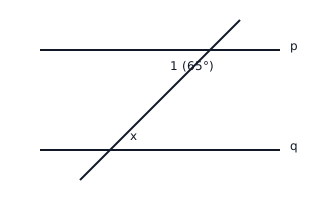
In the given figure, . If , find the value of the alternate interior angle .
Solution:
- Given that .
- and are alternate interior angles because they lie on opposite sides of the transversal and between the parallel lines.
- By the property of parallel lines, alternate interior angles are equal.
- Therefore, .
Explanation:
Since the lines are parallel, we apply the alternate interior angle theorem which states that such angles are equal in measure.
Problem 5:
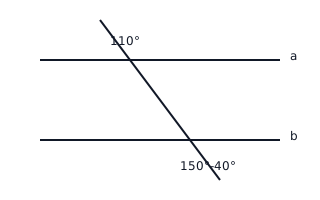
Identify if lines and are parallel if the alternate exterior angles are and .
Solution:
- First, calculate the value of the second angle using vertical subtraction:
- The first alternate exterior angle is .
- The second alternate exterior angle is .
- Since the pair of alternate exterior angles are equal (), the lines and must be parallel.
Explanation:
By the converse of the alternate exterior angles theorem, if the angles are equal, the lines are parallel.