
Review the key concepts, formulae, and examples before starting your quiz.
🔑Concepts
The Parallel Illusion: Parallel lines are two or more lines in a plane that never meet, no matter how far they are extended. Sometimes, our eyes can be deceived by surrounding patterns (like slanted transversals), making straight parallel lines appear curved or tilted. This is known as an optical illusion.
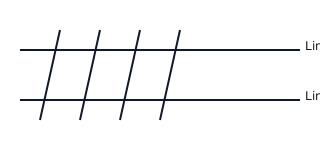
A Transversal is a line that intersects two or more lines at distinct points. When a transversal intersects two parallel lines, specific angle relationships are formed, such as corresponding angles, alternate interior angles, and co-interior angles.
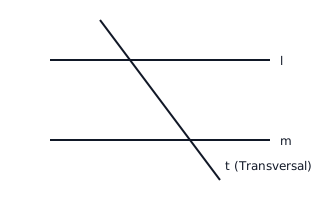
Alternate Interior Angles: These are pairs of angles on opposite sides of the transversal, lying between the two parallel lines. If , then these angles are always equal.
Co-interior Angles (Consecutive Interior Angles): These are angles on the same side of the transversal and inside the parallel lines. Their sum is always (supplementary).
📐Formulae
💡Examples
Problem 1:
In the given figure, line and is a transversal. If one of the interior angles is , find the measure of its co-interior angle .
Solution:
Since , the sum of co-interior angles is .
Explanation:
We use the property that interior angles on the same side of a transversal are supplementary when the lines are parallel.
Problem 2:
Two lines and are cut by a transversal . If a pair of alternate interior angles are and , for what value of will ?
Solution:
For , the alternate interior angles must be equal:
Explanation:
By the property of parallel lines, alternate interior angles are equal. Setting the expressions equal to each other allows us to solve for .
Problem 3:
If and form a linear pair and , calculate the value of using vertical arithmetic subtraction.
Solution:
Since they form a linear pair, . So, .
Explanation:
A linear pair consists of adjacent angles formed by intersecting lines whose sum is always degrees.
Problem 4:
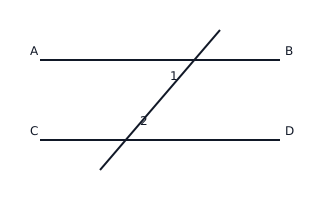
In the following figure, line is parallel to line (). If , find the value of .
Solution:
- Identify the relationship: and are Alternate Interior Angles because they are on opposite sides of the transversal and inside the parallel lines.
- Apply the property: Since , the alternate interior angles must be equal.
- Therefore, .
Explanation:
When a transversal cuts two parallel lines, the Z-shape formed identifies alternate interior angles, which are congruent.
Problem 5:
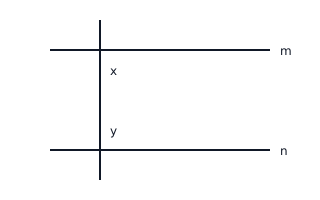
Given . If and are co-interior angles such that , calculate the value of using vertical subtraction.
Solution:
- Identify the relationship: Since , the sum of co-interior angles is .
- Equation: .
- Substitute the value: .
- Calculate : .
- .
Explanation:
Co-interior angles are supplementary when lines are parallel. We subtract the given angle from to find the unknown angle.