
Review the key concepts, formulae, and examples before starting your quiz.
🔑Concepts
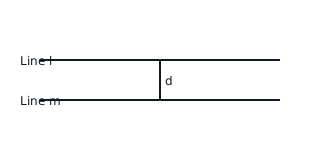
Parallel lines are lines in a plane that do not intersect or meet at any point, no matter how far they are extended. The distance between them remains constant throughout.
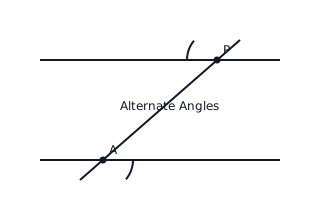
To draw a line parallel to a given line through a point not on it, we can use the property of alternate interior angles. By drawing a transversal through and creating an equal alternate angle at , we ensure the lines are parallel.
The 'Perpendicular Method' involves drawing a perpendicular segment of a specific length from line to a point , and then drawing another perpendicular to that segment at point . This second line will be parallel to at distance .
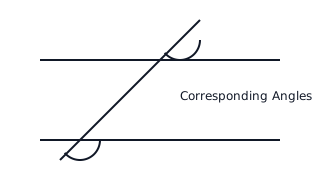
When constructing parallel lines, we use a ruler and a compass to copy an angle. If the corresponding angles created by a transversal are made equal, the two lines must be parallel.
📐Formulae
💡Examples
Problem 1:
Draw a line . Draw a perpendicular to at any point on . On this perpendicular, choose a point , away from . Through , draw a line parallel to .
Solution:
- Draw line . 2. Mark a point on . 3. Construct a perpendicular line at using a protractor or compass. 4. Measure from on this perpendicular and mark it as . 5. At , construct another perpendicular to the line . 6. Name this new line . Then .
Explanation:
Since the alternate interior angles or the corresponding angles (both here) are equal, the lines and are parallel. The distance between them is constant at .
Problem 2:
If a transversal intersects two lines and such that a pair of alternate interior angles are and , what must be the value of for ?
Solution:
Explanation:
According to the property of parallel lines, if a transversal intersects two parallel lines, the alternate interior angles must be equal. Therefore, for to be parallel to , must be equal to .
Problem 3:
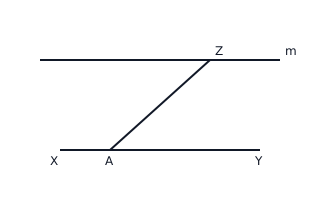
Draw a line segment . Take a point outside it. Construct a line passing through and parallel to using the concept of alternate interior angles.
Solution:
- Draw using a ruler.
- Mark point anywhere above .
- Take any point on and join .
- At , construct equal to such that and are on opposite sides of .
- Extend to form line . Since alternate interior angles are equal, .
Explanation:
The construction relies on the property that if a transversal () makes equal alternate interior angles ( and ), then the lines ( and ) must be parallel.
Problem 4:
Given a line and a point at a distance of from it, draw a line parallel to passing through using the perpendicular method.
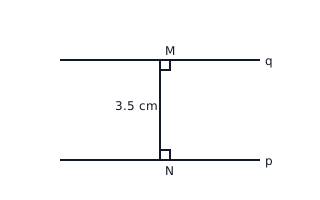
Solution:
- Draw line .
- Take any point on and draw a perpendicular line at using a compass or set-square.
- Measure on this perpendicular line starting from and mark point .
- At point , draw another perpendicular to line .
- This new line is the required line , which is parallel to .
Explanation:
If two lines are both perpendicular to the same line, they are parallel to each other. Here, both and are perpendicular to the line .